

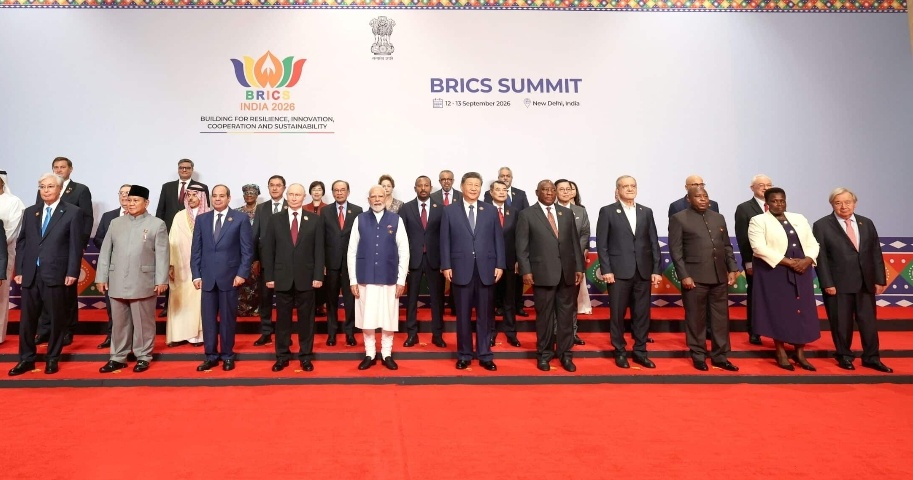
New Delhi, Sep 14: The 18th BRICS Summit in New Delhi has highlighted the grouping’s growing role as a platform where countries with divergent political and strategic interests can negotiate common positions on global economic and security issues.
The adoption of the New Delhi Declaration was seen as a significant outcome of the summit, particularly given the differences among the 11-member grouping on geopolitical conflicts, regional security and economic policies.
BRICS includes countries with competing interests, with India and China facing unresolved border and trade-related concerns, while member states also have differing positions on conflicts in West Asia and the Russia-Ukraine war.
Despite these differences, the grouping reached agreement on a wide range of issues, reinforcing its role as a forum for dialogue among emerging and developing economies.The New Delhi Declaration focuses on four broad themes — resilience, innovation, cooperation and sustainability — while also addressing global economic governance, technology, development and international security.
A major area of BRICS cooperation is reform of international institutions. Member countries have long sought greater representation for emerging economies in institutions such as the International Monetary Fund, World Bank and the United Nations Security Council.
With reforms progressing slowly, BRICS has increasingly focused on developing mechanisms that can provide additional options for its members.Financial cooperation is one such area.
The grouping is working towards greater use of national currencies, stronger cross-border payment arrangements and enhanced cooperation through the New Development Bank.The BRICS Payment Task Force has also been involved in discussions on improving payment connectivity among member countries.
The objective is to strengthen financial resilience and provide additional channels for international transactions.
The initiative does not necessarily amount to an immediate attempt to replace existing global financial systems. Instead, it represents a gradual effort to create alternative mechanisms that can reduce vulnerabilities and provide greater flexibility to BRICS economies.
The summit also underlined the importance of the Global South. BRICS members have argued that developing countries should have a greater role in shaping international economic and political institutions.The grouping’s relationship with the G20 is also significant.
Several BRICS members are part of the G20, creating an overlap between the two platforms. This provides countries with an opportunity to pursue reform and development objectives through both forums rather than treating them as competing organisations.
The evolution of BRICS can also be seen in the growing scope of its summit declarations. The group’s initial declaration in 2009 was focused largely on economic and financial concerns, while the New Delhi document covers a much wider range of subjects, reflecting the expansion of the grouping and the complexity of the global environment.
The summit’s handling of sensitive geopolitical issues also demonstrated the importance of diplomatic compromise. Rather than requiring members to adopt identical positions on every conflict, BRICS sought language that could accommodate differing national perspectives while preserving a common position on broader principles.The future of BRICS is likely to remain shaped by differences among its members.
However, the New Delhi summit suggests that these differences do not necessarily prevent cooperation.For the grouping, the ability to maintain dialogue, negotiate compromises and develop common initiatives despite competing interests could become one of its most important sources of influence.
The New Delhi Declaration therefore represents not just a list of agreements, but an indication of BRICS’ evolving role in a global system where multiple centres of economic and political power are increasingly seeking a greater voice.
