

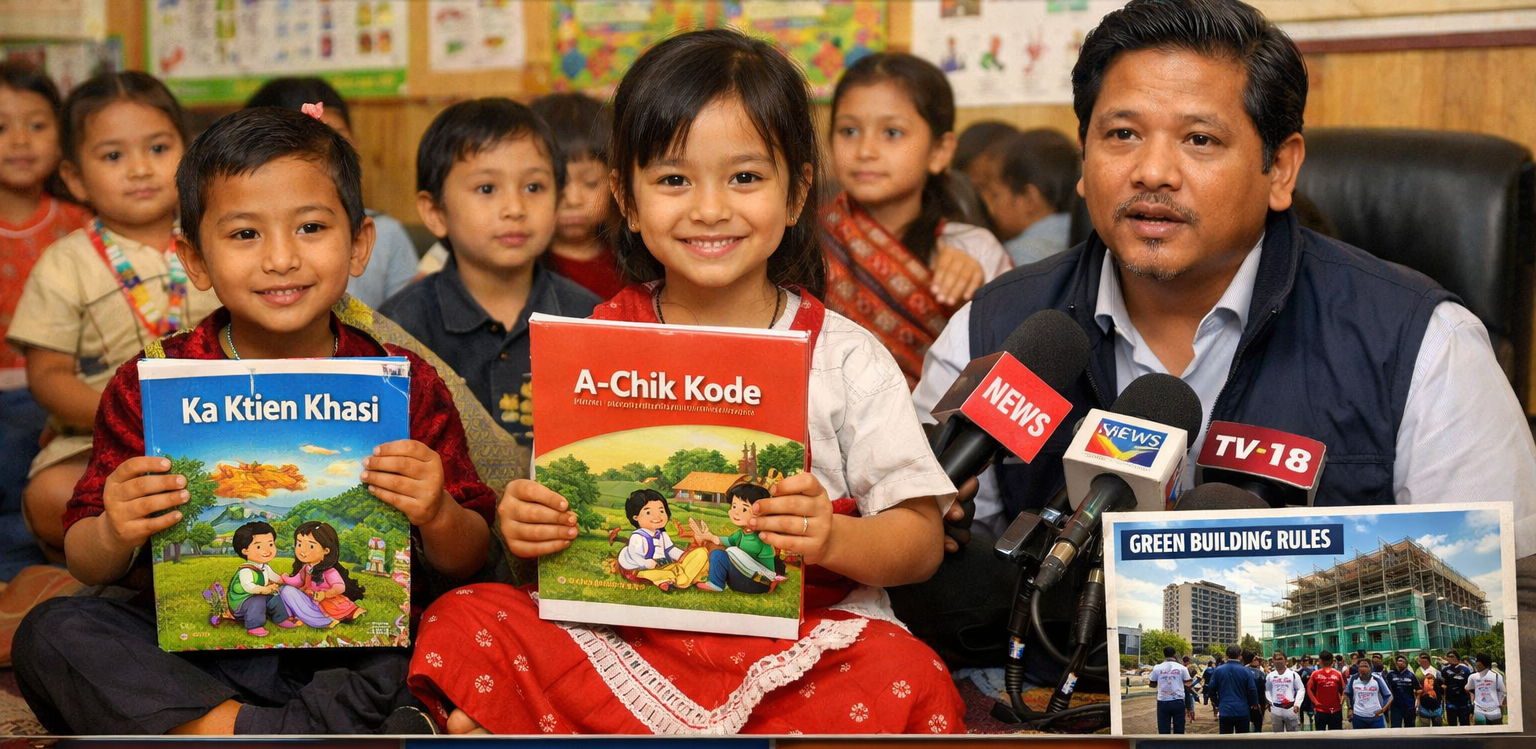
Shillong, Dec 22: The Meghalaya government has mandated the teaching of Khasi and Garo languages for children up to Class 1 as part of a revised foundational-stage curriculum aimed at strengthening cultural identity and simplifying early learning, officials said on Saturday. Chief Minister Conrad K. Sangma said the decision was taken to ensure that children develop confidence and a sense of belonging from an early age. “Children must grow with confidence and a sense of belonging. Learning our own languages early helps that,” Sangma said after chairing a cabinet meeting on Friday. According to officials, the newly developed textbooks will be introduced as optional material in the coming academic year and will become compulsory from the following session, as many schools have already finalised their syllabi for the next year. The foundational-stage curriculum, covering preschool to Class 1, focuses on ease of learning, basic values, and early exposure to Meghalaya’s history, traditions and cultural heritage. The move is intended to promote linguistic diversity while preserving the state’s indigenous languages.
In other decisions, the cabinet approved a revised pay structure for teachers appointed under the Sarva Shiksha Abhiyan (SSA) and for ad hoc teachers, addressing a long-pending demand. Sangma described the decision as recognition of their contribution and a step towards greater stability in the education system. The cabinet also cleared a five-year Mission Mode HIV/AIDS project with a total outlay of ₹25 crore. The project will focus on awareness generation, infrastructure development and targeted interventions. Amendments to the Meghalaya Building Bye Laws, 2021, were approved, making green building certification mandatory for large constructions. Former Meghalaya High Court Chief Justice S. Vaidyanathan was appointed chairperson of the Meghalaya Human Rights Commission.
Additionally, the cabinet approved the formation of the Meghalaya Livelihoods and Investment Financing Cooperative Society Ltd to support cooperative societies, agriculture and food processing sectors through working capital and investment support.
Approval was also granted for the creation of a National Games Secretariat Society to oversee preparations for the 39th National Games, marking a key step in the state’s readiness to host the event.
