

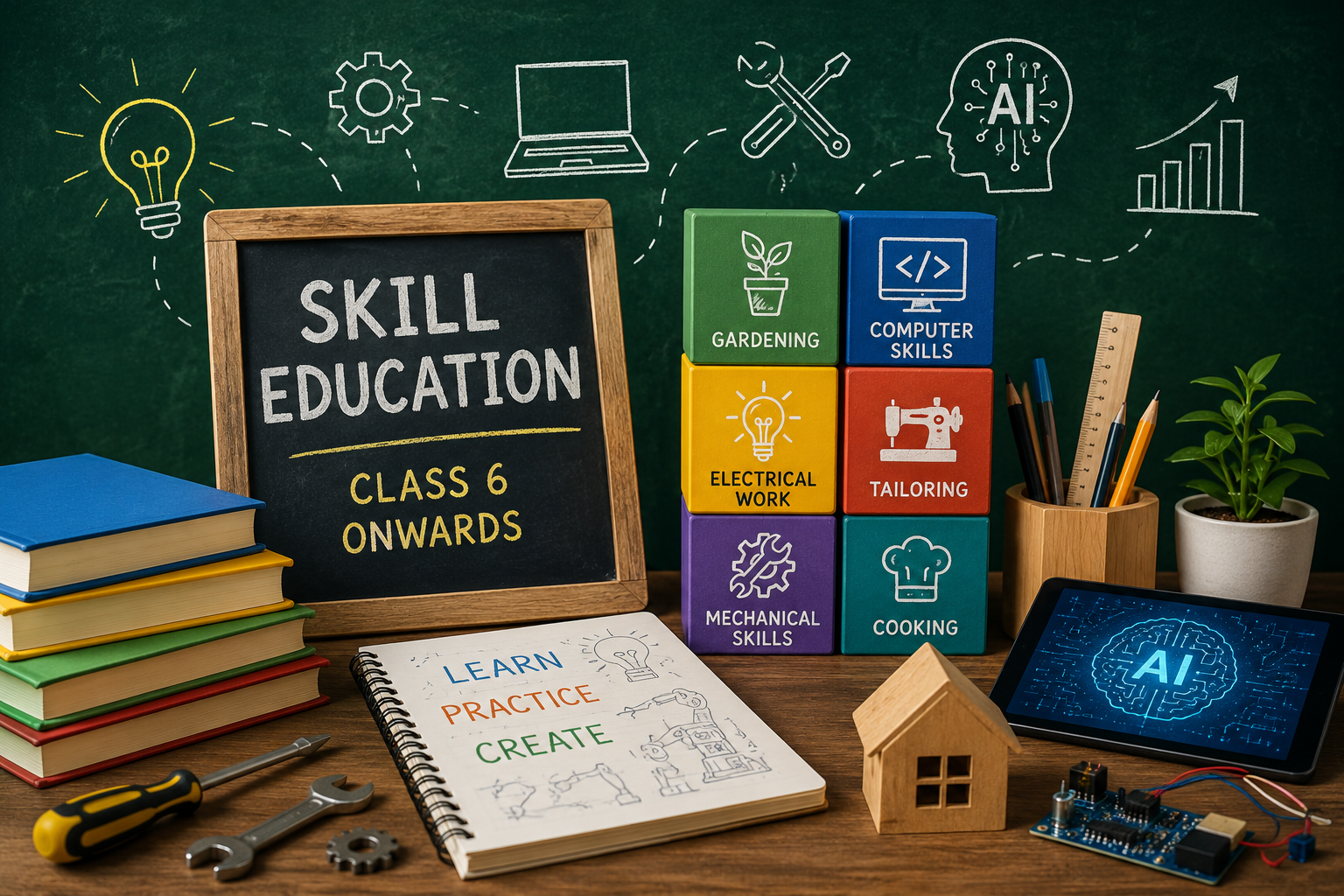
Palamu, July 16 : In a major reform aligned with the National Education Policy (NEP) 2020 and the National Curriculum Framework (NCF) 2023, the Jharkhand government has made skill education mandatory for students from Class 6 in all categories of schools across the state, including Palamu district.
The initiative aims to equip students with practical, technical and employment-oriented skills from an early stage, enabling them to better meet the demands of the evolving job market.
According to directives issued by the Jharkhand Education Project Council (JEPC), students of Classes 6 to 8 will study a compulsory subject titled “Kaushal Bodh-1” (Skill Awareness-1). The curriculum will be taught for four to five periods every week, with a total of 110 instructional hours during the academic session.
Science and Mathematics teachers will primarily be responsible for teaching the subject, with the objective of integrating scientific thinking with skill development among students.
To ensure effective implementation of the programme, the state has also initiated capacity-building programmes for teachers. Trainers and educators associated with mining engineering, computer science, information technology (IT) and information and communication technology (ICT) are being provided specialised training. The training is aimed at familiarising teachers with emerging technologies, including Artificial Intelligence (AI), so they can prepare students for future academic and professional requirements.
For Class 9 students, the government has introduced an integrated curriculum combining vocational and non-vocational education. Students entering Class 10 will continue studying the same skill subject they opted for in Class 9. No changes have been made to the curriculum for Classes 11 and 12 at present.
The process of supplying skill education textbooks to schools is currently underway. The programme is being rolled out initially in selected institutions, including CM Schools of Excellence, where emphasis will be placed on complementing classroom learning with practical and technical skills.
Education officials believe the initiative will strengthen students’ employability and promote holistic skill development in line with the objectives of the NEP.
The introduction of skill education at the school level is expected to help students develop practical and technical competencies from an early age, improve problem-solving, creativity and innovation, and provide early exposure to AI and other modern technologies. It is also expected to enhance students’ confidence, broaden career awareness, and prepare them for skill-based competitive environments while aligning school education with the requirements of the 21st century.
