

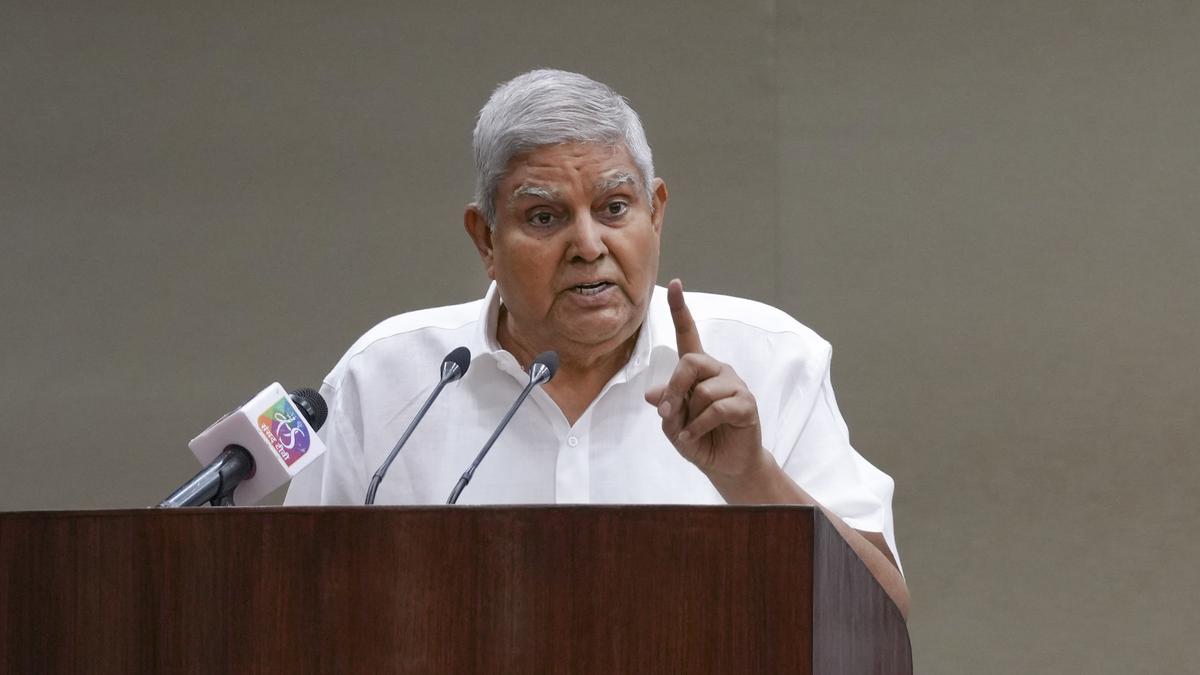
NEW DELHI, May 21 – India’s Vice President Jagdeep Dhankhar on Monday called on the Supreme Court to revisit a 1991 ruling that shields senior judges from prosecution under the country’s anti-corruption law, saying the judgment had contributed to judicial unaccountability and undermined public trust.
Speaking at a book launch in New Delhi, Dhankhar described the K. Veeraswami vs Union of India decision as “judicial legerdemain” and said it was time for legal reform to ensure transparency and accountability within the higher judiciary.
“The genesis of the problem of corruption in the judiciary lies in the Veeraswami judgment,” Dhankhar said, praising the current Supreme Court under Chief Justice D.Y. Chandrachud for its efforts to restore public faith in the legal system. “In a short time, the present Chief Justice has shown that things are soothing for people at large.”
Dhankhar’s remarks came in the wake of a scandal involving the recovery of large sums of cash from the official residence of a sitting Delhi High Court judge. No First Information Report (FIR) has been filed in the case, prompting concerns over enforcement of the rule of law.
“A judge’s residence in Lutyens’ Delhi had burnt notes, cash. There is no FIR to date. We have the rule of law and the criminal justice system. There can be no delay when the law demands action,” Dhankhar said.
The Vice President called for a “transparent, accountable, expeditious mechanism” to investigate allegations of corruption involving judges, while emphasizing the need to maintain judicial independence. “Judges must not be rendered vulnerable. They deal with powerful interests, and we must protect them to ensure fearless decision-making.”
Dhankhar’s comments reflect growing concern over judicial integrity in the country, as the judiciary continues to handle high-profile political and corporate cases. His statement marks one of the most direct calls by a sitting constitutional authority for reforming oversight of India’s higher judiciary.
The Veeraswami ruling, delivered by the Supreme Court in 1991, held that criminal investigations against sitting High Court and Supreme Court judges under the Prevention of Corruption Act could not proceed without prior approval from the Chief Justice of India — a precedent critics say inhibits accountability.
Dhankhar spoke at the release of The Constitution We Adopted (With Artworks), edited by senior Supreme Court advocate Vijay Hansaria.