New Delhi, July 29: The Indian Army has begun raising new integrated combat formations called ‘Rudra’ brigades and ‘Bhairav’ light commando battalions as part of a strategic shift to boost operational capabilities along its borders with China and Pakistan, officials said on Saturday.
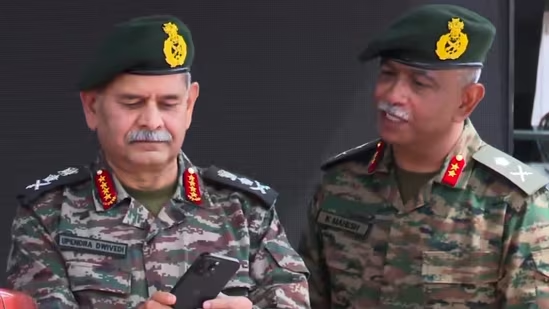
Announced by Army Chief General Upendra Dwivedi during the Kargil Vijay Diwas commemorations in Drass, the new units are part of the military’s broader initiative to build a “future-ready force” with rapid deployment and high-lethality capabilities.
Two existing infantry brigades have already been converted into Rudra all-arms brigades, which integrate infantry, mechanised and armoured units, artillery, Special Forces, unmanned aerial systems, and tailored logistics and combat support under a single command structure.
“Rudra brigades will enhance our force capabilities multifold,” General Dwivedi said. “These formations will bring together fighting components like mechanised infantry, artillery, Special Forces, and UAVs to provide quick and decisive combat support.”
Alongside, the army has also established a new Special Forces formation named the Bhairav Light Commando Battalion, which will be deployed close to the borders and kept on high alert to deliver surprise tactical blows during hostile encounters. “These forces will always be ready to shock the enemy at the border,” Dwivedi said, describing Bhairav units as lethal and agile.
The initiative does not involve fresh troop increases but rather a reorganisation of existing formations. According to a senior army officer quoted in the Times of India, about 250 single-arm brigades, each comprising over 3,000 soldiers, are being converted into integrated all-arms formations with built-in combat and support elements.
The restructuring is part of India’s ongoing efforts to modernise its military capabilities amid rising tensions along the Line of Actual Control (LAC) with China and the Line of Control (LoC) with Pakistan. The Indian Army has also been investing in surveillance, mobility, and unmanned systems to enhance its operational edge.
The move signals a doctrinal shift from traditional, segmented brigades to more agile and self-contained multi-domain units capable of responding to fast-evolving threats across difficult terrain.