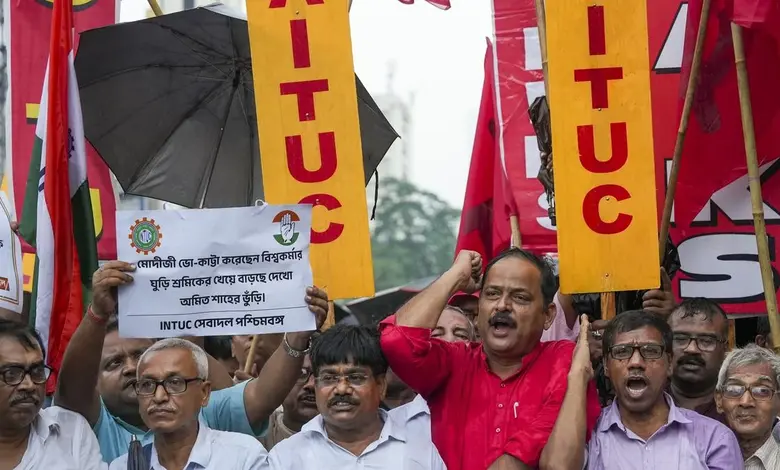
New Delhi, July 9: Ten central trade unions will launch a nationwide general strike on Wednesday to protest what they describe as the Narendra Modi government’s “anti-worker, anti-farmer and pro-corporate” policies, including the contentious labour codes and the newly announced Employment-Linked Incentive (ELI) scheme.
The strike, supported by a broad coalition of opposition parties and civil society groups such as the Samyukta Kisan Morcha (SKM) and the NREGA Sangharsh Morcha, is expected to cause widespread disruption, particularly in states like Bihar, Kerala, West Bengal and Tamil Nadu, where it may assume the form of a full bandh.
The participating unions include INTUC, AITUC, HMS, CITU, AIUTUC, TUCC, SEWA, AICCTU, LPF and UTUC. Originally scheduled for May 20, the strike was deferred following the Pahalgam terror strike and subsequent Operation Sindoor.
At a press conference on Monday, AITUC General Secretary Amarjeet Kaur said the government had reached out to unions for a meeting on Saturday, but without a clear agenda. “The charter of demands was submitted in March. The government had ample time but showed no willingness to engage,” Kaur said.
The unions are opposing the implementation of four labour codes which, they argue, are being pushed through state-level rules to bypass national-level consensus. Kaur said workers’ pressure has so far stalled key private-sector enforcement, particularly provisions to increase working hours.
CITU General Secretary Tapan Sen criticised the ELI scheme, calling it “a system of slavery” designed to replace regular workers with interns, apprentices, and trainees. He questioned the government’s claims of economic growth under the ‘Viksit Bharat’ (Developed India) vision, citing stagnating production.
A joint statement from the Platform of Central Trade Unions accused the government of weakening collective bargaining, undermining union activity, and prioritising employer interests under the banner of ‘Ease of Doing Business.’
The unions also raised concerns over the Election Commission’s Special Intensive Revision of electoral rolls in Bihar, alleging it was a ploy to disenfranchise workers and erode their political voice. The statement further condemned the government for not holding the Indian Labour Conference in the last decade and for policies that promote privatisation, outsourcing, and the casualisation of labour.
The unions have reiterated demands to:
- Revoke the four labour codes
- Stop privatisation of public sector units
- End casualisation and contractualisation
- Reinstate the right to collective bargaining and strike
- Reverse the decriminalisation of labour law violations by employers
With widespread participation expected across key industrial states, the strike signals mounting opposition from organised labour to the Modi government’s labour and economic policies.