

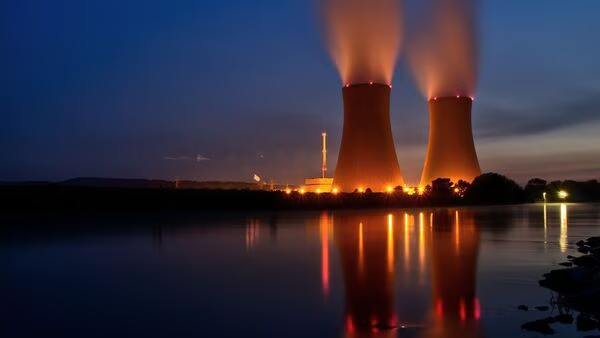
New Delhi, Dec 19: India’s Parliament has approved landmark legislation to open the country’s tightly regulated civil nuclear power sector to private companies, marking a major shift in energy policy as the government pushes to accelerate clean power generation and reduce dependence on fossil fuels.
The bill was passed by the lower house on Wednesday and cleared by the upper house on Thursday. It now awaits presidential assent, a procedural step before it becomes law.
The government has described the move as a necessary reform to modernize India’s nuclear framework in line with changing technological, economic and energy realities. Junior Minister Jitendra Singh told lawmakers the legislation retains core safety, security and regulatory safeguards while aligning India with global benchmarks.
“With India’s growing geopolitical role, we must adopt global strategies and standards,” Singh said, arguing that the reform is essential to meet the country’s rising energy demand.
Prime Minister Narendra Modi called the legislation a “transformational moment” for India’s technology and energy landscape. In a statement, he said the opening of the sector would create new opportunities for private investment, support emerging technologies such as artificial intelligence, and strengthen India’s clean-energy transition.
India is the world’s third-largest emitter of greenhouse gases, with more than 75 per cent of its electricity still generated from coal. The government has set an ambitious target of installing 100 gigawatts of nuclear power capacity by 2047, positioning nuclear energy as a key pillar of its long-term energy mix.
Supporters of the reform say it signals a decisive break from decades of state dominance. Karthik Ganesan of the Council on Energy, Environment and Water said the move sends a clear message to capable private players that India is open for business in the nuclear energy space. Energy experts also note that nuclear power, which does not rely on intermittent sources like wind or solar, could play a crucial role in reducing carbon emissions, despite concerns over radioactive waste.
Opposition parties, however, have raised strong objections, arguing that the legislation weakens safety and liability provisions. Lawmaker Ashok Mittal of the Aam Aadmi Party said the bill lacks sufficient safeguards for communities living near nuclear facilities. Anti-nuclear activist G. Sundarrajan described the law as “disastrous,” warning that it reduces accountability and offers limited recourse for citizens affected by radiation leaks or health hazards.
According to the Department of Atomic Energy, India’s nuclear capacity is expected to rise from the current 8,180 megawatts to 22,480 megawatts by 2031–32, including the commissioning of 10 new reactors totaling 8,000 megawatts. Six additional large nuclear plants with U.S. support have also received in-principle approval.
The reform carries global significance as many countries reassess nuclear power to meet climate targets and cut fossil fuel use. For India, the success of the policy will depend on how effectively it balances private participation with public safety, regulatory oversight and long-term environmental concerns.
