

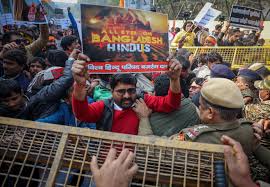
New Delhi, Dec 25: Hundreds of protesters gathered near Bangladesh’s High Commission in New Delhi on Monday to condemn the lynching of a Hindu man in Bangladesh, an incident that has heightened diplomatic tensions between the two neighbouring countries weeks ahead of Bangladesh’s parliamentary elections.
The victim, Dipu Chandra Das, 27, a factory worker, was beaten and set on fire by a mob in Mymensingh district last week after being accused of making derogatory remarks about the Prophet, according to police and local media. At least 10 people have been arrested in connection with the killing.
The protest in New Delhi, organised by Hindu groups, saw demonstrators chanting slogans and holding placards demanding action against violence targeting Hindus in Bangladesh. Television footage showed clashes between some protesters and police as security personnel attempted to prevent the crowd from breaching barricades near the diplomatic mission.
Similar demonstrations were reported in other parts of India, including Jammu and Kashmir, police officials said.
The incident has further strained ties between Hindu-majority India and Muslim-majority Bangladesh, prompting both countries to suspend visa services. Relations have already been tense following political upheaval in Bangladesh and the flight of former prime minister Sheikh Hasina to India after mass protests last year.
Bangladesh said it summoned the Indian envoy on Monday to convey its concerns over protests outside its diplomatic missions in New Delhi and other cities, urging Indian authorities to investigate what it described as violent demonstrations.
India’s Foreign Ministry said earlier that the protest near the High Commission involved a small group that was dispersed within minutes, reiterating that New Delhi remained committed to ensuring the safety of foreign diplomatic missions.
The diplomatic friction comes as Bangladesh grapples with wider domestic unrest following the killing of youth leader Sharif Osman Hadi, whose death has triggered protests, arson and attacks on media and cultural institutions ahead of the February election.
