

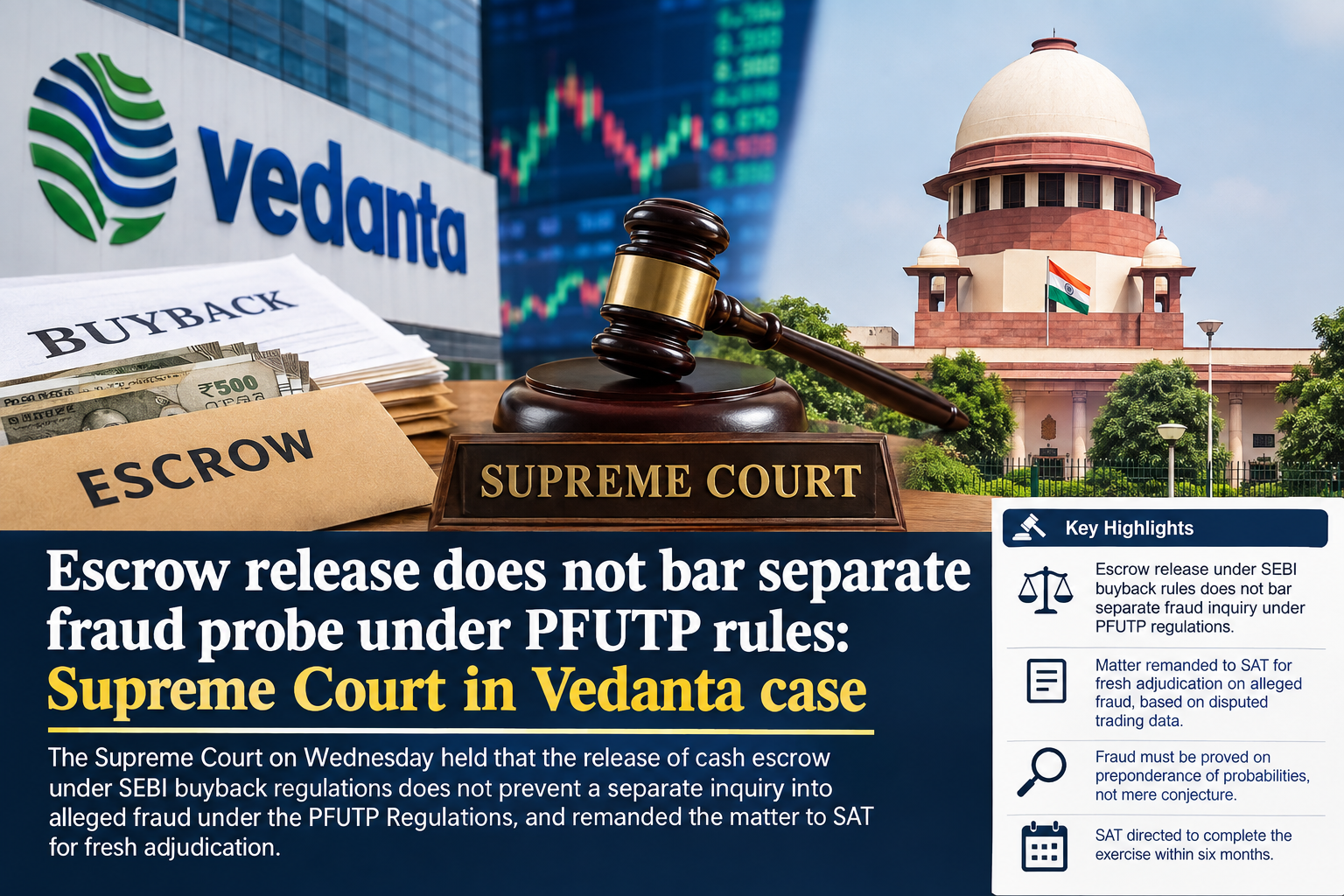
New Delhi, Sept 9: The Supreme Court on Wednesday held that the release of cash escrow deposited by a company under the SEBI Buyback Regulations does not prevent the securities regulator from conducting a separate inquiry into alleged fraud under the PFUTP Regulations.
A bench of Justices JB Pardiwala and KV Viswanathan, however, remanded the matter to the Securities Appellate Tribunal (SAT) for fresh consideration of the alleged fraud, observing that neither the adjudicating officer nor the tribunal had examined discrepancies raised by the respondents in the trading data relied upon to establish the alleged wrongdoing.
The case relates to a 2014 buyback announced by Vedanta Ltd, formerly Cairn India Ltd. The company had announced a buyback of 17.09 crore shares at a price cap of Rs 335 per share for a period of six months.
By the end of the buyback period in July 2014, the company had purchased around 21.48 per cent of the targeted shares, spending approximately 28.59 per cent of the earmarked amount.
SEBI had declined a request to extend the buyback period. The company subsequently sought release of the 2.5 per cent cash escrow deposited under the applicable Buyback Regulations.
SEBI released the escrow in 2016 after concluding that the conditions for exemption from forfeiture had been satisfied. However, a separate investigation into alleged fraud under the SEBI (Prohibition of Fraudulent and Unfair Trade Practices relating to Securities Market) Regulations, 2003, continued.
In 2021, SEBI’s adjudicating officer imposed a penalty of Rs 5.25 crore on Vedanta and Rs 15 lakh each on three individuals, alleging that the buyback announcement was misleading and that there was no genuine intention to fulfil it.
The SAT subsequently set aside the penalty order in 2023, holding that fraud had not been established and that the company had demonstrated bona fide intent despite adverse market conditions. SEBI challenged the decision before the Supreme Court.
The apex court rejected the argument that release of the escrow amounted to a finding that there was no fraud.
It held that the provision governing release or forfeiture of escrow addresses a specific question concerning the company’s entitlement to the escrow amount and does not determine whether the company violated the PFUTP Regulations.
The court said treating escrow release as immunity from a separate fraud proceeding would have no basis in the statutory scheme.
The bench also rejected reliance on an internal noting of SEBI’s Legal Affairs Department that had reportedly questioned the legal sustainability of a PFUTP case after the escrow exemption conditions were met. The court observed that departmental file notings do not have the force of law and cannot be treated as binding orders.
At the same time, the Supreme Court stressed that allegations of fraud cannot be sustained merely on conjecture or suspicion. Fraud under the PFUTP framework has to be established on a preponderance of probabilities after considering the totality of circumstances.
The court noted that the adjudicating officer’s finding of fraud was substantially based on historical trading data from the National Stock Exchange and the Bombay Stock Exchange.
The respondents had challenged the accuracy and consistency of the data before both the adjudicating officer and SAT, but the objections had not been adjudicated upon, the court said.
The bench noted that the respondents had pointed to at least three instances of apparent inconsistencies in the trading data.
It also flagged an apparent contradiction between SEBI’s 2016 investigation report, which found no material impact on price or trading volume, and a subsequent 2017 report that found fraud on substantially the same facts.
The court said these factual issues went to the root of the fraud finding and should be examined by SAT, which has powers akin to those of a civil court under Section 15U of the SEBI Act.
SAT has been directed to scrutinise the relevant trading data, including a letter from NSE, and record specific findings on each discrepancy raised by the respondents.
The tribunal has also been directed to use its statutory powers to summon company officials, merchant bankers and other relevant persons and call for necessary documents. It must further examine whether circumstances apart from the trading data support the allegation of fraud.
The Supreme Court clarified that its observations on the factual merits should not influence SAT’s final decision.
The tribunal has been directed to complete the fresh adjudication and dispose of the matter within six months from the date of the Supreme Court’s judgment.
