

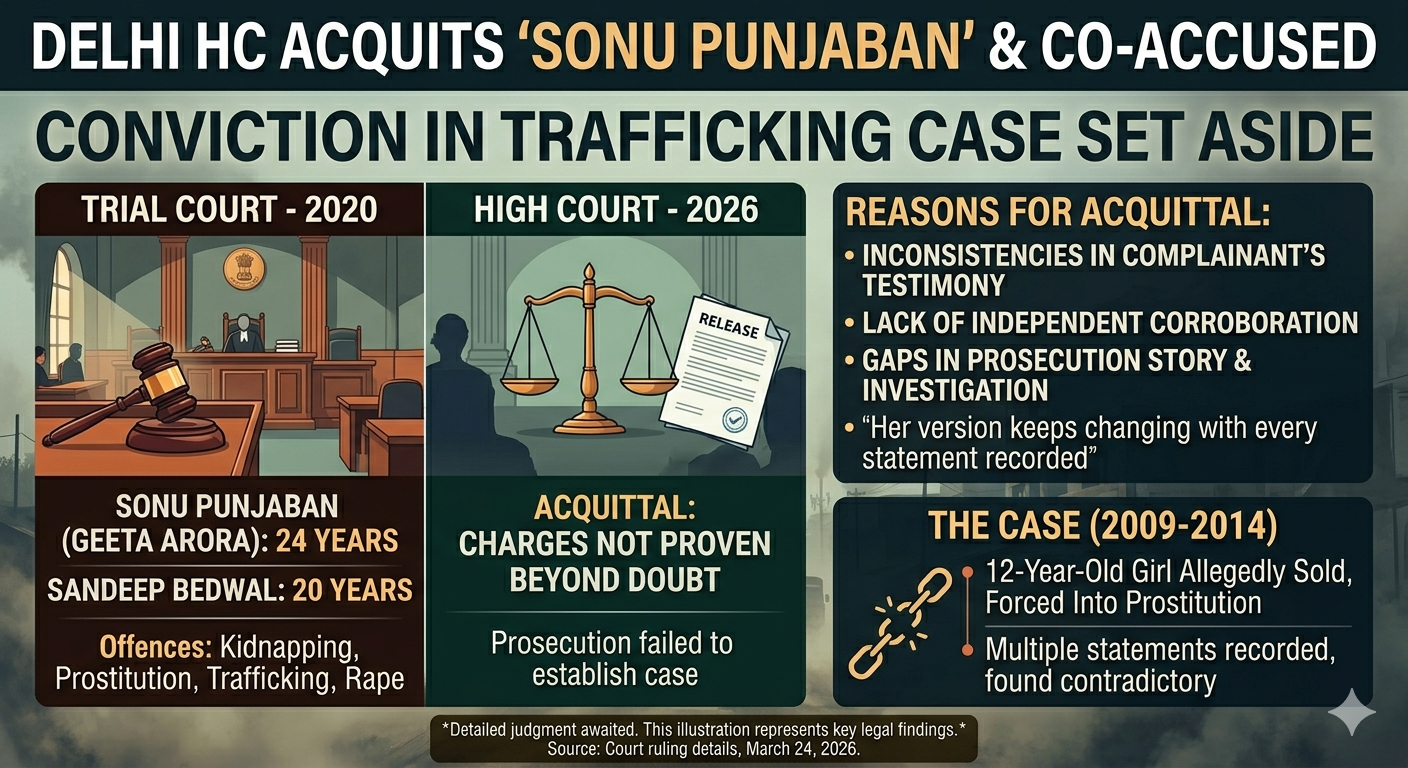
New Delhi, Mar 24: The Delhi High Court on Tuesday acquitted alleged trafficker Geeta Arora, popularly known as Sonu Punjaban, and co-accused Sandeep Bedwal in a prostitution and human trafficking case, setting aside their conviction and jail terms awarded by a trial court in 2020.
A bench headed by Justice Chandrasekharan Sudha allowed the appeals filed by the duo, observing that the prosecution failed to establish the charges beyond reasonable doubt due to inconsistencies in the complainant’s testimony and lack of independent corroboration.
“In the absence of any independent corroboration, it would be unsafe to sustain the conviction,” the court said, adding, “the appeals are allowed and the impugned judgment… is set aside.”
The trial court in July 2020 had sentenced Arora to 24 years’ imprisonment and Bedwal to 20 years in jail, along with fines of ₹64,000 and ₹65,000 respectively, in a case involving kidnapping, prostitution, human trafficking, and rape of a minor. It had termed the offences “extremely heinous” and recommended a compensation of ₹7 lakh for the victim.
The case dates back to 2009, when a 12-year-old girl was allegedly lured by Bedwal on the pretext of marriage and later sold into a trafficking network. The prosecution had claimed that the victim was forced into prostitution, drugged, and repeatedly exploited. The matter came to light in 2014 after the survivor approached police in Najafgarh and recorded her statement.
However, the High Court found serious flaws in the prosecution’s case, noting that it relied primarily on the survivor’s testimony, which it described as “inconsistent and unreliable.” The court pointed out contradictions in her statements regarding the timeline of events, sequence of trafficking, and the role attributed to the accused.
“These improvements are not minor embellishments but introduce entirely new facets to the prosecution story,” the court observed, adding that “her version keeps changing with every statement recorded.”
The bench also flagged procedural lapses, including the manner in which the complainant was cross-examined, and highlighted gaps in the investigation, such as failure to trace other alleged members of the trafficking network.
“The testimony… suffers from material contradictions, improvements and inconsistencies,” the court noted, while also taking into account the complainant’s subsequent conduct, including lodging multiple FIRs of a similar nature.
With the conviction now overturned, the detailed judgment is awaited and expected to provide further clarity on the court’s reasoning.
