

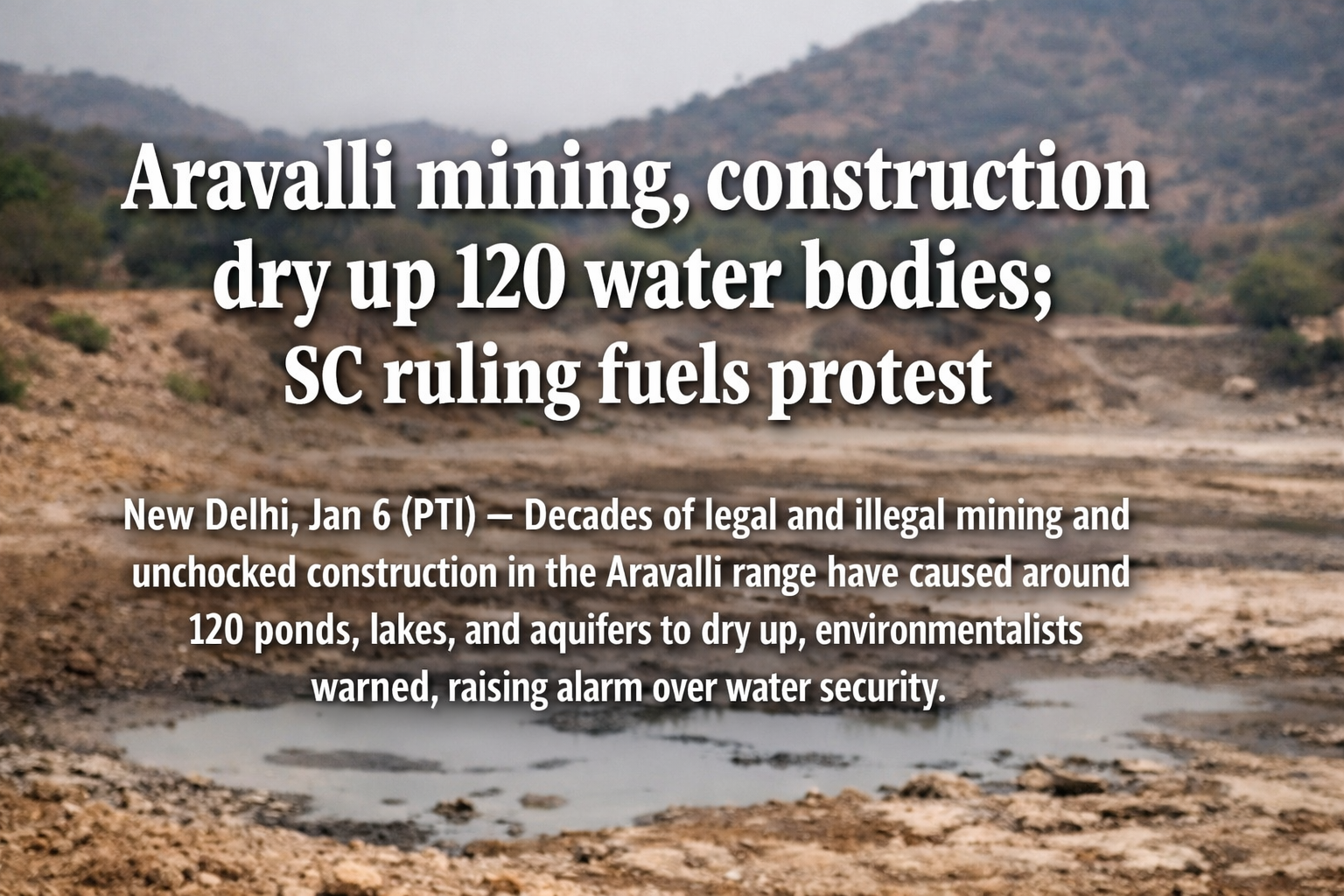
New Delhi, Jan 6: Around 120 ponds, lakes, and aquifers in the Aravalli range have dried up due to decades of legal and illegal mining and unchecked construction, environmentalists warned, raising concerns over water security and ecological degradation.
The Supreme Court’s November 20, 2025 ruling, which defined the Aravallis primarily by elevation (100 metres above local relief) rather than ecological function, could strip nearly 90 per cent of the range of environmental protection, activists said. The apex court later kept the order in abeyance on December 29, 2025, with the next hearing scheduled for January 21, 2026.
Stretching over 670 km across Delhi, Haryana, Rajasthan, and Gujarat, the Aravallis act as a natural barrier against desertification, a major groundwater recharge zone, and a climatic regulator, experts noted. Environmentalists emphasised that the hills support continuous flora, fauna, soil systems, and hydrology, irrespective of elevation.
R.P. Balwan, retired Indian Forest Service officer, described the elevation-based definition as scientifically unnecessary and ecologically dangerous, while Neelam Ahluwalia of People for Aravallis warned that the move jeopardises water security, biodiversity, and livelihoods. Swami Prem Parivartan (Peepal Baba) termed the range Delhi’s ecological spine and shield, cautioning that its degradation worsens air pollution and desertification.
Mining remains the most destructive threat, with illegal operations continuing despite previous Supreme Court bans. Environmentalists said major breaches have flattened hills, accelerating desert dust movement into the NCR and affecting agriculture, groundwater recharge, and local ecosystems. The Aravallis are estimated to recharge nearly 2 million litres of groundwater per hectare, but mining punctures aquifers, lowering water tables to 1,000–1,500 feet in parts of Haryana and Rajasthan.
Communities living in and around the Aravallis depend on the hills for grazing, fodder, medicinal plants, and water, but mining and stone crushing activities have contaminated water, reduced farmland productivity, and increased human-animal conflicts. The range also holds archaeological and geological significance, with evidence of human habitation dating back 150,000 years.
The Supreme Court ruling has triggered widespread protests across Rajasthan, Haryana, and Delhi, with groups like the Aravalli Virasat Jan Abhiyan demanding the recall of the elevation-based definition, halting mining near water bodies, forests, and farms, and transitioning to alternative building materials.
Union Environment Minister Bhupender Yadav said the government was committed to protecting the Aravallis and no new mining licences would be granted, adding that the reclassification was aimed at uniformity in environmental enforcement. Opposition leaders, however, questioned the figures and alleged that scientific inputs were being ignored.
Experts said restoration of the Aravallis was still possible within 15–20 years if immediate action is taken, but stressed that public engagement and awareness are crucial for meaningful recovery.
