

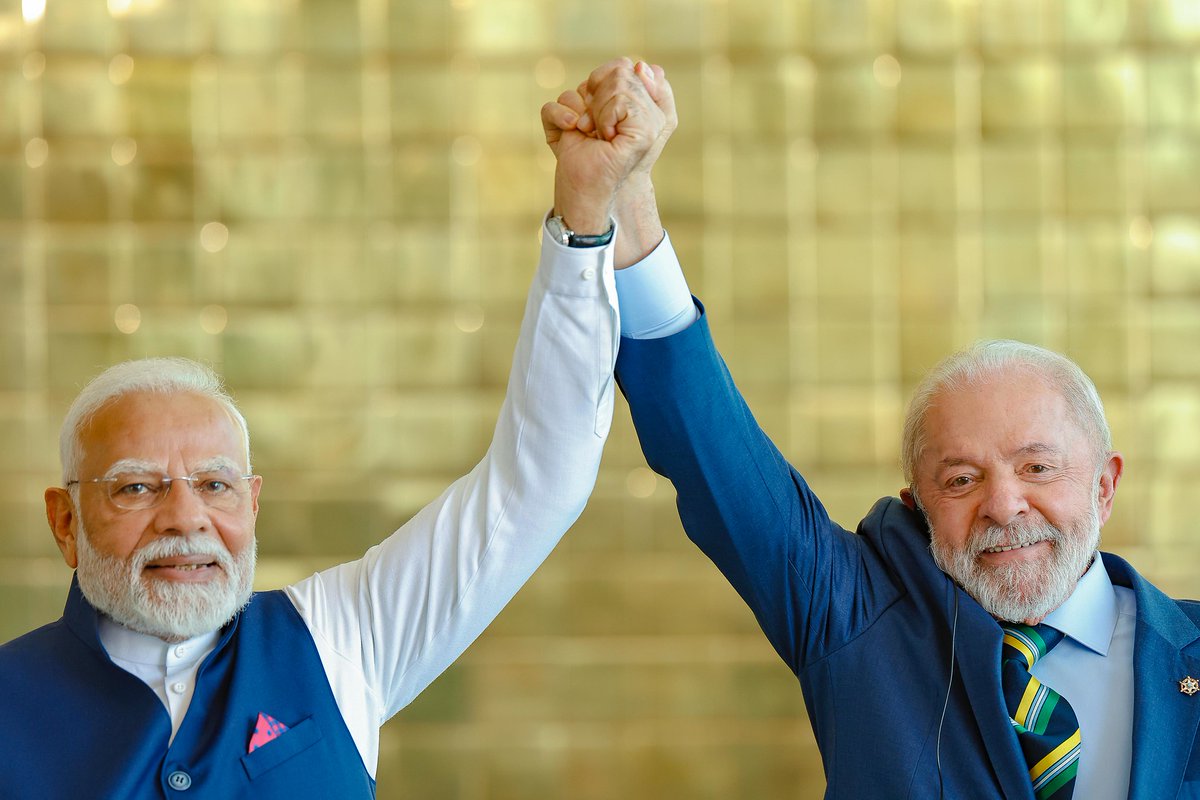
Brasilia, July 9; Indian Prime Minister Narendra Modi and Brazilian President Luiz Inácio Lula da Silva on Tuesday reaffirmed the strategic partnership between their countries, pledging to deepen cooperation across key sectors including energy, defence, and counter-terrorism.
The two leaders met in Brasilia a day after the conclusion of the BRICS summit in Rio de Janeiro. Addressing the media after bilateral talks, Modi described Lula as the “chief architect” of the India-Brazil Strategic Partnership and called the relationship an “important pillar of stability and balance” in a world marked by rising tensions and uncertainty.
“As two large democratic nations, our cooperation is relevant not only to the Global South, but to the entire world,” Modi said. He emphasized the shared view that all international disputes should be resolved through dialogue and diplomacy, adding that terrorism must be countered with “zero tolerance and zero double standards.”
Earlier, Modi was accorded a ceremonial welcome in Brasilia, where he was also conferred with Brazil’s highest civilian honour – the Grand Collar of the National Order of the Southern Cross – by President Lula. Modi thanked his Brazilian counterpart for his commitment to strengthening bilateral ties.
The two sides signed six agreements spanning renewable energy, counter-terrorism, agriculture, intellectual property, classified information protection, and defence cooperation.
“Our cooperation in the field of energy is constantly growing. Environment and clean energy are priorities for both our nations,” Modi said. “The agreement signed today will give new direction and momentum to our green goals.”
Modi also highlighted defence cooperation as a symbol of “mutual trust” and said the two countries would continue efforts to connect their respective defence industries. In a significant step toward digital economic integration, Modi announced that India and Brazil were “working together on the adoption of UPI [Unified Payments Interface] in Brazil.”
India and Brazil have also set a new target to raise bilateral trade to $20 billion over the next five years, up from approximately $12.5 billion in 2024, according to official estimates. The visit underscores a broader effort by both countries to enhance their role in shaping the global agenda, especially on behalf of the Global South.