

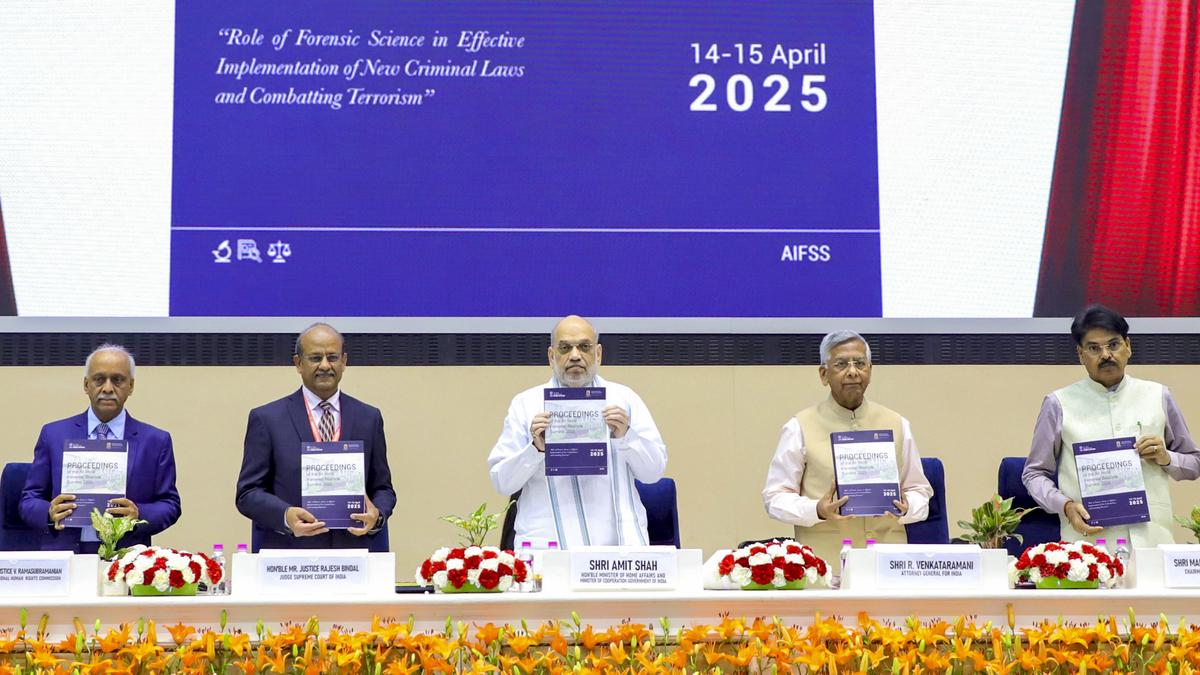
NEW DELHI, April 14 – India will soon allow private forensic laboratories to analyse certain samples received by government-run forensic science labs, Union Home Minister Amit Shah said on Monday, as the country seeks to ramp up capacity in criminal investigations under new legal frameworks.
Speaking at the All India Forensic Science Summit 2025 in New Delhi, Shah said the Ministry of Home Affairs is finalising an agreement to permit the transfer of specific forensic samples to private labs to support overburdened government facilities. “There is a need for 30,000 trained professionals to visit every crime scene where the punishment exceeds seven years,” Shah said, referring to requirements under India’s new criminal laws enacted in 2024.
To meet this demand, the National Forensic Sciences University (NFSU), established in 2020, will produce around 36,000 graduates annually, many of whom are expected to enter the private sector. The Minister added that the government has already set up seven NFSU campuses across India, with nine more to be launched in the next six months and 10 additional campuses proposed.
Shah also paid tribute to B.R. Ambedkar on his birth anniversary, noting his contribution to framing the Indian Constitution. “Our Constitution is not just a book; it is a system for the protection of the body, property and honour of every citizen,” he said, highlighting forensic science’s expanding role in supporting the criminal justice system.
The Minister further emphasised the need for reform within the penal system, advocating for psychological counselling in jails. He proposed categorising inmates into habitual offenders, those driven by circumstances, and those who committed crimes out of necessity, with tailored rehabilitation strategies aimed at reintegrating them into society.
The event, organised by NFSU, brought together policymakers, scientists and legal experts to discuss the future of forensic science in India’s justice system.