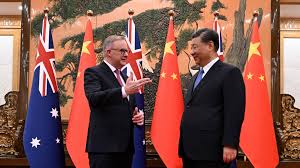
Canberra/Beijing, April 10 – Australia has rejected a proposal from China to form a united front against escalating U.S. tariffs, as tensions continue to rise between Washington and Beijing. Prime Minister Anthony Albanese said his government would act in Australia’s national interest and not align itself with China’s position.
The development comes as the U.S., under President Donald Trump, imposed a 10% import tax on Australian goods and sharply increased tariffs on Chinese products to 125%. In response, China approached Australia with a proposal for joint resistance to what it called U.S. “hegemonic and bullying behavior.”
“The international community… should firmly say no to unilateralism and protectionism,” China’s ambassador to Australia, Xiao Qian, said on Thursday, warning that U.S. trade policies risk destabilising the global economy. But Canberra was quick to push back. “We will speak for ourselves,” Albanese said. “We’re not about to make common cause with China, that’s not what’s going to happen here.”
Defence Minister Richard Marles reinforced the stance, stating that Australia would not be “holding China’s hand” in any campaign against the U.S. “We don’t want to see a trade war between America and China, to be clear, but our focus is on actually diversifying our trade,” he told Nine News. Despite growing frustration over the new U.S. duties, Australia has opted not to retaliate, instead seeking further negotiations with Washington.
Australia is now prioritising efforts to reduce its economic reliance on both China and the United States by expanding trade with alternative markets. Trade Minister Don Farrell has recently held talks with counterparts from Japan, Singapore, South Korea, and India.
“Eighty percent of our trade does not involve the United States. There are opportunities for Australia, and we intend to seize them,” Albanese said, pointing to expanding partnerships with countries such as Indonesia, the United Kingdom, and the UAE. China, meanwhile, has accused the U.S. of “weaponising” trade and undermining the rules-based international trading system. While Australia and China have worked to stabilise diplomatic ties in recent months, the latest developments underscore Canberra’s cautious stance amid rising geopolitical and economic tensions in the Asia-Pacific region.