

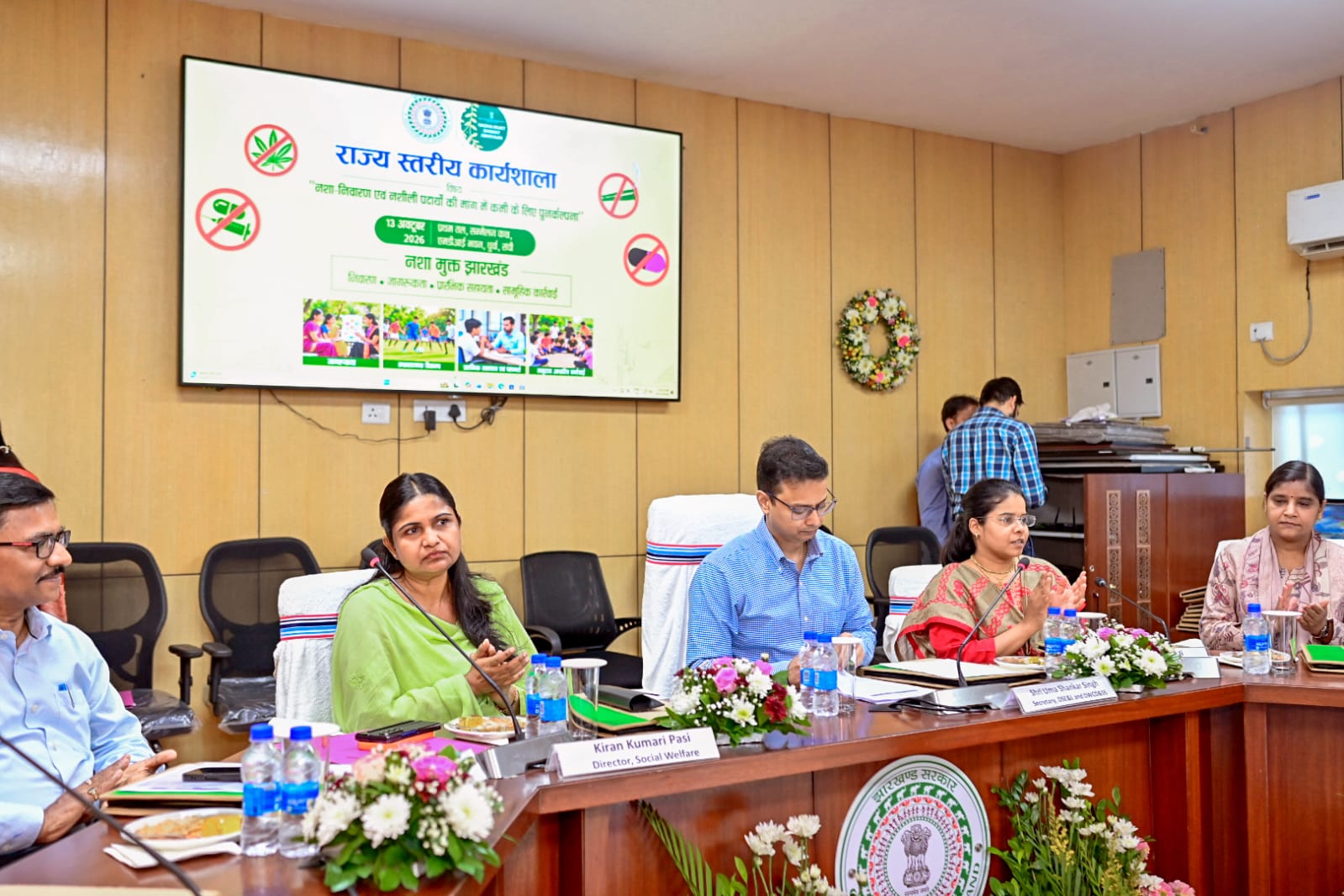
Ranchi, Oct 13: A state-level consultation workshop on drug de-addiction and demand reduction, titled “Re-imagining Prevention and Drug Demand Reduction in India,” was held at Project Bhawan, MDI Building on Tuesday to draft a comprehensive road-map for making Jharkhand drug-free.
Organised by the Jharkhand government in accordance with directives from the Union Ministry of Social Justice and Empowerment, the day-long event brought together key administrative departments, development partners, and domain experts to formulate evidence-based, community-centred strategies against substance abuse.
Chief Guest Umashankar Singh, Secretary for School Education & Literacy and Women, Child Development & Social Security, inaugurated the workshop and called for converting de-addiction initiatives into a grassroots mass movement rather than treating substance abuse strictly as a law-and-order issue. Singh emphasised that success should not be measured by the number of activities conducted, but by how many people are saved from addiction and the positive change brought to their lives, stressing the need for coordinated action across panchayats, schools, and local communities.
Speaking on the occasion, Director of Social Welfare Kiran Kumari Pasi highlighted the pivotal role of families and local institutions in early detection and support. She called for actively involving Anganwadi workers, ASHAs, self-help groups, panchayat representatives, and youth organisations as front-line stakeholders in prevention, counselling, and community outreach.
The workshop featured active participation and inputs from various government wings, including the Panchayati Raj, Urban Development, Higher and Technical Education, Social Security, Integrated Child Protection Scheme (ICPS), Jharkhand State Livelihood Promotion Society (JSLPS), and the Narcotics Cell of the Home Department.
During the technical sessions, delegates agreed on adopting an integrated approach that seamlessly connects prevention, early counselling, medical treatment, rehabilitation, and social reintegration. To ensure grassroots execution, the workshop prioritised building coordinated action frameworks across district, block, and village levels, alongside launching a state-wide strategy for the widespread publicity of the official drug-free helpline, 14446.
The proceedings concluded with the formulation of an official state action plan detailing Jharkhand’s commitment and strategy for drug demand reduction, which will be formally submitted to the Ministry of Social Justice and Empowerment, Government of India.
