

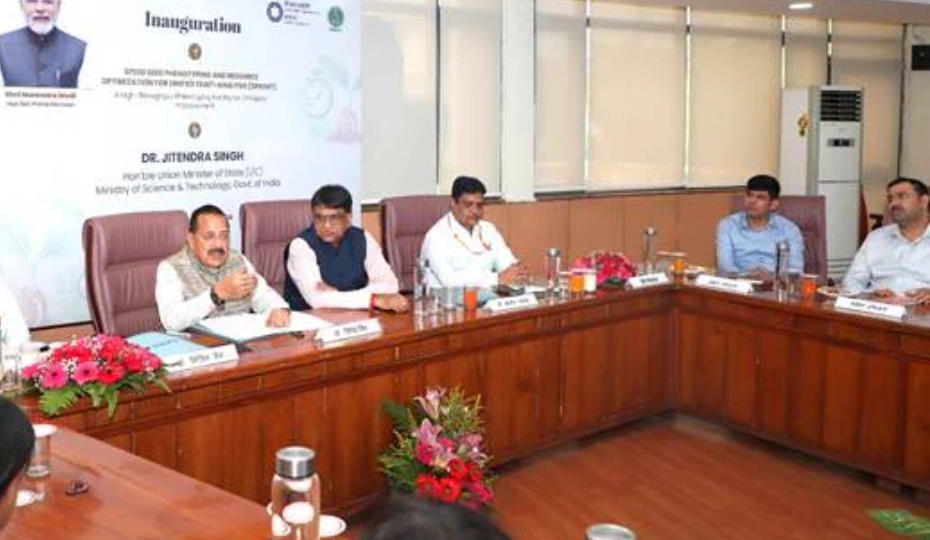
New Delhi, Sep 15: Union Minister of State (Independent Charge) for Science and Technology and Earth Sciences Dr Jitendra Singh on Tuesday inaugurated a new controlled-environment research facility at the BRIC-National Institute of Plant Genome Research (BRIC-NIPGR), aimed at speeding up the development of crops capable of withstanding changing climatic conditions.
The facility, named SPROUT — SpeedSeed Phenotyping and Resource Optimisation for Integrated Trait Analysis — will enable researchers to evaluate plants under controlled environmental conditions without being dependent on seasonal weather patterns.
The facility has been designed for high-throughput phenotyping, stress testing and evaluation of germplasm, breeding populations, mutants, transgenic plants and genome-edited lines. Its initial focus is on chickpea research.The initiative seeks to bring together advances in genomics and genetic technologies with precise assessment of plant characteristics.
This could help scientists identify useful traits, validate them and incorporate them into crop improvement programmes more efficiently.Addressing the programme, Dr Singh said such capabilities were particularly important for India, given the country’s diverse agricultural and climatic conditions. He highlighted the need to develop crops that can perform under challenges posed by changing weather patterns.
The minister also highlighted SpeedSeed, a technology developed by NIPGR to accelerate plant generation cycles. In chickpea, optimised processes can reduce the time required to produce a generation to around 40 days, potentially shortening the duration of breeding and research programmes.
The combination of SPROUT and SpeedSeed is expected to help researchers evaluate promising traits faster and reduce the time between scientific discoveries and the development of improved crop varieties.Dr Singh linked the initiative with the government’s broader BioE3 policy, which promotes biotechnology-based innovation and a sustainable bioeconomy.
He said India was making progress across plant biotechnology, human biotechnology, genomics and other emerging areas.According to the information shared at the event, the Department of Biotechnology supported more than 300 projects in agricultural biotechnology and related areas between 2014 and 2026.
More than 50 improved varieties involving crops and forestry species have also been developed, with several showing enhanced tolerance to drought, floods, salinity, pests and diseases.The minister cited the development of 17 climate-resilient rice varieties through genomics-assisted breeding as an example of how advanced scientific research can translate into agricultural applications.
These varieties are reportedly being cultivated across about 15 lakh hectares.Dr Singh also emphasised the importance of taking scientific advances beyond laboratories and research institutions. He called for stronger communication between scientists, farmers, industry and other stakeholders so that the practical benefits of emerging technologies can be better understood.
He suggested using short films, workshops and other visual communication tools to explain complex scientific developments in an accessible manner.
He also encouraged research institutions to provide farmers with opportunities to visit laboratories and understand how modern biotechnology is being developed for agricultural applications.
The minister said scientific institutions should continuously adapt their communication and human-resource practices to keep pace with rapid technological developments.
The inauguration of SPROUT marks another step towards strengthening India’s agricultural biotechnology infrastructure.
By combining controlled-environment research, genomics, precision phenotyping and accelerated breeding techniques, the facility is expected to support efforts to develop crops better suited to future climate and agricultural challenges.
