

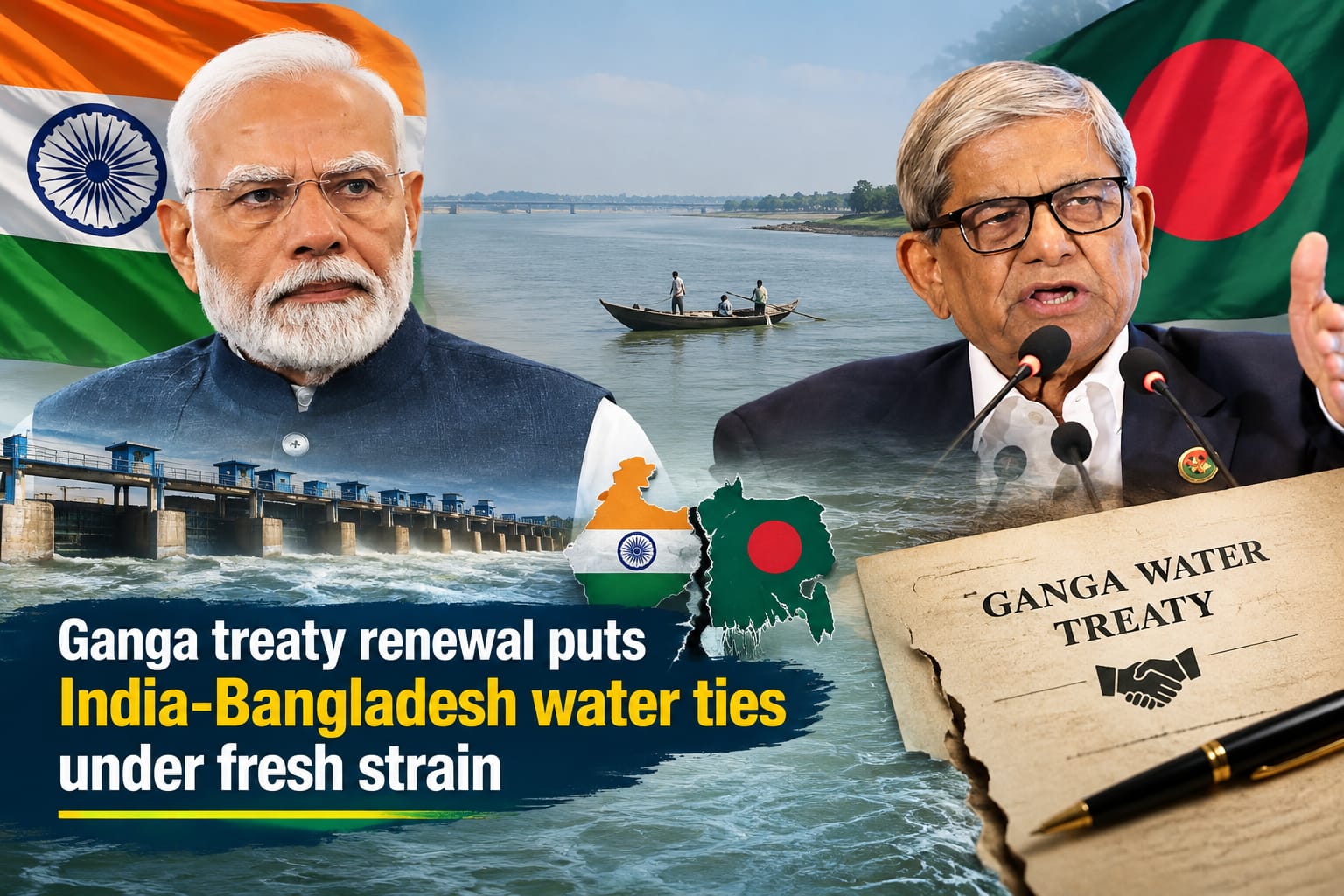
Dhaka, Sept 6: The impending expiry of the India-Bangladesh Ganga Water Sharing Treaty in December has brought a long-standing water dispute back into sharp focus, with Dhaka seeking a revised, climate-sensitive agreement while Bihar has raised strong objections to its renewal in the present form.
The 1996 Ganga Water Sharing Treaty, which governs the sharing of Ganga waters between the two neighbours, is approaching the end of its current term at a time when both sides are pressing competing concerns over water availability, flooding and ecological sustainability.
Bangladesh wants the treaty to be renegotiated with what it describes as fairer and more climate-responsive provisions. Dhaka has also indicated a preference for an indefinite agreement rather than another fixed-term arrangement, making the renewal process potentially more complex.
For Bangladesh, the issue has significance beyond water management and is closely linked to its broader relationship with India.
BNP general secretary Mirza Fakhrul Islam Alamgir said the future of bilateral relations would depend substantially on how the Ganga treaty is renewed, while arguing that Bangladesh wants an indefinite arrangement instead of a fixed-term pact.
Bangladesh Foreign Minister Khalilur Rahman has described a “revised, fair, and climate-based Ganga Treaty” as the “first test” in efforts to rebuild relations with India, which have become strained following the ouster of former prime minister Sheikh Hasina.
However, Bihar has emerged as a significant stakeholder in the debate, with the JD(U), a key ally of the BJP-led NDA, becoming one of the most vocal opponents of the treaty’s renewal in its existing form.
The party argues that the 1996 agreement does not adequately reflect Bihar’s economic, ecological and geographical interests. Since the Ganga flows through the state, Bihar faces the twin challenge of excessive water during the monsoon and shortages during the dry season.
Bihar’s contention is that while Bangladesh has traditionally raised concerns about inadequate downstream flows, the state itself has suffered from flooding during periods of high discharge and water scarcity when river levels fall.
The Centre has taken Bihar’s concerns seriously and assured the state that its water requirements and interests will be considered before any decision is taken on the future of the treaty.
The dispute has gained another dimension with Bangladesh’s approval of the proposed USD 2.8 billion Padma Barrage at Rajbari, around 180 km downstream of Farakka.
The barrage is planned to store nearly 2.9 billion cubic metres of monsoon water, which could then be released during the dry season to support around 2.88 million hectares of drought-prone areas in southwestern Bangladesh.
Supporters of the project see it as an important mechanism for reducing the impact of seasonal water shortages. Critics, however, argue that heavy investment in downstream storage could effectively amount to adapting to insufficient upstream water availability instead of securing increased flows through the bilateral treaty.
The Farakka Dam has remained at the centre of the India-Bangladesh water debate for decades. Bangladesh has repeatedly blamed the structure for contributing to water shortages during the dry season. Bihar’s argument introduces a contrasting concern, claiming that the same river-management system can contribute to flooding during the monsoon while failing to adequately address dry-season requirements.
Indian experts have also raised environmental and hydrological concerns over the proposed Padma Barrage. They have warned that the structure could potentially trap backwater and silt upstream, affecting natural river flows and sediment movement.
Against this backdrop, experts have suggested that Bangladesh conduct a comprehensive hydrological and silt-modelling study before proceeding with the barrage.
The competing demands underline the complexity of the Ganga water issue, where downstream water security for Bangladesh intersects with the flood-control, irrigation and ecological concerns of Indian states such as Bihar.
With the treaty’s expiry approaching, New Delhi faces the challenge of balancing its bilateral commitments with Dhaka and the concerns of a politically important riverine state, while Bangladesh seeks a long-term arrangement that it believes can address both water scarcity and the growing impact of climate change.
