

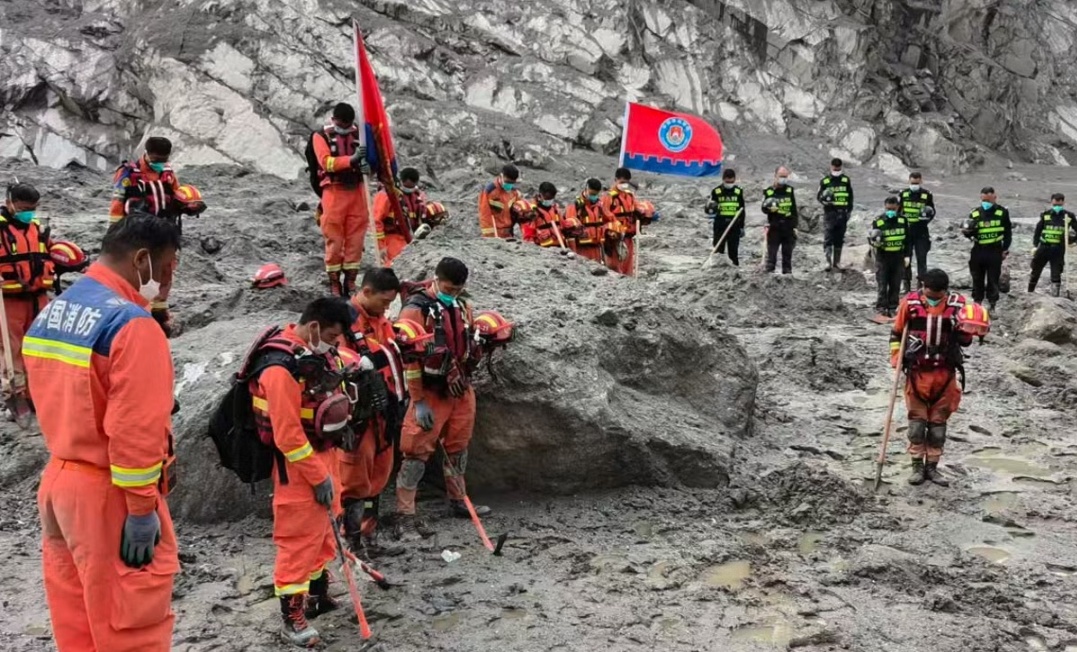
Gyirong, September 6: Chinese rescue teams have intensified operations at Gyirong Port after a massive mudslide triggered by a glacier-related event on the Nepal side of the border caused widespread destruction and left hundreds of people unaccounted for.Officials said 12 more bodies were recovered on Sunday, taking the confirmed death toll on the Chinese side to 43.
As of Saturday, 519 people were still reported missing in the affected area, including 261 foreign nationals from 23 countries.Rescue personnel equipped with excavators, shovels and ground-searching technology are examining the thick layers of mud and debris covering the border crossing. The operation is focused on locating missing people and recovering remains.
The disaster virtually wiped out the port’s major structures. The former five-storey customs building has disappeared beneath the debris, while the large border gate that once marked the crossing is no longer standing.
A Chinese flag has been placed near the location of the destroyed gate.Authorities are also working to identify recovered victims. Officials said teams are recording fingerprints and distinctive physical characteristics, including tattoos.
Nearly 1,000 personal belongings recovered from the site are also being catalogued as part of the identification effort.The recovery operation has drawn concern from families and foreign governments whose citizens remain missing.
Some diplomats have sought greater clarity from Chinese authorities regarding DNA testing and whether surveillance footage from the border crossing could assist in identifying victims.
China’s Foreign Ministry has maintained that information about the disaster has been released in a transparent and timely manner and said it is prepared to cooperate with relevant countries and organisations.
Gyirong Port had developed into a major commercial and travel link between Nepal and Tibet, particularly after the 2015 earthquake damaged another important route farther east.
The crossing handled trade as well as travellers, including pilgrims heading towards Mount Kailash, a site of religious significance for Hindus and Buddhists.
The disaster has also raised concerns about the vulnerability of Himalayan border areas to sudden glacier-related floods and landslides. Chinese officials said the country monitors thousands of glacial lakes, including 187 classified as high-risk.
Authorities have indicated that the future design and reconstruction of Gyirong Port will be reviewed in light of the disaster. Officials have also stressed the need for stronger cross-border cooperation to improve monitoring and early-warning mechanisms for glacier-related hazards.
The catastrophe has affected communities on both sides of the China-Nepal frontier and has prompted renewed attention to disaster preparedness across the Himalayan region.
