

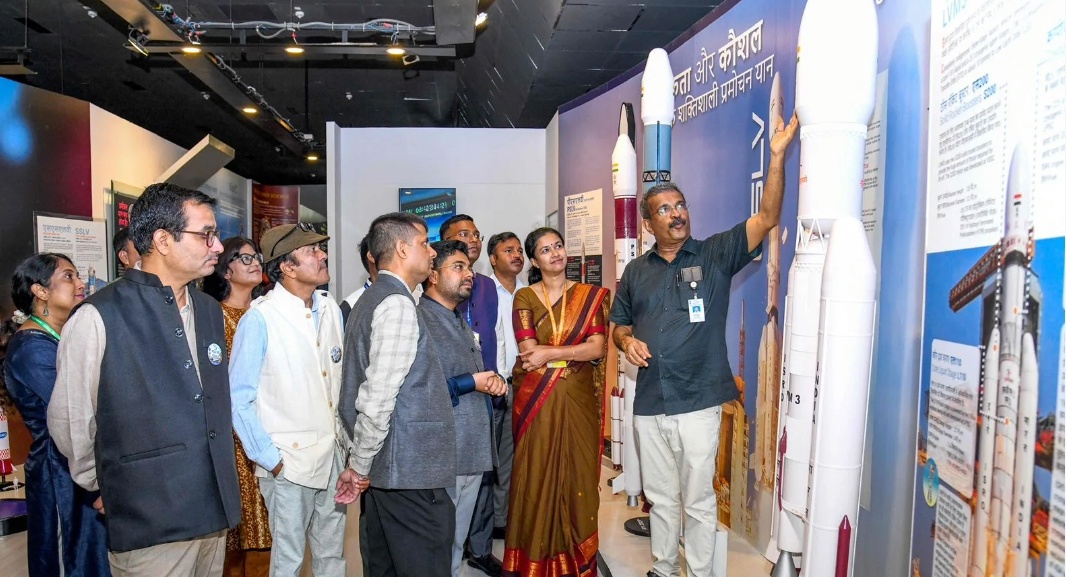
Thiruvananthapuram, September 3: A delegation of journalists from Jharkhand visited the historic Thumba Equatorial Rocket Launching Station (TERLS) on Thursday and received an overview of India’s development in space science and technology.
During the visit, the journalists were briefed on the history and scientific importance of the Thumba facility. The centre was established in 1962 under the leadership of space pioneers Vikram Sarabhai and Homi J. Bhabha, with its location selected because of its proximity to the Earth’s magnetic equator.
The delegation was also taken through the Space Museum, where exhibits and working models showcased the evolution of India’s space programme. The displays included information on satellites, launch vehicles and various technologies developed as the country expanded its capabilities in space research.
Officials also highlighted the early years of India’s space programme, when facilities and resources were limited. The local fishing community supported the effort, while the St Mary Magdalene Church premises were used by early space scientists as an office and laboratory.
The journalists visited a section dedicated to former President and renowned scientist APJ Abdul Kalam. The display focuses on Kalam’s early career and his contribution to India’s space programme during his years at Thumba.
The delegation was further briefed on India’s human spaceflight ambitions, particularly the Gaganyaan programme. The mission is aimed at demonstrating the country’s ability to undertake human spaceflight using an Indian human-rated spacecraft.
Officials also discussed India’s broader plans for human exploration of space, including the development of a planned space station and long-term objectives linked to the country’s space vision for 2047.
The visit provided the delegation with an opportunity to trace India’s space programme from its modest beginnings at Thumba to its growing capabilities and ambitious plans for future human and lunar exploration.
