

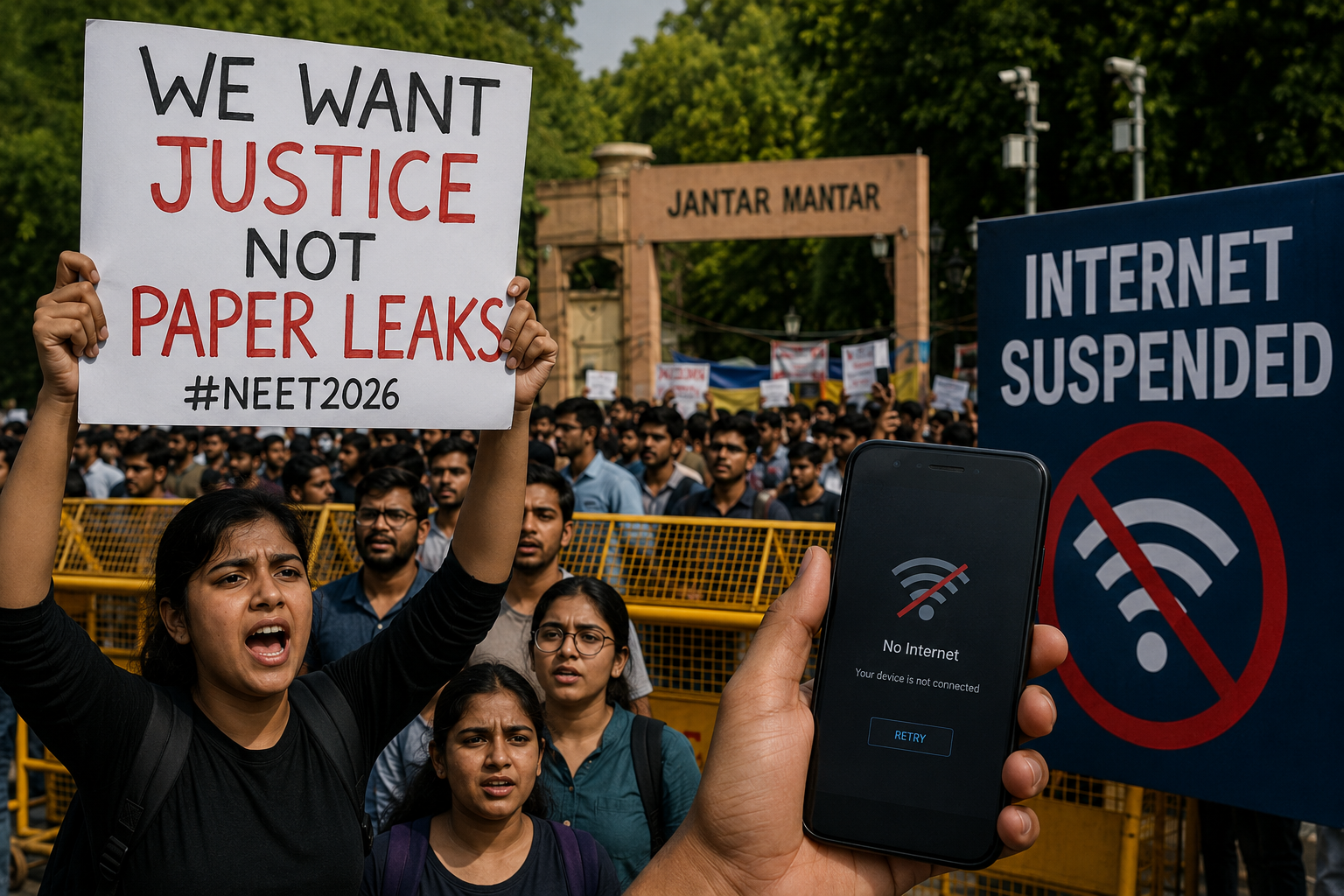
New Delhi, July 25 : Delhi witnessed its longest mobile internet shutdown during the recent student protests over the NEET-UG examination controversy, with authorities repeatedly extending restrictions in parts of central Delhi over five days before services were restored following the withdrawal of the agitation.
The suspension, imposed around Jantar Mantar where the Cockroach Janta Party (CJP) had been leading protests, was extended through seven separate government orders. Although the latest order had directed telecom operators to maintain the shutdown until midnight on Saturday, mobile internet services were restored shortly after Union Education Minister Dharmendra Pradhan announced his resignation and the CJP called off its protest, citing assurances from the Centre on its key demands.
People familiar with the matter said telecom service providers had not received any formal revocation order by Saturday evening, despite internet connectivity being restored on the ground.
The shutdown began on July 20, when authorities ordered telecom companies to suspend mobile internet services between 10 a.m. and 6 p.m. around the protest site. Fresh orders followed over the next several days, extending the restrictions multiple times, with only July 21 seeing no suspension order.
The restrictions covered a 1.5-km radius around Jantar Mantar, affecting areas including Janpath Market, Le Meridien Hotel, Shangri-La Hotel, the National Media Centre and the Indian Women’s Press Corps.
The prolonged suspension made it the longest internet disruption recorded in the national capital, surpassing earlier shutdowns imposed during the 2019 Citizenship (Amendment) Act protests and the 2021 farmers’ agitation, both of which were comparatively shorter and linked to law-and-order concerns.
The repeated restrictions also prompted legal scrutiny. Digital rights organisation SFLC.in challenged the shutdown before the Delhi High Court, arguing that the suspension orders were unlawful and disproportionately affected citizens.
With mobile internet unavailable, several protesters reportedly turned to offline communication platforms such as Bluetooth-based mesh messaging applications to stay connected during the demonstrations.
The protest, which centred on alleged irregularities in the NEET-UG 2026 examination, concluded after the Centre agreed to consider examination reforms and other demands raised by student representatives, leading to the restoration of internet services and normalcy in the affected areas.
