

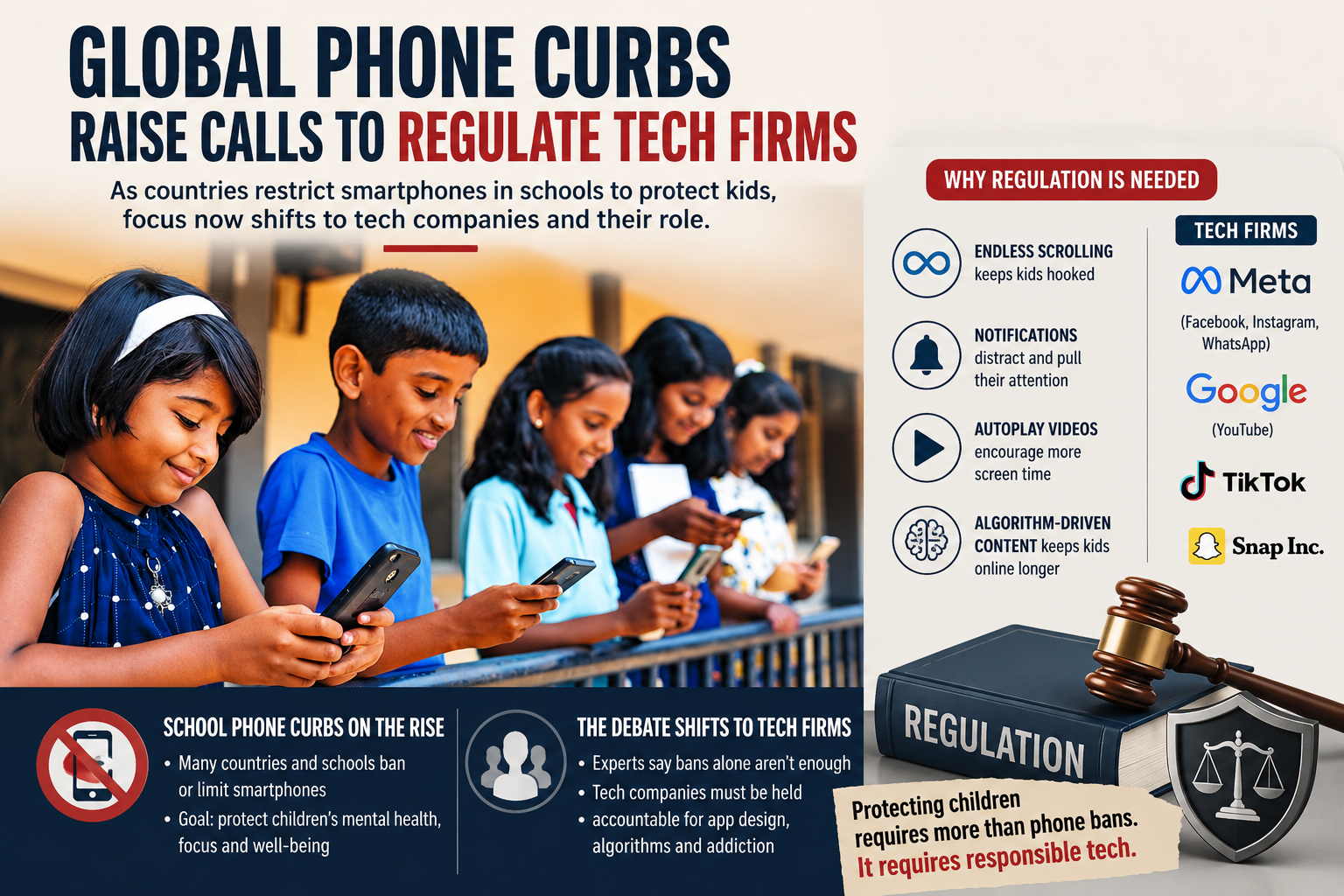
Delhi , July 10 : Governments around the world are tightening restrictions on smartphone and social media use among children, with policymakers increasingly seeking to address concerns over academic performance, classroom discipline and online safety. However, experts argue that protecting children requires stronger regulation of technology companies, rather than placing the burden solely on schools, parents and students.
From France and Brazil to Denmark and South Korea, restrictions on smartphones in schools are expanding rapidly. According to UNESCO’s Global Education Monitoring Report, 114 education systems—representing 58% of countries worldwide—have introduced national-level restrictions on mobile phone use in schools.
Australia has gone a step further by becoming the first country to ban social media access for children under the age of 16. While India has not announced a nationwide policy, the debate has gained momentum, with Karnataka and Andhra Pradesh introducing state-level restrictions on children’s social media use in March 2026.
The growing policy trend comes amid mounting evidence that excessive smartphone and social media use can affect students’ learning and well-being. Research indicates that cell phone bans can improve academic achievement by reducing classroom distractions. However, evidence on their impact on students’ mental health remains mixed.
Schools that have implemented restrictions have nevertheless reported several positive outcomes, including fewer behavioural problems, reduced incidents of bullying and better classroom engagement.
In the United States, states and school districts have adopted different approaches to limiting mobile phone use. Some have introduced “bell-to-bell” bans, which prohibit phone use throughout the school day. While these offer the most comprehensive restrictions, they often require significant infrastructure and monitoring systems. Others have opted for instructional-time bans, which are easier to implement but may deliver more limited benefits and present enforcement challenges.
Support for restricting mobile phone use in schools continues to grow among educators and policymakers. However, some parents and teachers have expressed concerns over implementation, emergency communication and the practical challenges of enforcing such rules.
Education experts say effective policies require consultation with students, parents, teachers and school administrators. They also stress the importance of clearly defined objectives, consistent enforcement, transparent guidelines and adequate support for teachers through professional development and practical enforcement tools.
At the same time, critics argue that school phone bans address only part of the problem. They contend that technology companies have spent billions of dollars designing platforms and applications that maximise user engagement and keep children online for longer periods. As a result, they say, policymakers should place greater emphasis on regulating the design and business practices of digital platforms instead of relying primarily on restrictions within schools.
Experts argue that without stronger oversight of technology companies, policies targeting children’s phone use alone are unlikely to fully address the broader challenges posed by addictive digital platforms.
