

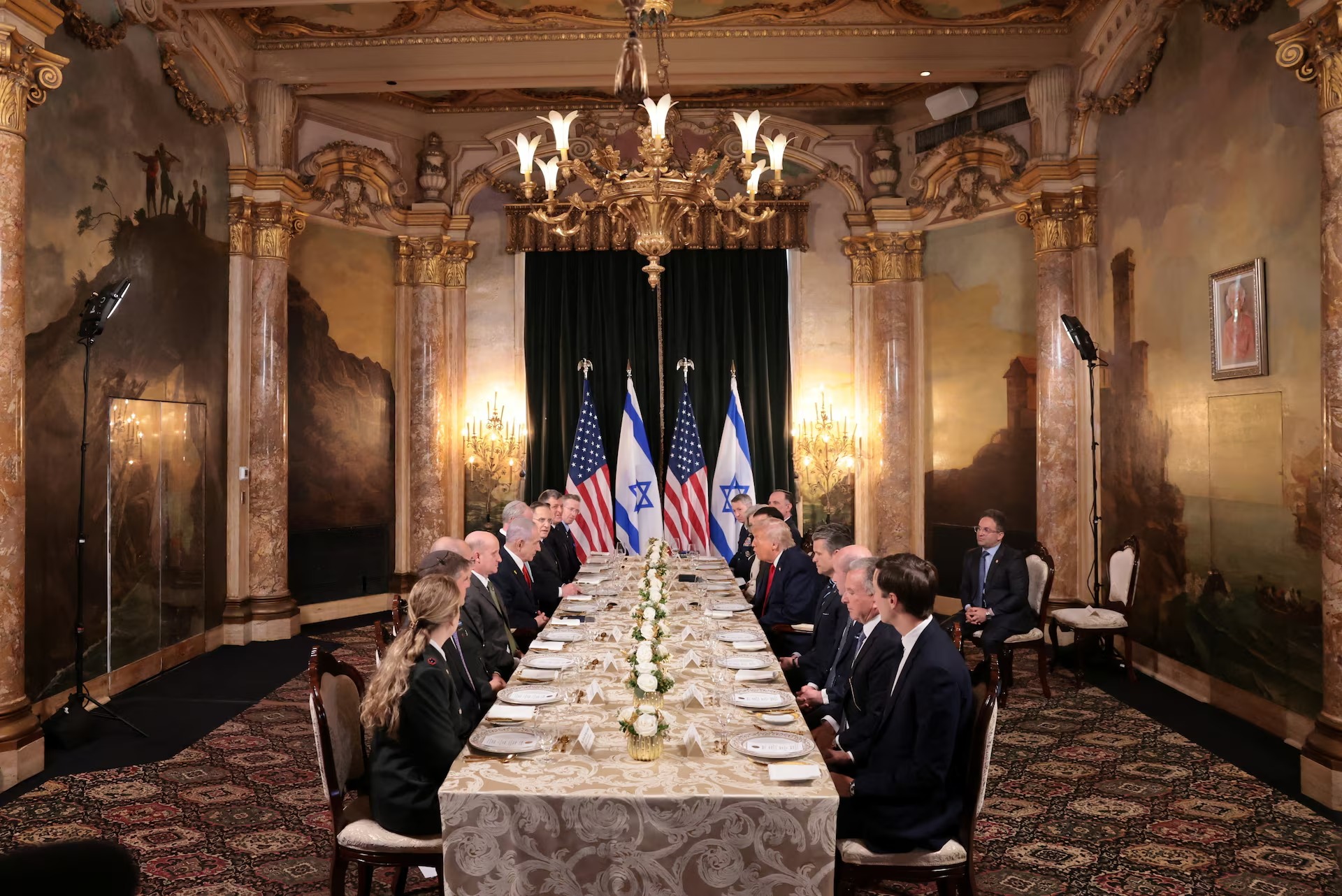
Palm Beach, Florida, December 30: U.S. President Donald Trump met Israeli Prime Minister Benjamin Netanyahu in Florida on Monday for talks aimed at breaking a deadlock over the Gaza ceasefire, while also addressing Israeli concerns about Iran and the Lebanese armed group Hezbollah.
Speaking to reporters as the two leaders arrived at Trump’s Mar-a-Lago resort, Trump voiced strong support for Netanyahu and said he wanted to move quickly to the second phase of the ceasefire deal between Israel and the Palestinian militant group Hamas.
“I want to go to phase two as soon as possible,” Trump said, adding that any progress would require the disarmament of Hamas.
Trump also said he would be open to backing another swift Israeli strike on Iran if Tehran continues to advance its ballistic missile and nuclear weapons programmes. He praised Netanyahu, saying Israel would not exist “with the wrong prime minister.”
Trump said Israeli President Isaac Herzog had told him he planned to pardon Netanyahu over corruption-related charges. He also expressed hope that Israel could eventually get along with Syria, despite Israel’s repeated actions infringing on Syrian territorial sovereignty since the ouster of former president Bashar al-Assad late last year.
Israel and Hamas signed a U.S.-brokered ceasefire deal in October, but alleged violations have been frequent and little progress has been made toward the more difficult political and security arrangements envisioned in later stages.
Netanyahu said earlier this month that Trump had invited him for talks as Washington presses for the establishment of transitional governance in Gaza, including a civilian administration and an international security force, moves Israel has been reluctant to embrace.
While Washington has brokered three ceasefires involving Israel – with Hamas, Iran and Hezbollah – Netanyahu has repeatedly warned that Israel’s adversaries could use pauses in fighting to rebuild their forces.
Under Trump’s Gaza plan, Israel would ultimately withdraw from the territory, while Hamas would give up its weapons and forgo any governing role. The first phase included a partial Israeli withdrawal, increased humanitarian aid and exchanges of Israeli hostages for Palestinian detainees and prisoners.
An Israeli official close to Netanyahu said the prime minister would insist that Hamas return the remains of the last Israeli hostage still in Gaza, Ran Gvili, before moving ahead with the next phase. Israel has also yet to open the Rafah crossing between Gaza and Egypt, another condition of the plan, citing the same demand.
The family of Gvili has joined Netanyahu’s delegation and is expected to meet U.S. officials during the visit.
Analysts say Netanyahu faces mounting political pressure at home ahead of an election due in October. “He doesn’t want a clash with Trump in an election year,” said Chuck Freilich, a political scientist at Tel Aviv University and former Israeli deputy national security adviser. “Trump wants to go forward, and Netanyahu will have to make some compromises.”
Ahead of his meeting with Trump, Netanyahu met U.S. Secretary of State Marco Rubio and Defence Secretary Pete Hegseth. Rubio has said Washington wants a transitional administration, including a board of Palestinian technocrats, in place soon to govern Gaza before the deployment of an international security force mandated by a Nov. 17 U.N. Security Council resolution.
On the ground, the truce remains fragile. Hamas has refused to disarm and has been reasserting control in parts of Gaza, while Israeli troops remain in roughly half of the enclave. Israel has warned it will resume military operations if Hamas does not disarm peacefully.
Although large-scale fighting has eased since October, violence has not fully stopped. Israeli strikes have killed more than 400 Palestinians, most of them civilians, according to Gaza health officials, while Palestinian militants have killed three Israeli soldiers.
Tensions are also high in Lebanon, where a U.S.-backed ceasefire reached in November 2024 ended more than a year of fighting between Israel and Hezbollah. The deal requires the disarmament of the Iran-backed group in southern Lebanon, but Israel says progress has been slow and has carried out near-daily strikes to prevent Hezbollah from rebuilding.
Iran, which fought a brief war with Israel in June, said last week it had conducted missile exercises for the second time this month. Netanyahu has said Israel is not seeking a confrontation with Tehran but plans to raise concerns over Iran’s activities with Trump, including intelligence on Iran’s efforts to rebuild its military capabilities.
Trump ordered U.S. strikes on Iranian nuclear sites in June but has since signalled openness to a potential diplomatic deal with Tehran.
