

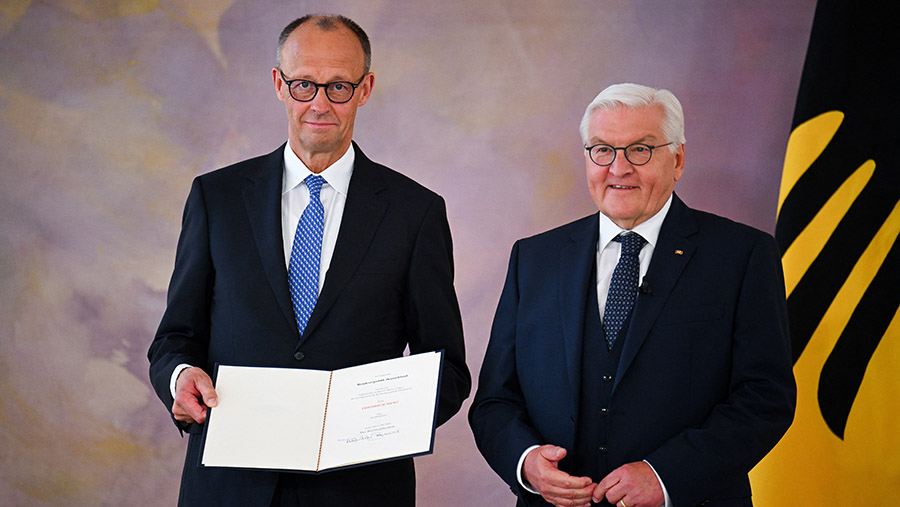
Berlin, May 6 – Germany’s conservative leader Friedrich Merz was elected chancellor on Tuesday after securing a narrow majority in a dramatic second round of voting in parliament, hours after an unprecedented initial defeat.
Merz, 69, won 325 votes against 289 in the Bundestag, clinching the absolute majority needed to become Germany’s 10th post-war chancellor. The outcome followed his surprise failure to win the first secret ballot by just six votes — a first in the country’s post-war political history.
The leader of the Christian Democratic Union (CDU) now heads a fragile coalition between his CDU/CSU bloc and the center-left Social Democrats (SPD), formerly led by outgoing Chancellor Olaf Scholz. President Frank-Walter Steinmeier formally appointed Merz shortly after the vote. “With a slight delay, but all the more heartfelt, my congratulations on your election,” Steinmeier told Merz at Bellevue Palace in Berlin.
Merz’s appointment follows six months of political deadlock after Scholz’s government collapsed in November. He is expected to visit Paris and Warsaw on Wednesday in his first diplomatic trip as chancellor. Merz’s path to power was marred by the first-round defeat, which exposed cracks in the governing coalition and raised doubts about his ability to command unified support. German tabloid Bild described the result as “the Happy End after the Betrayal”.
“The six-month power vacuum at the heart of Europe is over,” said Holger Schmieding, chief economist at Berenberg Bank. “But the failed first vote raises concerns about Merz’s capacity to lead a divided coalition.”
Merz, a former corporate lawyer with no prior government leadership experience, has long sought the chancellorship. His ambitions were previously blocked by former CDU rival Angela Merkel, who led Germany for 16 years.
The far-right Alternative for Germany (AfD), recently labeled a “right-wing extremist” group by domestic intelligence, welcomed Merz’s initial defeat. “Merz should step aside and the way should be cleared for a general election,” said AfD co-leader Alice Weidel.
Merz has pledged tougher immigration policies in an effort to curb support for the AfD, which has surged in recent polls.
Merz takes office amid economic uncertainty and renewed geopolitical pressure from the United States following President Donald Trump’s return to the White House. Trump has criticized NATO allies for low defence spending and reintroduced tariffs targeting German exports.
CDU parliamentary leader Jens Spahn called for urgency ahead of the second vote. “The whole of Europe, perhaps even the whole world, is watching,” he told lawmakers. “Be aware of this special responsibility.”
Merz has promised to reinvigorate the German economy and strengthen Berlin’s leadership role in Europe. “We live in times of profound upheaval and uncertainty,” he said on Monday. “It is our historic obligation to lead this coalition to success.”
Still, analysts caution the rocky start may signal further turbulence. “The initial setback leaves Merz severely weakened and suggests that hopes for greater stability in German politics may be disappointed,” said Franziska Palmas of Capital Economics.