

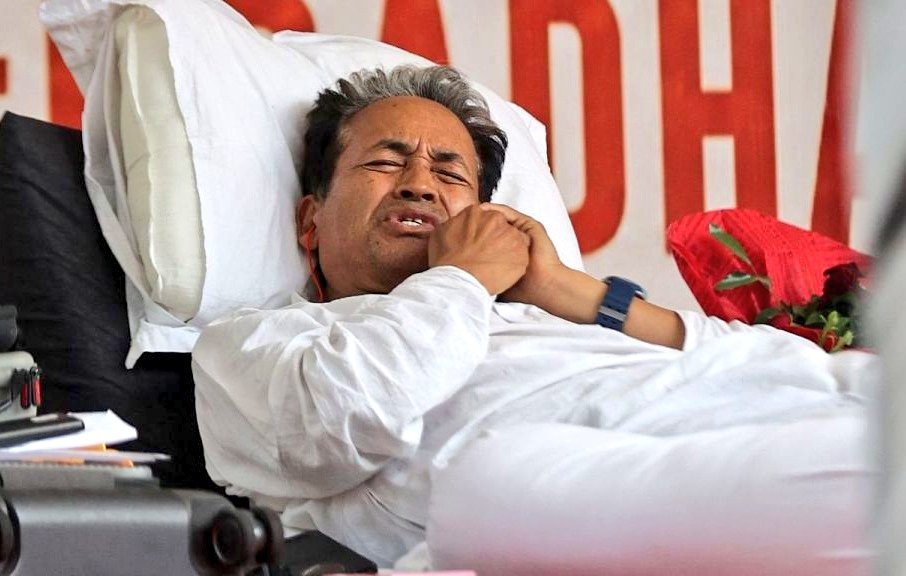
New Delhi, July 17: The Delhi High Court on Thursday directed authorities to ensure climate activist Sonam Wangchuk receives all necessary medical care as his indefinite hunger strike entered its 19th day, amid growing concern over his deteriorating health during protests demanding education reforms and the resignation of Education Minister Dharmendra Pradhan.
The court said “whatever medical intervention is needed to save Sonam Wangchuk’s life should be done,” adding that “the life of any citizen is precious” and authorities must make every effort to protect it.
The order came after a petition warned that the 59-year-old activist, who has lost around 8.5-9 kg since beginning his fast, might not survive the next 48 hours if he continued without medical intervention. The petition urged authorities to hospitalise and force-feed Wangchuk if necessary.
The court also instructed the government to conduct regular medical examinations through government doctors and intervene if his condition worsened.
The government, represented by Solicitor General Tushar Mehta, told the court Wangchuk was undergoing daily health check-ups, although some examinations were being conducted by private doctors.
Wangchuk joined protests organised by the Cockroach Janta Party (CJP) at Delhi’s Jantar Mantar on June 28 after accusing the government of failing to engage with demonstrators. The group is demanding reforms to India’s education and competitive examination system and Pradhan’s resignation following multiple question paper leaks, including the cancellation of the NEET-UG medical entrance examination in May.
Doctors attending Wangchuk say he has become severely weak and now requires assistance to walk short distances.
In a video message released before the court hearing, Wangchuk said he would not end his fast without a response from the government, arguing that doing so would send the “wrong message.”
“It is not bad… Yes, there is weakness… my muscles are getting tired… but my heart and core are still fine,” he said.
Rather than appealing for him to break his fast, Wangchuk urged supporters to participate in a planned march to Parliament on July 20.
“Instead of just saying ‘break the fast’, I would request you take a small step. Come in large numbers on July 20… so a message goes to the government,” he said.
The CJP, founded on May 16 by Abhijeet Dipke, has attracted students, parents, academics and other supporters who argue India’s examination system places excessive pressure on young people and has been undermined by repeated paper leaks.
The protests were triggered by widespread outrage after the NEET-UG examination was cancelled following a paper leak, affecting millions of aspiring medical students.
Several protesters have also begun hunger strikes alongside Wangchuk, with at least one participant reportedly hospitalised.
CJP spokesperson Ashutosh Ranka criticised the government’s refusal to engage with demonstrators.
“Why won’t they talk to us? Don’t they know they are servants of this country who are meant to be accountable to the people?” he said.
Opposition politician Anish Gawande also criticised the government’s response.
“Ministers are sitting 100 metres away from Jantar Mantar and ignoring these voices. In a functioning democracy, a government listens to its people and their aspirations,” he said.
Concern over Wangchuk’s health has prompted appeals from public figures for him to end his fast. Congress MP Shashi Tharoor said the activist had already done enough to “awaken the conscience of the nation.”
More than 1,800 prominent personalities also issued an open letter urging him to stop the hunger strike, arguing that “this battle is a marathon not a sprint and we need you, your strength and leadership in the days to come.”
Despite those appeals, Wangchuk has maintained he will continue fasting until the issue is placed before lawmakers, calling on supporters to join the July 20 rally and “show your support.”