

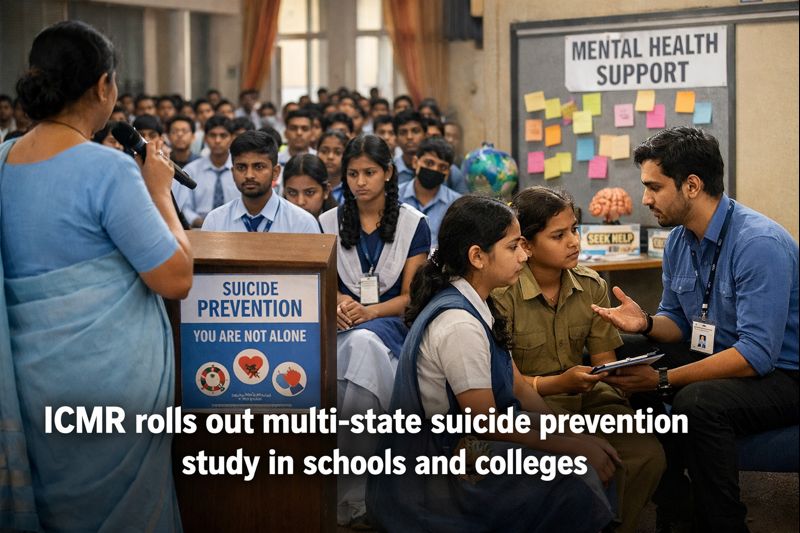
New Delhi, Dec 22: In a major push to address the growing mental health crisis among young Indians, the Indian Council of Medical Research (ICMR) has constituted a Suicide Prevention Study Group involving experts and institutions from eight states and Union Territories, with a focus on taking suicide prevention beyond helplines and into classrooms and college campuses.
The initiative aims to develop a scalable, evidence-based intervention model to reduce suicidal behaviour among students by directly addressing key risk factors such as high perceived stress and depressive symptoms, while simultaneously strengthening help-seeking behaviour.
The multi-state study will be implemented across Andaman and Nicobar Islands, Arunachal Pradesh, Assam, Delhi, Karnataka, Kerala, Maharashtra and Rajasthan. It will target students from Classes 9 to 12, as well as those enrolled in undergraduate and postgraduate courses, excluding doctoral programmes. Interventions will span a wide range of government, aided, tribal-aided and private educational institutions, with districts selected based on reported suicide rates in consultation with state health and education departments.
Oversight for the project will be provided by leading academic and medical institutions, including NIMHANS in Bengaluru, Tata Institute of Social Sciences in Mumbai, AIIMS centres in Guwahati and Jodhpur, and Government Medical College, Kollam. Data collection is expected to conclude by December 2026, with results anticipated by March 2027.
The study comes amid mounting concern over India’s suicide burden. India accounts for the highest share of global suicide deaths, with a national suicide rate of 12.69. Students account for 7.6% of suicide deaths, and since the COVID-19 pandemic, socio-environmental and psychological risk factors among students have increased by 25%, while protective factors have declined. The 15–24 age group remains the most vulnerable, driven by a complex mix of biological, psychological and socio-environmental stressors. According to NCRB data for 2023, 1.71 lakh suicides were reported in India in a single year, with youth forming the largest share of victims.
According to the study protocol, the intervention model will integrate systematic risk assessment, mental health awareness and sensitisation, capacity building for staff and students, and structured referral and postvention mechanisms. Suicide risk will be assessed using indicators such as perceived stress and depressive symptoms. A key component is gatekeeper training to equip teachers, hostel wardens, support staff and students to identify distress, provide initial support and guide at-risk peers to professional help.
The programme also envisages the formation of campus crisis response teams, the adoption of standardised first-response protocols, and the development of evidence-based self-help modules aligned with WHO suicide prevention strategies.
Designed as a dynamic initiative, the project will undergo repeated cycles of implementation, evaluation and refinement. It will also assess the financial feasibility of embedding comprehensive mental health and wellbeing interventions within existing education and healthcare systems, with the aim of shifting India’s approach from crisis response to long-term prevention.
The study has identified significant systemic gaps, including lack of training, knowledge and confidence among teachers, a shortage of psychologists and mental health professionals in schools, and the limited effectiveness of guidelines without structured implementation and support. Researchers note that many existing protocols fail to reflect the realities of severe crises faced by educational institutions.
“The programme aims to evolve a scalable, evidence-based model to curb suicidal behaviour among students by directly addressing key risk factors such as high perceived stress and depressive symptoms, while simultaneously strengthening help-seeking behaviour,” the investigators said, underscoring the urgency of building accessible, school- and college-based mental health systems across the country.
