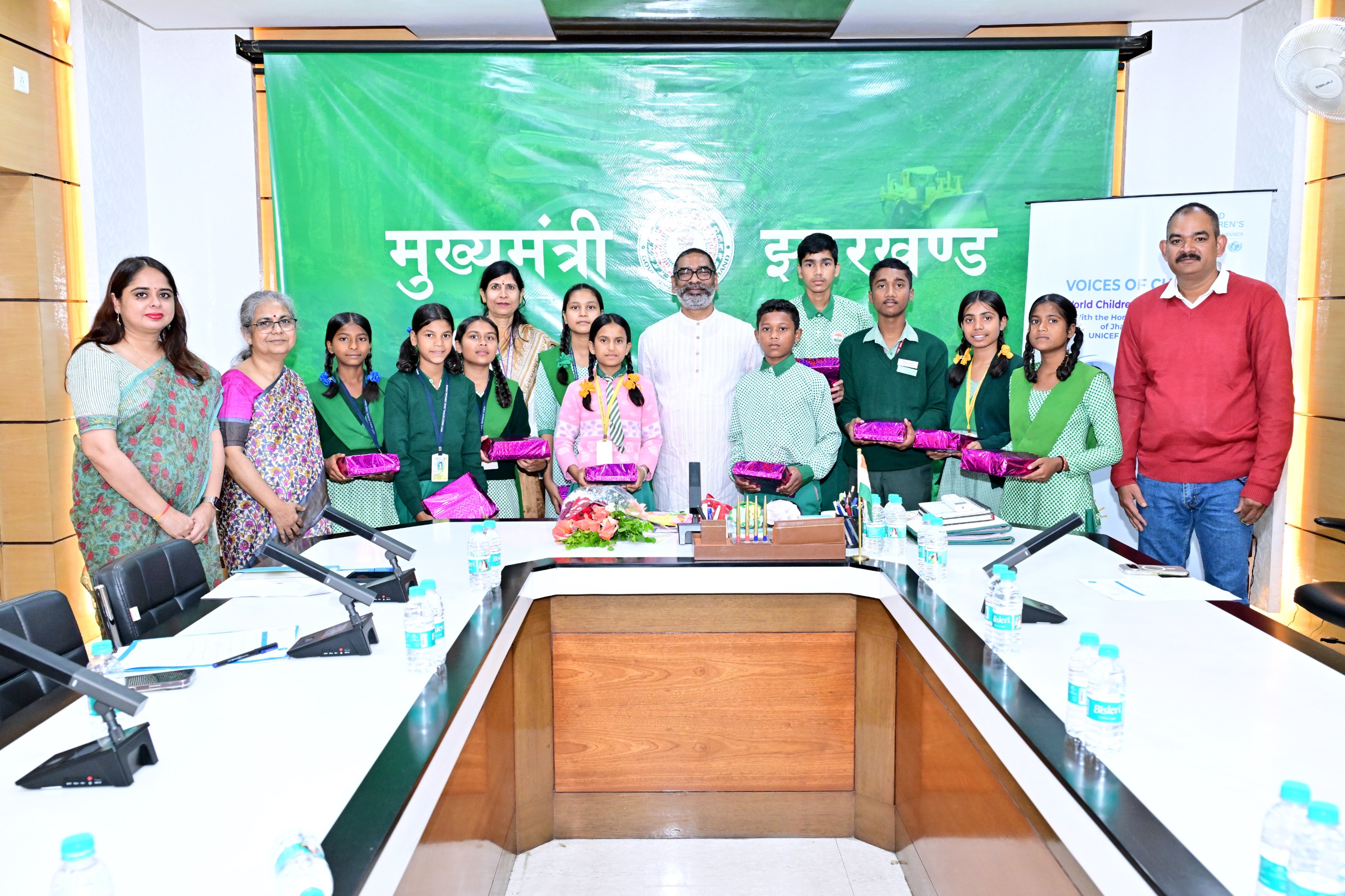
Ranchi, Nov 20: Jharkhand Chief Minister Hemant Soren on Friday said children must be heard and involved in decisions affecting their lives, asserting that they are the most vital link to the state’s future.
Interacting with 10 UNICEF child journalists at his residential office on Kanke Road here on the occasion of World Children’s Day, Soren said the state government was committed to creating a child-friendly environment where every child gets equal opportunities to learn, express views, remain safe and realise their aspirations.
The child journalists apprised the Chief Minister of their initiatives to prevent child marriage and child labour, bring school dropouts back into mainstream education and create awareness about menstrual hygiene, childhood non-communicable diseases, healthy eating habits and climate change.
Responding to their queries, Soren said the government was continuously working to improve the quality of school education. A formal review would be undertaken to explore ways to keep teachers away from non-academic duties, allowing them to focus on teaching, he said.
The government has also decided to provide sports equipment to government schools and construct playgrounds at the panchayat level to encourage students interested in sports, he added.
Highlighting the Mukhyamantri Utkrisht Vidyalaya initiative, Soren said the programme was bringing positive changes in the academic standards of students. Libraries were also being constructed at the district level to promote education and reading habits.
The Chief Minister said government officials had been instructed to spend a day in schools under their respective jurisdictions and interact with students to understand their concerns.
Emphasising the need to prevent child marriage, he said it was not only a legal offence but also harmful to the well-being of children. No child should be married before attaining the legally prescribed age, he added.
Soren also highlighted ongoing menstrual hygiene awareness campaigns in schools and the provision of sanitary pads to girls and women.
Praising the confidence and awareness demonstrated by the child journalists, he said their ability to articulate their rights and raise issues affecting their communities reflected their potential to become future leaders.
He said the concerns raised by children offered the government valuable insights into whether welfare schemes and development initiatives were reaching their intended beneficiaries.
Commending UNICEF’s work, Soren said programmes that encouraged children to speak about their experiences and aspirations could bring visible changes in society.
UNICEF Jharkhand Chief Dr Kaninika Mitra said children should not be viewed merely as beneficiaries of government schemes but should be actively involved in decisions affecting their lives.
Drawing on UNICEF’s 80 years of experience working with children, she said the child journalist programme demonstrated how access to information, confidence and leadership opportunities could enable children to bring about wider social change.
Aastha Alang, Communication, Advocacy and Partnership Specialist at UNICEF Jharkhand, said geographical constraints, poverty and gender inequality continued to impede the development of many children. Investments in children were essential for building a better future for society, she added.
The 10 child journalists who participated in the interaction represented government schools in Ranchi district, including Kanke, Ormanjhi, Ratu and other areas. Representatives of NBJK, including Sushmita Bhattacharya and Vivek Kumar, were also present.