

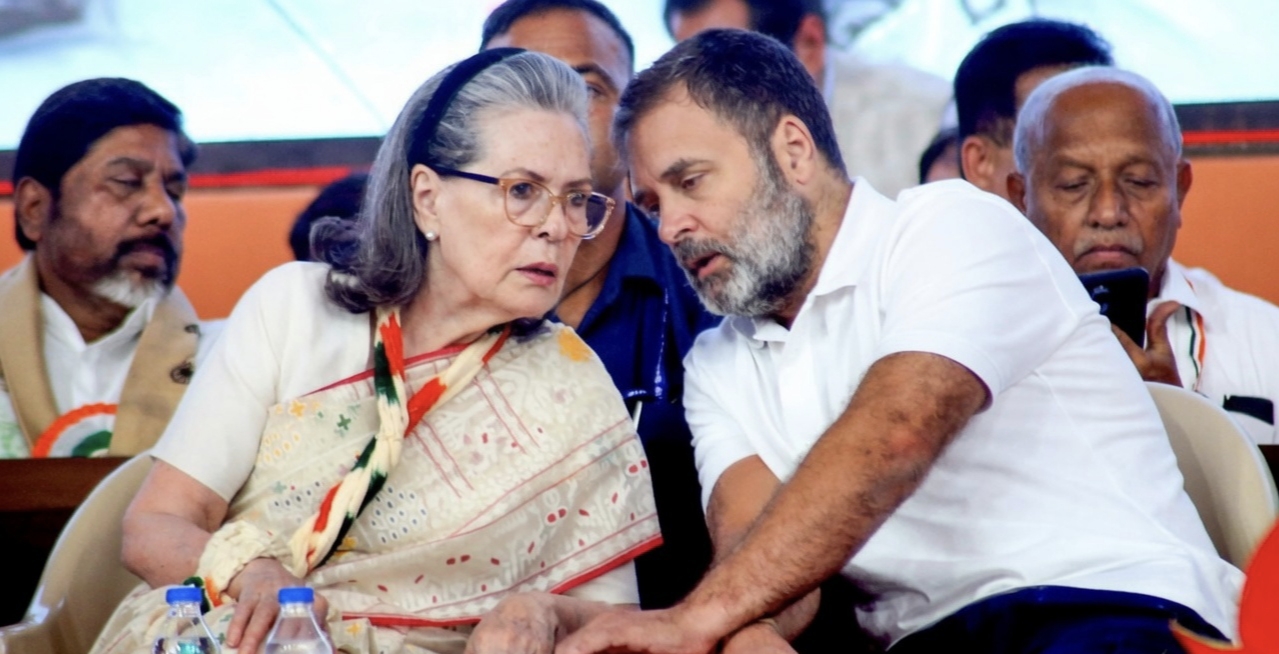
New Delhi, July 27: The Delhi High Court on Monday granted Congress leaders Sonia Gandhi and Rahul Gandhi, along with other respondents, three weeks to file their replies to the Enforcement Directorate’s (ED) petition challenging a trial court order that refused to take cognisance of the agency’s prosecution complaint in the National Herald-linked money laundering case.
Justice Manoj Jain posted the matter for hearing on September 10, observing that the court’s board was heavily listed and arguments could not be heard on Monday.
Apart from Sonia Gandhi and Rahul Gandhi, notices have also been issued to Congress leaders Suman Dubey and Sam Pitroda, as well as Young Indian, Dotex Merchandise Pvt. Ltd., and Sunil Bhandari.
Appearing for the ED, Solicitor General Tushar Mehta argued that the trial court had committed a serious legal error in refusing to take cognisance of the prosecution complaint. He told the court that the issue involved a pure question of law and that respondents had already been granted sufficient time to file their replies.
Senior counsel representing the respondents sought additional time to respond, following which the High Court directed that replies, if not already filed, be submitted within three weeks.
The Enforcement Directorate has accused Sonia Gandhi, Rahul Gandhi, late Congress leaders Motilal Vora and Oscar Fernandes, along with Suman Dubey, Sam Pitroda and Young Indian, of conspiracy and money laundering under the Prevention of Money Laundering Act (PMLA).
According to the ED, properties worth nearly ₹2,000 crore belonging to Associated Journals Limited (AJL), the publisher of the National Herald newspaper, were allegedly acquired through Young Indian after the company took over AJL in exchange for a ₹90 crore loan. The agency has alleged that Sonia Gandhi and Rahul Gandhi collectively held a 76 per cent stake in Young Indian.
The case reached the High Court after the trial court declined to take cognisance of the ED’s complaint, holding that the investigation and prosecution under the PMLA were not maintainable without an FIR being registered for the scheduled offence. The trial court observed that the ED’s investigation originated from a private complaint rather than a police FIR.
Challenging that finding, the ED argued that the trial court’s interpretation was legally flawed and could have far-reaching consequences. The agency contended that a prosecution under the PMLA can proceed even when the scheduled offence arises from a private complaint before a competent court and not necessarily from an FIR registered by a law enforcement agency.
The ED further submitted that cognisance taken by a magistrate on a private complaint stands on a stronger legal footing than a police FIR, as courts retain the power to reject cognisance even after a chargesheet is filed following an FIR.
The High Court will now hear detailed arguments on September 10, when it takes up the ED’s challenge to the trial court’s refusal to proceed with the money laundering complaint in the National Herald case.
