

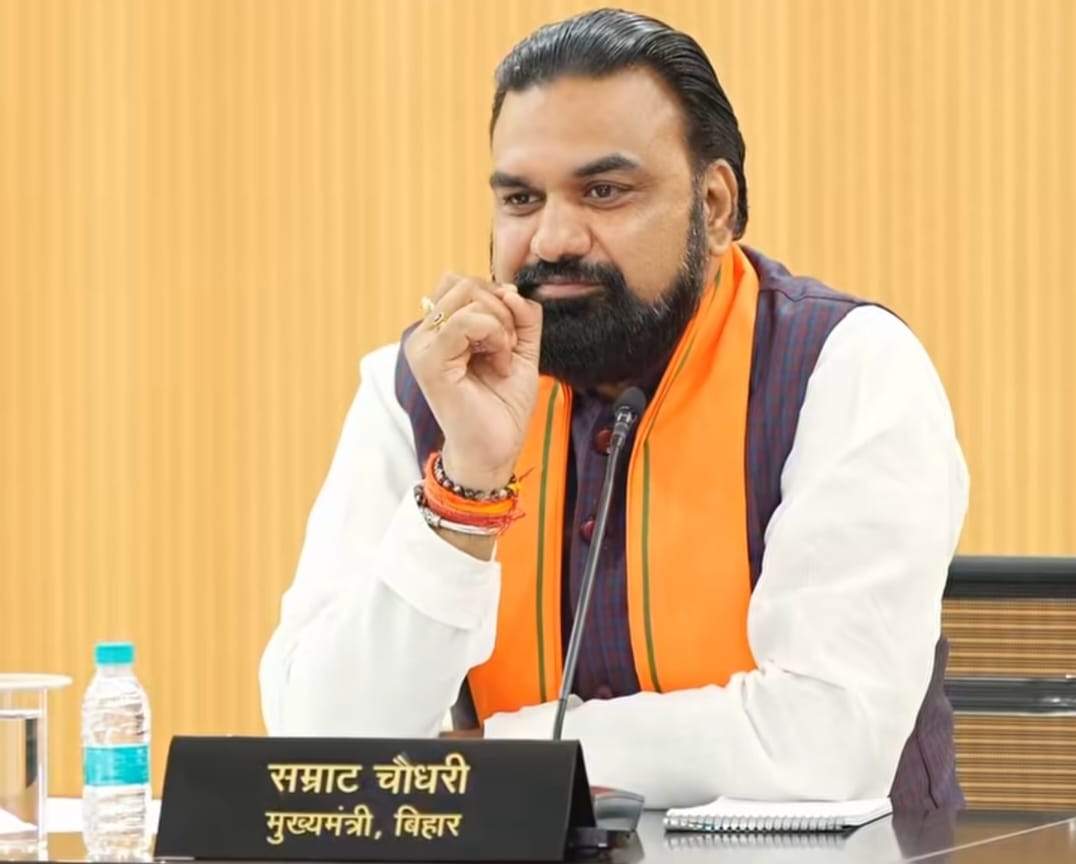
Patna, Aug 18: Seeking to address student grievances before they escalate into organised protests, the Bihar government has launched a time-bound complaint redressal mechanism under which unresolved student complaints could trigger automatic escalation to the Chief Minister’s Office and action against officials responsible for delays.
Chief Minister Samrat Choudhary launched the Vidyarthi Sahayog Portal on August 17, describing it as a single-window platform where students can register complaints related to academic issues, hostel facilities and other educational concerns.
Students can submit grievances online or through a toll-free number, with the government assuring that their identities will remain confidential.
The most significant feature of the system is its strict timeline. The government has promised resolution within 30 days, along with written intimation to the student.
If no action is initiated within 10 days of a complaint being lodged, an automatic notice will be issued from the Chief Minister’s Office on the 11th day. Further notices will be sent on the 20th and 25th days if the matter remains unattended.
If a grievance is still unresolved after 30 days, action can be taken against the official responsible for the delay.
The initiative comes against the backdrop of recent student-led agitations in Delhi and neighbouring Jharkhand, where young people have taken to the streets over education, recruitment and examination-related issues.
The Bihar government’s approach is notably administrative: rather than waiting for grievances to turn into protests, it is attempting to create a formal channel through which complaints can be heard and escalated.
“The state has put itself on the clock,” reflecting the significance of the government’s 30-day commitment.
From August 25, the government will also begin the Vidyarthi Sahayog Abhiyan across schools and hostels. Under the initiative, the fourth Tuesday of every month will be observed as Vidyarthi Sahayog Camp, allowing students to raise problems and offer suggestions directly to authorities.
The government already had student-help camps, but the new portal is intended to formalise and expand that mechanism by combining digital complaints, confidentiality and time-bound escalation.
The initiative also forms part of a broader education push announced by Choudhary. The government has spoken of establishing 211 new degree colleges, expanding degree courses in 342 B.Ed colleges, developing modern model schools at 551 locations and providing greater access to live teacher support through mobile phones and laptops.
The government has also said that its Student Credit Card scheme has provided financial assistance worth nearly Rs 18,000 crore.
However, the credibility of the grievance mechanism will ultimately depend on implementation. A portal can receive complaints, but its effectiveness will be judged by whether officials actually resolve them within the promised timeframe and face accountability when they fail to do so.
“A portal can receive a million complaints; it cannot by itself make a negligent official diligent, a teacher competent, an examination secure or a university responsive.”
The broader political significance of the initiative lies in its attempt to intervene before student dissatisfaction becomes collective action. “The idea is not to wait for a complaint to become a movement,” the approach suggests.
“Protest is, at its simplest, a demand to be heard,” and the grievance mechanism seeks to institutionalise that hearing before students feel compelled to take their demands to the streets.
The ultimate test, therefore, will not be the number of complaints registered but whether students develop confidence that filing a complaint can actually produce results.
“Young people are no longer content merely to be described as the country’s future. They want to know what is being done about their present.”
