

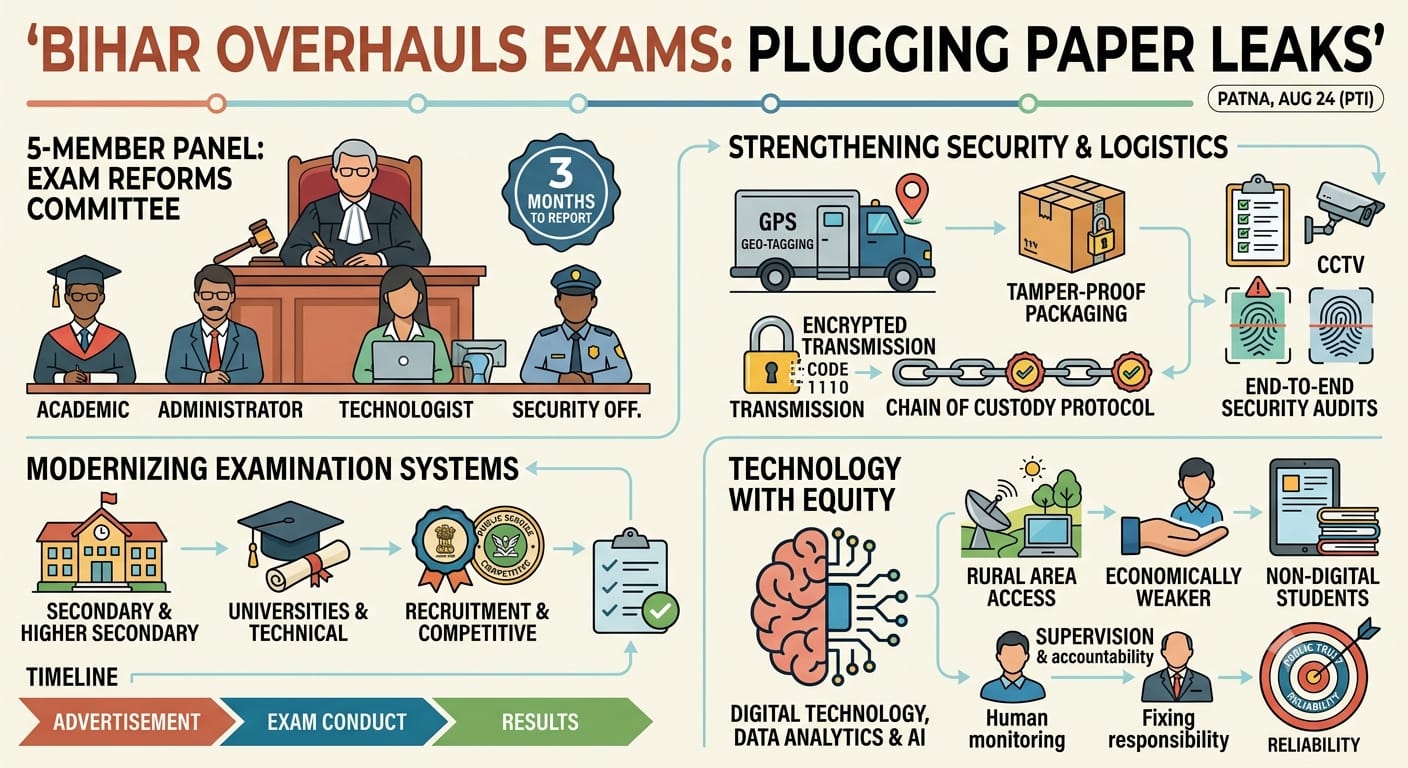
Patna, Aug 24: The Bihar government has decided to constitute a five-member expert committee headed by a serving or retired judge to recommend comprehensive reforms in the state’s examination system and strengthen measures against paper leaks and other malpractices.
The General Administration Department (GAD), under Chief Minister Samrat Choudhary, issued a notification constituting the Expert Committee on Examination Reforms, giving it three months from the date of formation to submit its report.
The committee will review examination systems covering secondary and higher secondary education, universities, professional and technical courses, entrance and eligibility tests, and recruitment and competitive examinations.
Its mandate includes reviewing the institutional structure, infrastructure and responsibilities of examination boards, commissions, universities, recruitment agencies and district administrations.
The panel will also recommend maximum timelines for each stage of the examination process, from issuing advertisements and conducting examinations to declaring results and completing re-evaluation.
A major focus will be on strengthening question-paper security. The committee will review question-paper setting, including multi-level setting and moderation, and undertake “end-to-end security audits” covering biometric authentication, CCTV surveillance, deployment of invigilators, collection and transportation of answer books, secure storage, scanning, evaluation and result processing.
The panel will also prescribe a clear “chain of custody protocol” for question papers and answer books. Measures such as tamper-proof packaging, encrypted transmission and geo-tagging or geo-fencing will be considered to prevent unauthorised access and tampering.
The government said the reforms are aimed at preventing paper leaks, impersonation, cheating, mass copying, manipulation at examination centres, tampering with answer books, unauthorised access to examination data and manipulation of results.
The committee will also examine the use of digital technology, data analytics, artificial intelligence and cybersecurity tools, while ensuring human supervision and data security.
The government has stressed that technological reforms should not create additional difficulties for students from rural areas, economically weaker sections or socially deprived backgrounds, or for those who are not familiar with digital technology.
The panel will also focus on ensuring that examinations are conducted within stipulated timelines and results are declared on time, with accountability fixed at every stage.
According to the notification, the committee will review the existing examination framework and recommend “comprehensive reforms across state examination boards, commissions, universities, and recruitment agencies.”
It will also suggest mechanisms for “fixing accountability for failures at different stages of the examination system.”
The government said the broader objective is to “strengthen the reliability, integrity, and public trust of examinations conducted by the State and its examination bodies.”
