

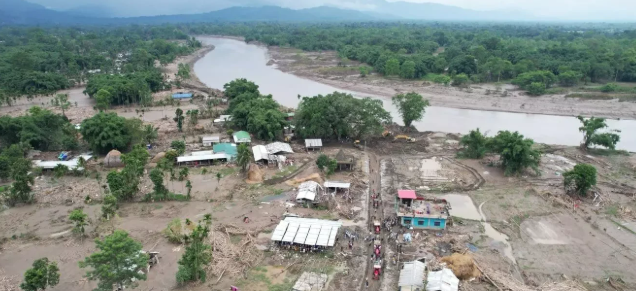
Guwahati, Aug 14: Human-driven changes to land and river systems significantly increased the impact of the devastating floods in eastern Assam this year, while there is no clear evidence that climate change intensified or increased the likelihood of the rainfall that triggered the disaster, according to an international scientific analysis.
The study by World Weather Attribution (WWA), a global collaboration of climate scientists, examined rainfall patterns and climate data linked to flooding in eastern Assam and adjoining hill catchments in Nagaland and Arunachal Pradesh.
The flooding between late June and early August severely affected districts including Sivasagar, Charaideo and Jorhat. At least 103 people were reported dead, while large numbers of residents were displaced and forced to seek shelter in relief camps.
Researchers analysed historical weather observations and climate-model simulations to determine whether global warming had influenced the rainfall associated with the floods.
The analysis found that the rainfall was broadly within the historical range for the region and did not show a clear climate-change-related trend in intensity or probability.
However, scientists cautioned that limited weather-station coverage and difficulties in modelling weather systems over mountainous terrain introduce uncertainty into the findings.
The study identified several human factors that increased flood vulnerability, including unplanned urban development, deforestation, wetland loss and riverbank erosion.
Researchers said the degradation of natural drainage systems allowed floodwater to accumulate and increased the impact on downstream communities. They also raised concerns about excessive reliance on hard infrastructure such as concrete embankments.
According to the study, embankments can restrict natural drainage and trap sediment, potentially raising riverbeds and increasing the consequences of breaches during severe flooding. The researchers also highlighted the historical vulnerability of communities living along riverbanks and on chars, or riverine sandbars. Repeated displacement and limited access to safer land have left many low-income agricultural families exposed to recurring floods.
The study called for a broader approach to flood management, including restoration of wetlands and floodplains, protection of natural drainage systems and improved land-use planning. It also recommended strengthening localised early-warning systems and anticipatory disaster-management measures so that vulnerable communities can be moved to safety before floodwaters arrive.
Scientists stressed that the absence of a detectable climate-change signal in this particular rainfall event should not be interpreted as evidence that Assam faces no future climate risk.
With global temperatures continuing to rise, changes in South Asian monsoon behaviour could affect rainfall patterns and extreme-weather risks in the years ahead. The researchers said improving flood resilience will therefore require a combination of environmental protection, better infrastructure planning, early warnings and community preparedness rather than dependence on engineering solutions alone.
The findings underline that the severity of a flood depends not only on the amount of rainfall but also on how land, rivers and vulnerable settlements are managed.
