

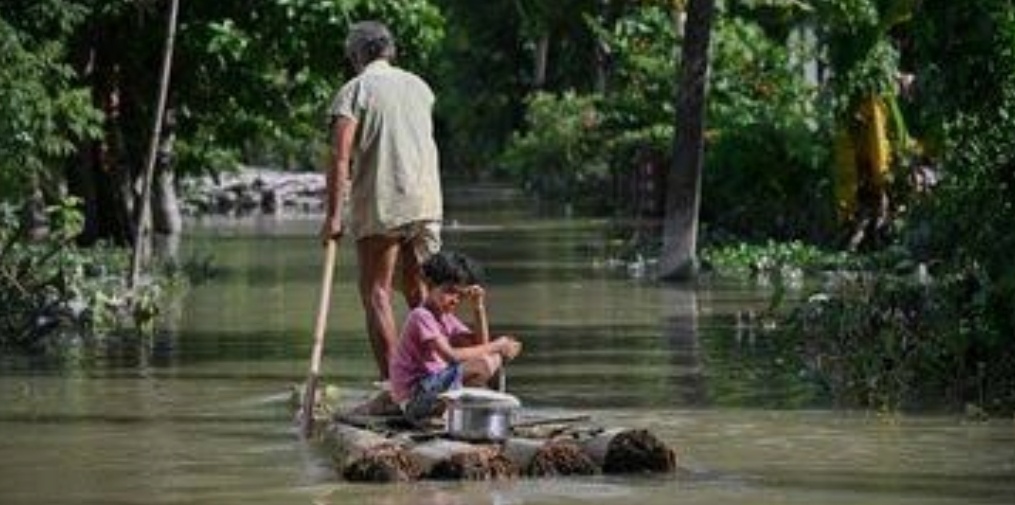
Guwahati, Aug 12: Assam Chief Minister Himanta Biswa Sarma on Wednesday said the state would strengthen flood-control measures in Upper Assam and focus greater attention on tributaries of the Brahmaputra following severe flooding in parts of the region.
Sarma said the recent floods had highlighted vulnerabilities in districts where major flood-control interventions had previously been limited. He indicated that the government’s future strategy would place greater emphasis on rivers and tributaries that have contributed to flooding in Upper Assam.
The Chief Minister specifically referred to the Dikhow and Dorika tributaries, saying they played a significant role in the flooding witnessed in Sivasagar and surrounding areas.He directed the Water Resources Department to concentrate on such tributaries and said the government would be better prepared in the affected districts in the coming years.Sarma also said flood-control measures had helped reduce the impact in several areas that traditionally face inundation.
He cited Nalbari, Baksa, Bajali, Biswanath and Bihpuria as districts where significant flooding was not reported this time, while damage in Dhemaji and Lakhimpur remained relatively limited.
However, the latest deluge exposed new vulnerabilities in Sivasagar and Charaideo, where major flood-control interventions had not been undertaken to the same extent because such severe flooding had not been common in the past.The government has deployed high-capacity de-watering pumps in affected areas.
In Sivasagar, the equipment is removing around 1.35 lakh litres of water per hour to clear residual floodwater.
According to the Assam State Disaster Management Authority, 49 embankments were breached and another 104 were affected during the floods. Thirty-six bridges and 1,187 roads were also damaged.
ASDMA Chief Executive Officer Sweety Changsan said the flood situation had improved, but more than 1.12 lakh people across seven districts and 25 revenue circles were still affected. Forty-seven relief camps were operational, providing shelter to nearly 8,000 people.
Sivasagar recorded the highest number of deaths at 50, followed by Charaideo with 22, Jorhat with nine and Golaghat with eight, according to ASDMA.Rescue agencies, including the National Disaster Response Force, State Disaster Response Force, Indian Army and Civil Defence volunteers, rescued more than 21,700 people during the emergency.
The government is now shifting its focus from immediate relief operations towards strengthening preparedness in areas identified as emerging flood hotspots.Sarma also suggested that flood patterns along the Brahmaputra could change in the coming years, citing major reservoir and hydropower projects in neighbouring regions.
He said this made it even more important for the state to prepare for flooding originating from the Brahmaputra’s tributaries.The proposed strategy marks a shift towards a more localised approach to flood management, with greater emphasis on tributary systems, embankment protection, drainage and preparedness in vulnerable districts.
