

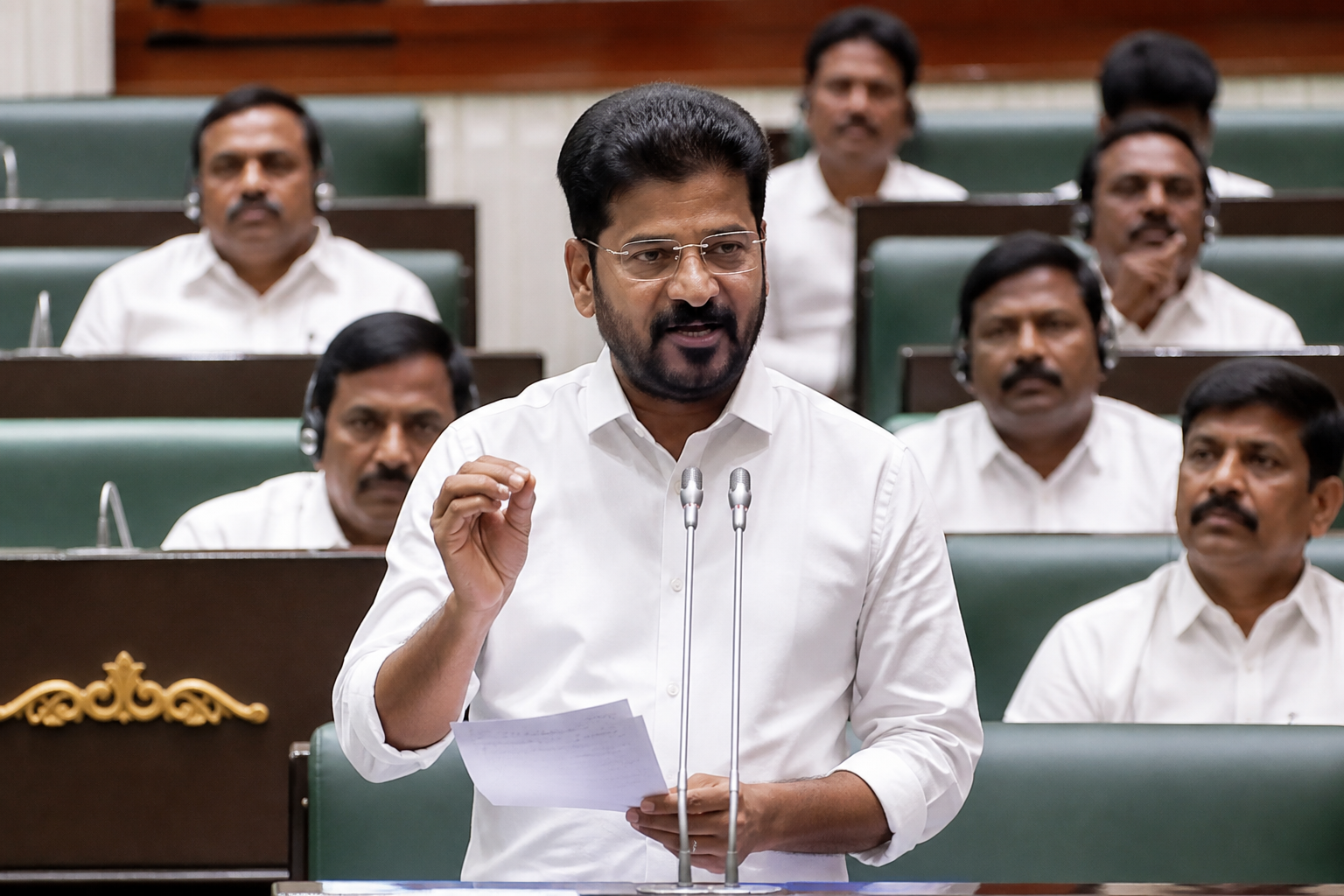
Hyderabad, Sept 17: Telangana Chief Minister A Revanth Reddy on Wednesday said around 98.31 lakh acres of land have to remain on the prohibited properties list under Section 22A of the Registration Act, while the dispute involving private land is limited to about 3.77 lakh acres.
Continuing the discussion on issues related to Section 22A in the Assembly, Reddy said the total 98,31,320 acres included assignment lands, forest lands, State and Central government lands, endowment and Waqf properties, besides lands attached by agencies such as the Enforcement Directorate and the CBI.
“Nearly 98,31,320 acres have to be in the prohibited (properties) list,” Reddy said.
He asserted that legally prohibited land should not be removed from the list, saying, “Not even an inch can be removed from the list.”
Reddy said removing such land could lead to injustice and create opportunities for encroachment of forest land.
“The dispute between the government and private entities is pertaining to 3,72,930 acres of private land,” he said, adding that claims had been made that around one crore acres were included in the prohibited properties list.
The Chief Minister also questioned the financial management of the Dharani land records portal, saying its cost was initially around Rs 58 crore for five years but subsequently increased to nearly Rs 1,300 crore.
He said the previous government should explain the increase in expenditure and other decisions related to the portal.
Reddy said the Congress government introduced Bhu Bharati in 2025 to correct land records and establish a mechanism for resolving land disputes.
He said the government’s approach would be to protect the nearly 98 lakh acres that legally have to remain under the prohibited list while finding solutions for genuine private landowners affected by Section 22A-related disputes.The Assembly also took up discussions on the effects of El Nino and remedial measures. Questions were scheduled on career guidance cells for minority students, improvement of public transport in the CURE region and expansion of horticulture crops in the state.
