

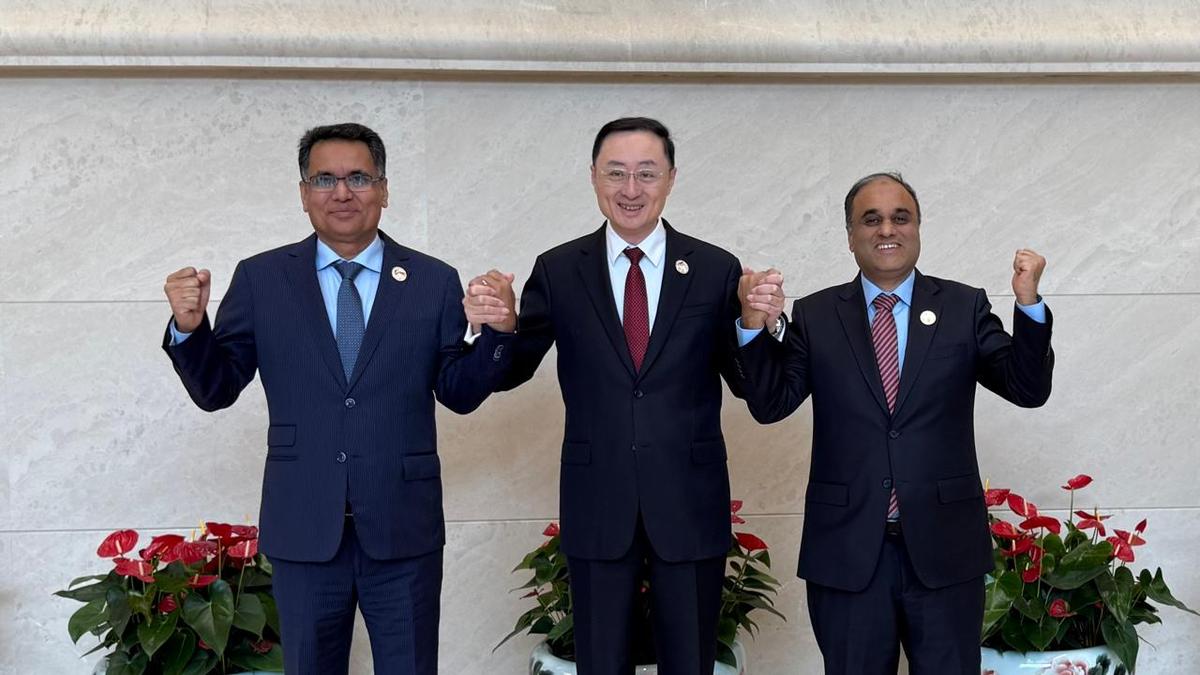
Kunming, China, June 21: Bangladesh, China, and Pakistan held their inaugural trilateral foreign office-level talks in the Chinese city of Kunming on Thursday, signalling a potential new phase of diplomatic coordination among the three neighbours of India.
The consultations were led by Chinese Vice Foreign Minister Sun Weidong, Bangladesh’s Acting Foreign Secretary Ruhul Alam Siddique, and Pakistan’s Additional Foreign Secretary Imran Ahmed Siddiqui. Pakistan’s Foreign Secretary Amna Baloch also joined the discussions via video link, according to a statement by Pakistan’s Ministry of Foreign Affairs.
“This mechanism reflects our common aspiration for people-centric development,” Baloch said, adding that Pakistan seeks deeper engagement between China and South Asian countries.
The trilateral meeting came in the backdrop of rising geopolitical tensions in the region following India’s Operation Sindoor, which escalated hostilities between New Delhi and Islamabad, and amid growing concerns in Delhi over Dhaka’s diplomatic outreach to Beijing.
The meeting follows the March visit of Bangladesh’s interim Chief Adviser Prof. Mohammed Yunus to China, during which he pitched Bangladesh as a strategic gateway to northeast India. He referred to Bangladesh as the “only guardian of the ocean,” a comment that Indian officials later cited as a factor behind new trade restrictions imposed on Bangladeshi textile and other goods entering India’s northeast. The Indian order came into effect on May 17.
The trilateral engagement also coincided with a separate Bangladesh–U.S. dialogue in Washington on Thursday, where Bangladesh’s National Security Adviser Dr. Khalilur Rahman met U.S. Deputy Secretary of State Christopher Landau. Discussions focused on the Rohingya refugee crisis, U.S.–Bangladesh tariff negotiations, democratic transition in Dhaka, and developments in South Asia.
The Rohingya issue has gained renewed diplomatic attention, particularly amid recent U.S. humanitarian activity near Bangladesh’s Cox’s Bazar and growing interest in the strategic Rakhine–Chin–Sagaing corridor in western Myanmar. Dr. Rahman has advocated for a humanitarian corridor to Rakhine province, a proposal that intersects with the interests of India, China, and the United States.
Analysts say the trilateral talks in Kunming, while largely symbolic, may indicate a subtle shift in regional alignments and could complicate South Asia’s already delicate strategic balance.