

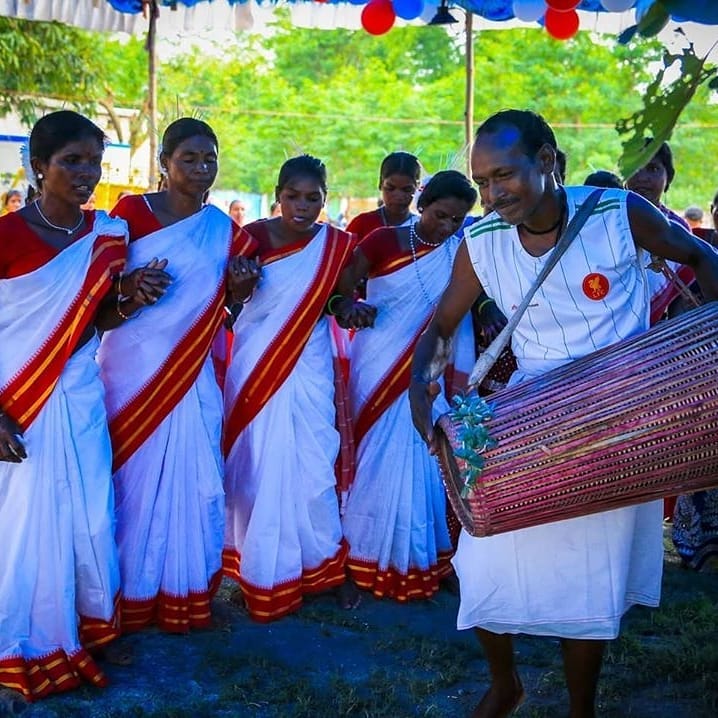
Ranchi, Sep 21: When the mandar begins to beat and a branch of the Karam tree is brought into the akhra, Jharkhand does more than celebrate a festival. It remembers a story, a way of life and a relationship with nature that has survived generations.
Karma Puja, celebrated on the 11th day of the bright fortnight of Bhadra, is observed by several Adivasi communities of Jharkhand, including the Oraon, Munda, Ho, Santhal and Kharia. At the heart of the festival is the Karam tree, regarded as sacred and associated with strength, prosperity and well being.
For filmmaker Bijju Toppo, Karma is best understood through the story of the seven brothers, an oral tradition passed down through generations. Speaking with Bodhi Wire, Toppo recalled how the brothers’ prosperity was disrupted after one of them disrespected the Karam branch. Their crops failed, their cattle suffered and their household lost its well being. Realising their mistake, the brothers sought forgiveness and restored the Karma ritual.
Toppo’s recollection goes beyond folklore. In his understanding, the story connects Karma with Dharma, actions with responsibility. The lesson is not simply that good deeds bring rewards, but that human beings have responsibilities towards nature, family and society, and that disturbing this balance has consequences.
The story also explains why Karma remains closely connected with agriculture. Research has linked the festival to the agricultural calendar and the dependence of tribal communities on forests, rainfall and fertile land.
That connection has acquired a new significance today. Jharkhand has changed rapidly, with migration, urbanisation and changing lifestyles reshaping traditional communities. Yet Karma continues to bring people together through fasting, singing, dancing and collective worship.
There is also an important distinction in the use of the word karma . PC Chaudhury a Buddhist scholar, points out that in Buddhism, karma or kamma is a foundational concept referring to intentional action, rather than a deity or festival to be worshipped.
There is no Karma Pooja in Buddhism. Karma itself is a foundational concept in Buddhism.
According to Chaudhury, Buddhist traditions work with karma through ethical conduct, mindfulness, repentance, meditation, merit making and other purification practices. He notes that practices such as Vajrasattva purification and formal repentance rites exist in particular Buddhist traditions.
This is distinct from Jharkhand’s Karma Puja, a nature and harvest linked Adivasi festival centred on the Karam tree, community well being and sibling bonds.
In a time of shrinking green spaces and growing concern over climate change, the festival’s environmental message has renewed relevance. The worship of a tree reflects an older understanding in which nature is not merely a resource but part of community life.
Perhaps that is Karma’s enduring strength. The costumes may change, young people may leave villages for cities and celebrations may find new forms, but when the Karam branch is raised and the mandar begins to play, an old memory comes alive again.
Karma remains a festival of action, responsibility, community and nature, and a reminder that culture survives when people continue to live it.
