

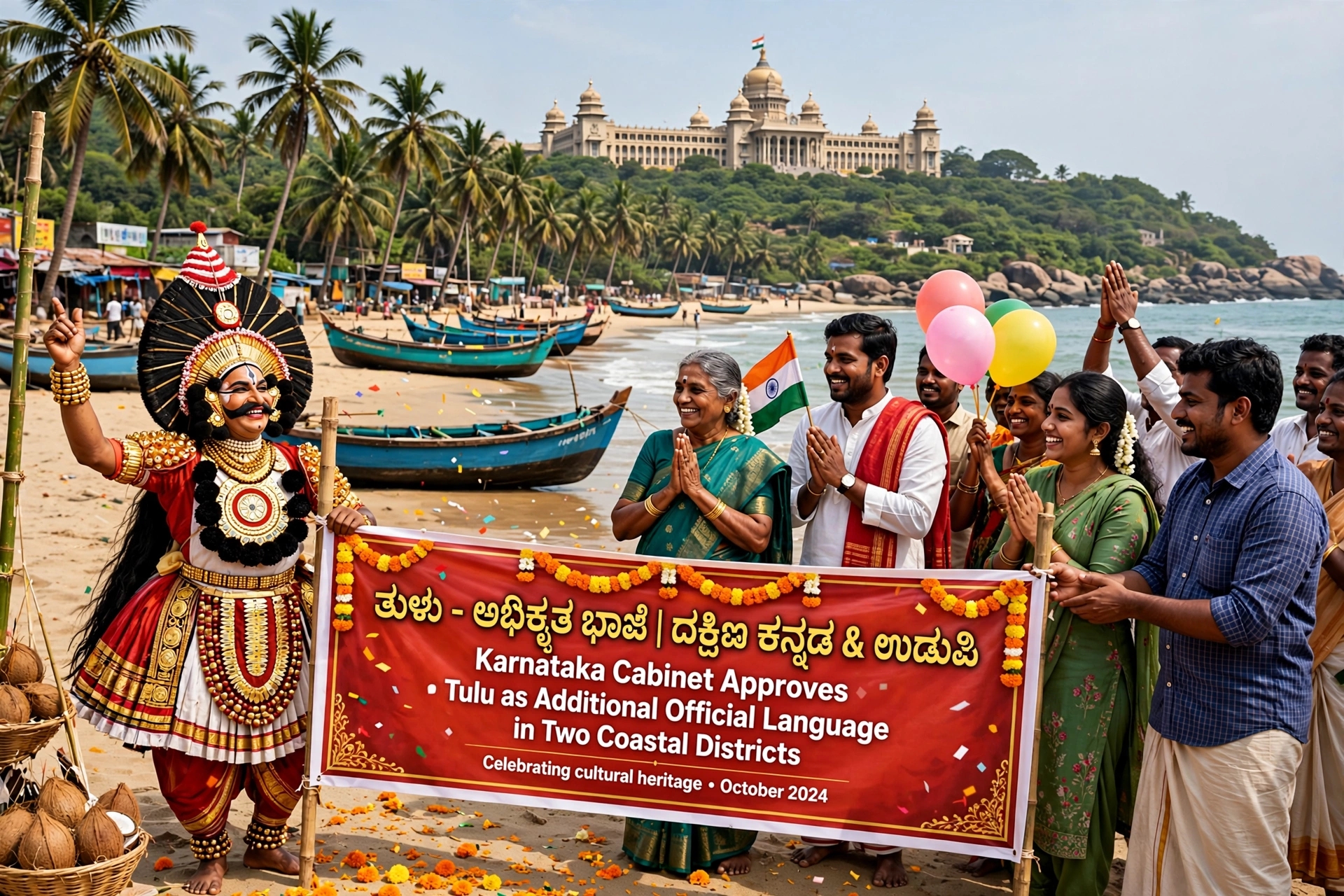
Mangaluru, September 18: The Karnataka Cabinet on Friday decided to accord Tulu the status of the state’s second additional official language in Dakshina Kannada and Udupi districts, meeting a long-pending demand from the coastal region.
Chief Minister D K Shivakumar, who announced the decision after a Cabinet meeting held in Mangaluru, said Tulu would be used for administrative purposes in the two districts. The respective district administrations will implement the decision.
The government will allocate Rs 82 lakh annually for translation, training and other language-use requirements, Shivakumar said.
“The demand to make Tulu an additional official language has been there for a long time in Dakshina Kannada and Udupi,” he said.
A committee headed by educationist M Mohan Alva had earlier examined the demand and submitted its recommendations.
The Cabinet also gave in-principle approval to upgrade Mangaluru Fisheries College into a Fisheries University, with the annual student intake proposed to be increased from 60 to 200. An initial Rs 11 crore is expected to be earmarked for the upgradation.
The Cabinet cleared expenditure and investment proposals worth Rs 32,611 crore, including around Rs 16,000 crore for rural roads, development and infrastructure.It also approved the Coastal-Malnad Karnataka Tourism Policy 2026, under which tourism projects in the coastal and Malnad regions will be treated as infrastructure projects. A 150-acre fisheries park and Rs 549 crore for a medical college at Puttur were also among the proposals cleared.
The government is also considering renaming Dakshina Kannada district as Mangaluru district. Shivakumar said a draft notification would be issued seeking suggestions and objections from the public for one month before a final decision is taken.
“Mangaluru has international recognition,” he said.
The Chief Minister said the government plans to hold Cabinet meetings at 10 to 12 locations across Karnataka over the next 15 months, depending on local requirements as well as financial and legal considerations.
“We do not do politics only on emotions. We work on people’s lives. Society cannot be built only on emotions. We must give people social and economic strength and help them build a better life,” Shivakumar said.
