

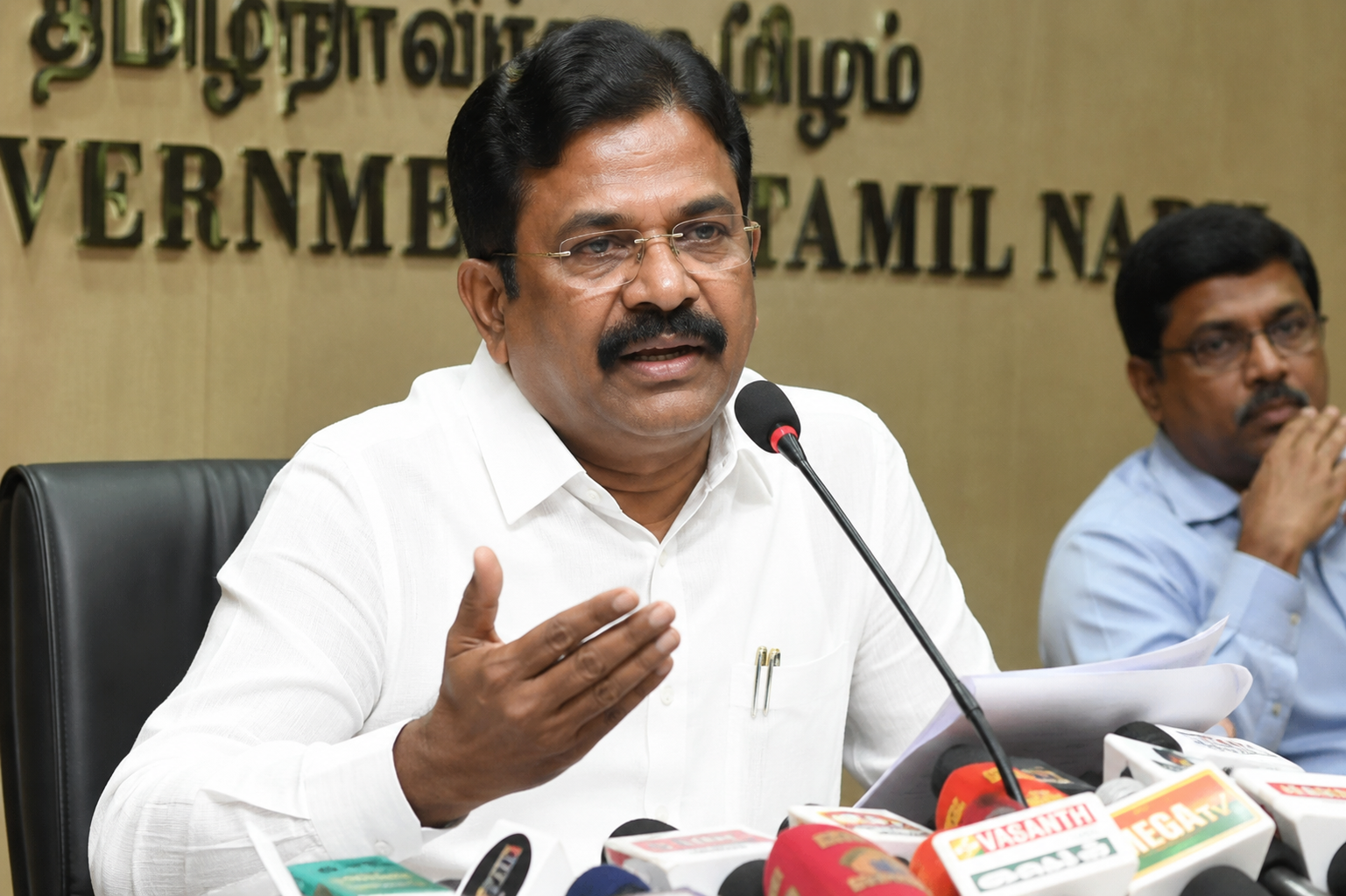
Chennai, Sep 18: Tamil Nadu School Education Minister Rajmohan on Friday said the state government would continue with its two-language policy and maintain its stand against providing land for establishing Jawahar Navodaya Vidyalayas (JNVs).
Responding to questions at a press conference at the Secretariat here, Rajmohan said Tamil Nadu followed a Tamil-English two-language policy and there would be no change in the government’s position.
“As far as Tamil Nadu is concerned, we follow the two-language policy, and we will continue to do so. There will be no change in our stand,” he said.
His remarks came a day after the Supreme Court gave the state three more months to identify suitable land in every district for setting up Navodaya schools and asked the Centre and the state to resolve their differences through discussions.
The apex court had also observed that Tamil Nadu needed to change its “mindset” that Hindi cannot be taught in the state, cautioning that “individual States cannot act like individual countries”.
Reacting to the observations, Rajmohan said the remarks made by Justice B V Nagarathna were not a final verdict.
“Justice B.V. Nagarathna has expressed her opinion. This is not the verdict. The judicial proceedings are under way,” he said.
The minister also rejected the suggestion that Tamil Nadu’s position was against Hindi.
“We are not against Hindi or any other language,” he said, adding that the state had been successfully running model schools and several students from these institutions had excelled in higher education.
Jawahar Navodaya Vidyalayas are co-educational residential schools run by the Navodaya Vidyalaya Samiti under the Union Ministry of Education. The schools primarily seek to provide quality residential education, particularly to talented students from rural areas.
The Navodaya scheme follows a three-language formula involving the regional language, Hindi and English. Tamil Nadu, however, has maintained a two-language policy of Tamil and English for decades.
The state has argued that the three-language structure followed by Navodaya schools is incompatible with its existing education and language policy. Its position also draws on the Tamil Nadu Tamil Learning Act, 2006.
The dispute has also raised broader questions concerning education policy, Centre-State relations and the respective powers of the Union and state governments.Tamil Nadu has remained the only state without a Jawahar Navodaya Vidyalaya, with successive governments maintaining opposition to the establishment of the schools.The issue has been under judicial consideration for several years. The Madras High Court had earlier held that establishing Navodaya schools would not violate the Tamil Nadu Tamil Learning Act and directed the state to facilitate their establishment.The Supreme Court has now asked the Union and Tamil Nadu governments to engage in discussions while the legal proceedings continue.
