

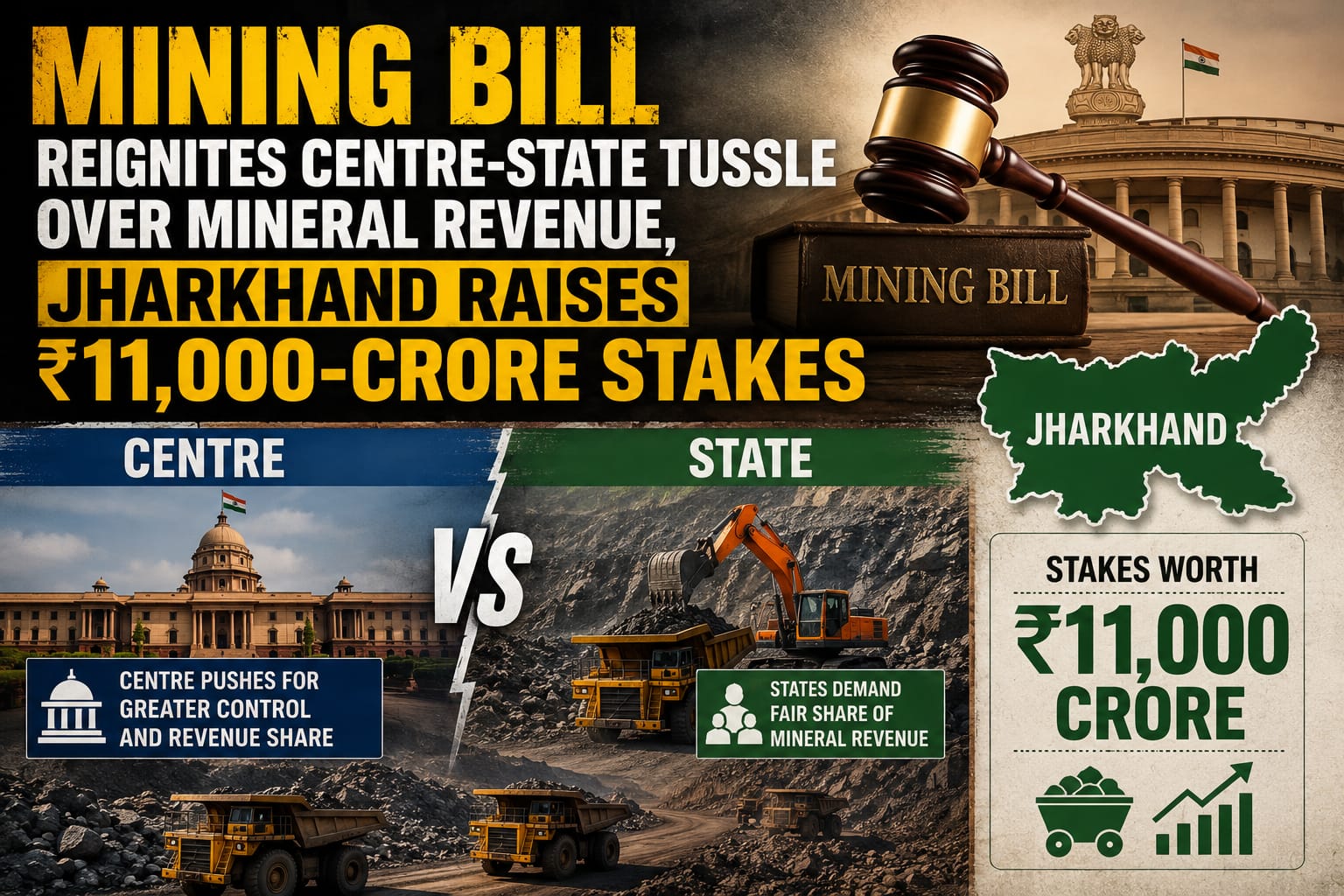
New Delhi/Ranchi, Aug 14: The passage of the Mines and Minerals (Development and Regulation) Amendment Bill, 2026, in both Houses of Parliament has revived a contentious Centre-state debate over the power to tax mineral resources and the revenues generated from mining.
The amendments seek to restrict states from imposing specified levies on mineral rights and mineral-bearing land, even as mineral-rich states have moved to tap additional revenue following the Supreme Court’s landmark 2024 ruling upholding their power to tax mineral rights.
The development has drawn strong opposition from Jharkhand Chief Minister Hemant Soren, who has threatened protests against the amendments, saying the move could significantly affect the state’s fiscal resources. Kerala Chief Minister V D Satheesan has also raised concerns over the implications for the federal structure.
The Indian Express reported that Jharkhand and Tamil Nadu have already introduced mineral-bearing land taxes, while Karnataka has proposed a similar levy. Jharkhand’s mineral-bearing land tax on iron ore was initially fixed at ₹100 per tonne and subsequently raised to ₹400 per tonne, while Tamil Nadu has imposed a ₹160-per-tonne levy on limestone.
A major point of contention is the Bill’s provision to extinguish unpaid or unrecovered dues arising from such levies imposed before the proposed law comes into force. Estimates cited in the Indian Express report put the outstanding dues across the mining sector at around ₹2 lakh crore.
The Centre, however, has argued that unchecked state-level levies could increase the cost of key minerals, with potential consequences for inflation and infrastructure costs.
The issue stems from the Supreme Court’s July 25, 2024 judgment, which upheld the legislative competence of states to impose taxes on mineral rights and mineral-bearing land. The ruling overturned the 1989 India Cement judgment, which had treated royalty as a tax and held that states lacked the power to tax mineral rights.
The 2024 judgment also waived interest and penalties on tax demands for the period preceding July 25, 2024, and permitted payment of eligible dues over 12 years from April 1, 2026.
According to figures cited in the Indian Express report, mineral and petroleum receipts accounted for around 41 per cent, or ₹1.36 lakh crore, of states’ own non-tax revenue in 2024-25. The dependence was considerably higher in mineral-rich states, with such revenues accounting for around 23 per cent of Odisha’s, 13 per cent of Jharkhand’s and 5 per cent of Chhattisgarh’s total revenue receipts.
Soren, in a letter to Prime Minister Narendra Modi, said mining revenue accounted for approximately 84.9 per cent of Jharkhand’s own non-tax revenue in 2024-25. He also said the state’s Mineral Bearing Land Cess was expected to generate approximately ₹11,000 crore annually.
“These figures demonstrate that mineral-related revenues are not marginal receipts but a critical component of the state’s fiscal capacity,” Soren said in the letter, according to the Indian Express report.
He warned that any substantial restriction on the revenue would directly affect Jharkhand’s ability to sustain developmental, welfare and social-security interventions.
The mining industry, meanwhile, has welcomed the proposed changes, arguing that multiple levies have increased uncertainty and the overall fiscal burden on mining companies.
Mining industry expert and former Federation of Indian Mineral Industries Director General B K Bhatia told the Indian Express that, apart from royalty and mandatory contributions to the District Mineral Foundation and National Mineral Exploration and Development Trust, companies also pay various other cesses.
“The mineral-bearing land tax was the biggest additional burden on the industry,” Bhatia said.
A senior Mines Ministry official said there are around 14 levies in the mineral sector and indicated that the Centre wants their cumulative burden to remain within a prescribed limit.
“All we are saying is all these levies together should not be beyond a certain percentage,” the official said, adding that the limit would be decided after consultations with states.
Experts have, however, cautioned that fiscal certainty for mining companies should not come at the expense of mineral-producing states.
Prabhat Ranjan, Senior Director at Nexdigma, said the issue should not be framed as a choice between competitive mining and state revenues.
“The outcome should not be viewed as a choice between competitive mining and state revenues,” Ranjan said, according to the Indian Express.
He called for reasonable and transparent safeguards, along with adequate consultation with mineral-producing states.
“The reform will only succeed if it reduces fiscal unpredictability for industry without leaving mining states inadequately compensated for the burdens they bear,” he said.
The proposed changes have therefore opened a fresh fault line in India’s fiscal federalism, with the Centre seeking to create greater certainty for the mining industry and mineral-rich states defending their right to raise resources from their natural wealth.
For Jharkhand in particular, the dispute has major fiscal implications given the state’s heavy dependence on mining-related revenue. The coming consultations between the Centre and mineral-producing states are likely to determine how the new framework balances investment certainty, mineral prices and states’ revenue rights.
