

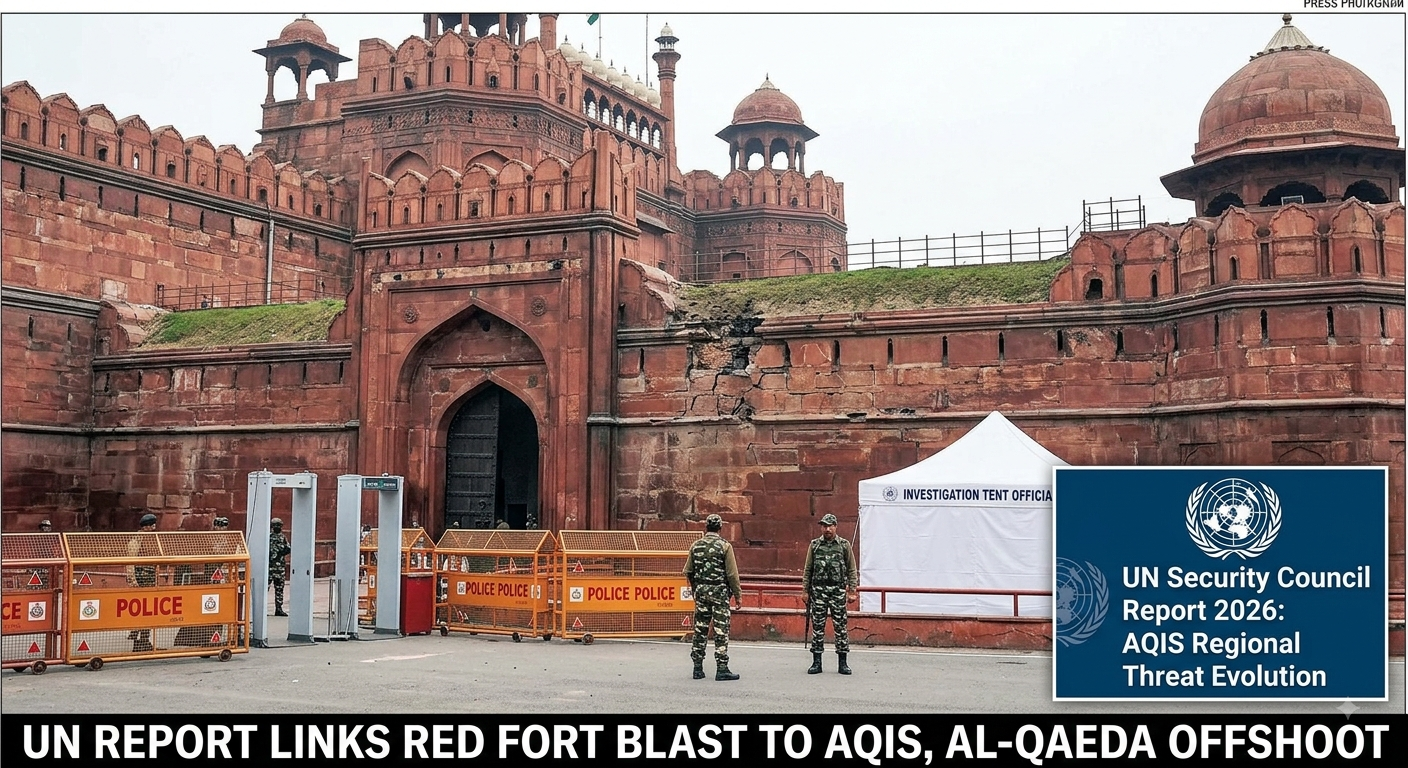
New Delhi, Aug 13 : The November 2025 blast near Delhi’s Red Fort that killed 15 people has been linked to Al-Qaeda in the Indian Subcontinent (AQIS) and its affiliate Ansar Ghazwat-ul-Hind (AGuH), according to a United Nations Security Council monitoring report released this week.
The report said AQIS has continued to evolve from a fragmented organisation into a regional terrorist entity, increasingly relying on small, separate cells rather than attempting to establish large militant formations.
The UN assessment also said the group had developed logistical and financial networks to support its operations.
The findings come against the backdrop of the investigation into the November 10, 2025 blast near the Red Fort in Delhi. The National Investigation Agency (NIA) has filed a 7,500-page chargesheet against 10 accused in the case, alleging links to AGuH, a designated affiliate of AQIS.
According to the investigation, the accused were involved in efforts to revive the AGuH network, with some of them, including medical professionals, allegedly having been radicalised and recruited into the module.
The blast occurred amid a wider investigation that led to the recovery of around 2,900 kg of explosives, including ammonium nitrate, from a location in Haryana’s Faridabad, around 50 km from Delhi.
Investigators have alleged that the Red Fort blast was carried out using triacetone triperoxide (TATP), a highly volatile explosive. The accused allegedly manufactured the explosive after procuring chemicals clandestinely and conducting repeated experiments.
Umar Mohammad, identified by investigators as the suicide bomber, allegedly detonated the explosive device after the arrest of two key members of the module, Dr Muzammil Shakeel and Dr Adil Rather, and the seizure of explosives.
The NIA has also alleged that the module was seeking to expand its network beyond Delhi and establish a wider presence in other major parts of the country.
UN flags Bangladesh
The UNSC monitoring body has specifically expressed concern that AQIS could seek to exploit Bangladesh to establish new terrorist cells.
The assessment is significant for India, which has repeatedly raised concerns over the emergence and expansion of extremist networks in neighbouring Bangladesh.
The report said AQIS’s evolving structure and regional networks could allow it to maintain operational capabilities despite fragmentation and counter-terrorism pressure.
Al-Qaeda, ISIL interest in chemical and biological weapons
The UN assessment also highlighted continuing concerns over the interest shown by Al-Qaeda and Islamic State (ISIL/Daesh) affiliates in developing chemical and biological weapons.
While the groups have so far been unable to overcome significant technical challenges associated with producing such weapons, the report noted that instructions for developing chemical and biological agents have circulated widely in online extremist communities.
It cited an edition of ISIL’s English-language Invade magazine published in February that contained instructions related to the development of botulinum toxin and cyanide.
AQIS and its affiliates were designated as terrorist organisations by India’s Union Home Ministry in 2018.
The latest UN assessment underscores concerns among international counter-terrorism agencies that AQIS and its affiliates are adapting their organisational structures and recruitment strategies to operate through smaller, decentralised networks across the region.
