

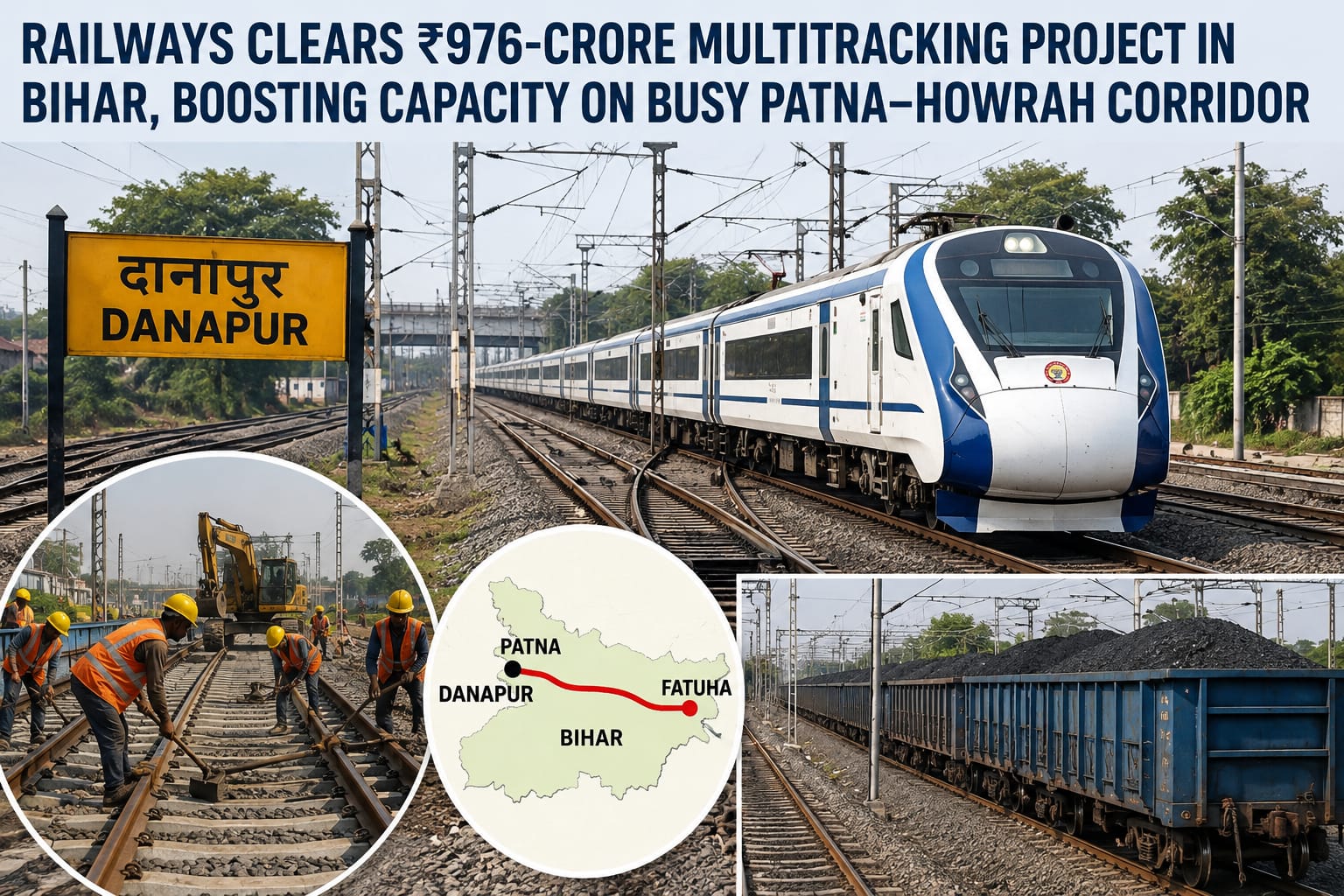
New Delhi, Aug. 1: Indian Railways has approved a ₹976-crore multitracking project for the 29-km Danapur–Fatuha section under the East Central Railway (ECR), a move aimed at easing congestion on the heavily used Patna rail corridor and significantly enhancing passenger and freight movement.
The project involves laying third and fourth railway lines between Danapur and Patna, constructing a third line between Rajendra Nagar and Patna Saheb, and adding third and fourth lines between Patna Saheb and Fatuha. The additional infrastructure is expected to reduce congestion, minimise delays and improve train punctuality across the Patna region.
According to Indian Railways, the upgraded section will enable the operation of 22 additional passenger trains and 18 additional freight trains every day in its first year. The project will also increase freight handling capacity by 5.2 million tonnes per annum (MTPA).
The sanctioned work forms part of the ongoing quadrupling of the Delhi–Deen Dayal Upadhyaya Junction–Patna–Kiul–Bhagalpur–Khana–Howrah route, one of the country’s key rail corridors. The route has been identified under Indian Railways’ Energy, Mineral and Cement Corridor, aimed at strengthening logistics for core industries.
The enhanced rail infrastructure is also expected to support the upcoming 2,120 MW thermal power plant at Chausa in Bihar’s Buxar district, which will depend on rail transport for the movement of bulk inputs.
Highlighting the significance of the project, Indian Railways said, “The project will decongest one of the busiest stretches on the Patna rail corridor and create room for a large increase in both passenger and freight services.”
It further noted that “The additional lines will ease congestion, minimise delays, and improve punctuality across the Patna region.”
The Railways said the approval underscores its commitment to expanding infrastructure on high-density routes.
“The approval reaffirms the commitment of Indian Railways to expanding capacity on high-density routes, strengthening logistics for energy and industry, and supporting the socio-economic development of Bihar,” it said.
Meanwhile, Indian Railways also highlighted improvements in operational safety, stating that consequential train accidents have declined by 88 per cent over the past 12 years—from 135 in 2014-15 to 16 in 2025-26. Only two consequential train accidents have been recorded till June in the current financial year (2026-27), it added.
