

New Delhi, July 9: The National Council of Educational Research and Training (NCERT) has released a revised edition of its Class 8 Social Science textbook, introducing changes to chapters on India’s independence movement, citizenship and the judiciary.
The revised textbook, Exploring Society: India and Beyond – Part II, was issued after the Supreme Court directed NCERT to withdraw the previous edition following objections to its chapter on the judiciary. Along with rewriting that section, NCERT has made several changes to the history and civics content.
Among the key revisions is a change in the chapter India’s Long Road to Independence, where the description of the Indian National Congress’s stand on Partition has been modified. The revised text says that Partition was “widely opposed even by the Indian National Congress” and adds that whether accepting it was “the only way forward” to secure Independence remains a subject of debate.
The earlier edition had stated that although Mahatma Gandhi and most Congress leaders opposed Partition, they eventually accepted it as the only way forward after the British decided to divide the country. The revised version also omits a sentence that described Congress leaders as “helpless” amid the communal violence that accompanied Partition.
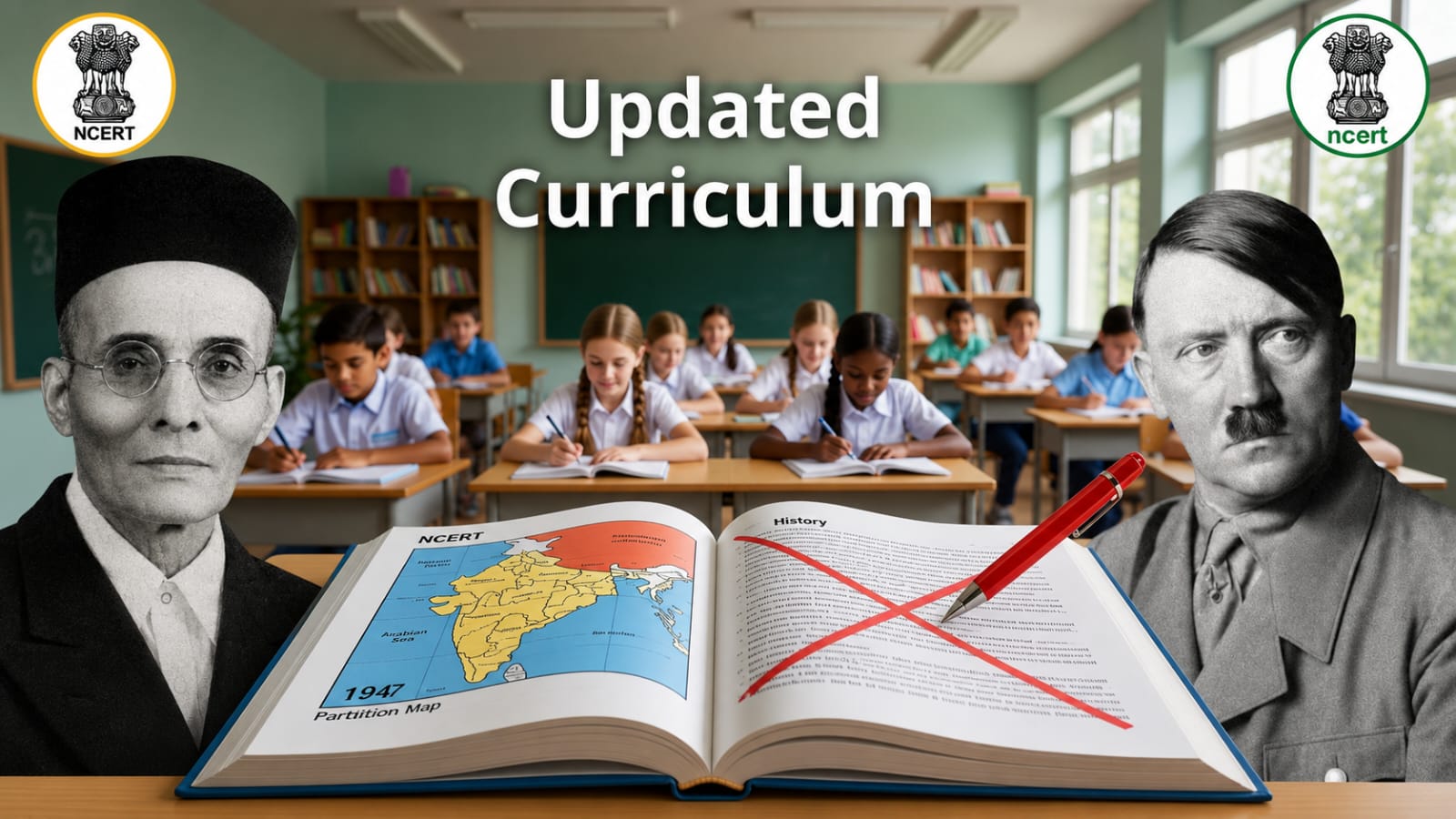
The updated textbook has also expanded its account of the demand for complete independence by including a reference to V.D. Savarkar. It states that Savarkar had articulated a similar demand for Swaraj in 1925, a reference that was absent from the previous edition.
Changes have also been made to the section on Netaji Subhas Chandra Bose. The earlier text referred to Bose seeking Adolf Hitler’s support to raise an army and described Hitler’s Nazi ideology and expansionist policies in the context of the Second World War. In the revised edition, the passage has been replaced with a broader reference stating that Bose sought assistance from “anti-British forces”, without naming Hitler or discussing Nazi ideology.
The civics section has also been updated. In the chapter Citizenship: Rights and Duties, the textbook now includes economic background among the grounds on which discrimination can occur, alongside caste, religion, ethnicity, disability, race, physical appearance, gender and sexuality.
The revised text states that discrimination against individuals or groups on any of these grounds is unethical and legally prohibited. It further notes that children from economically disadvantaged families may also face prejudice and unequal treatment.
The addition comes at a time when the definition of discrimination has been under public discussion following the Centre’s UGC (Promotion of Equity in Higher Education Institutions) Regulations, 2026, which list religion, race, caste, gender, place of birth and disability as protected grounds but do not explicitly include economic background.
The revised Class 8 textbook is part of NCERT’s latest curriculum updates and incorporates changes across history, civics and constitutional studies in addition to revisions made to the judiciary chapter.
