

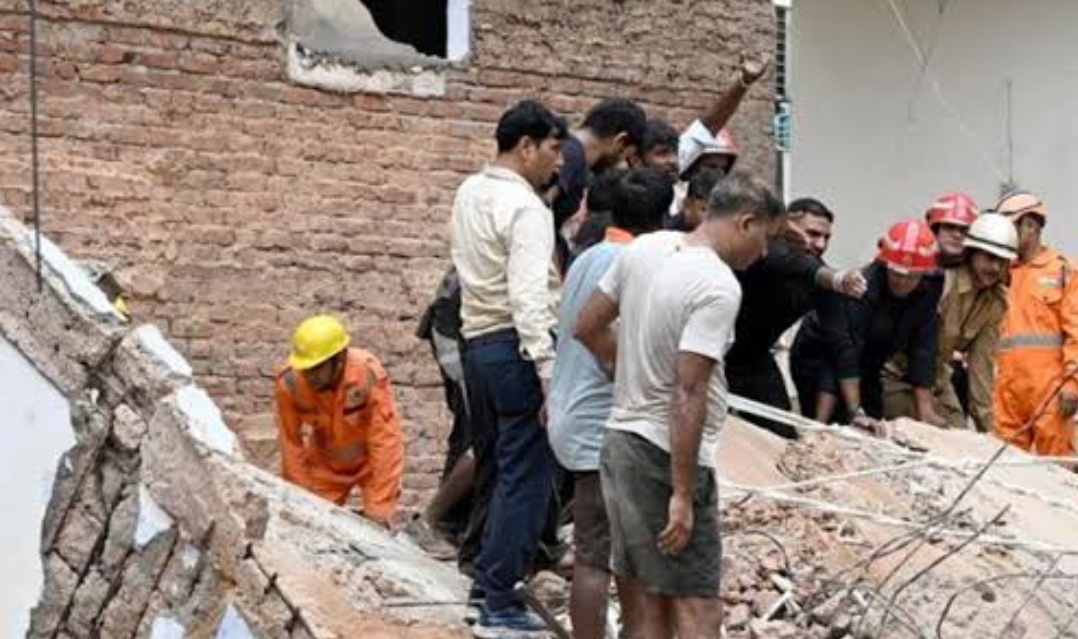
New Delhi, Sep 22: The building collapse in Delhi’s Satya Niketan area earlier this month has renewed concerns over the city’s urban planning system, safety enforcement and the availability of affordable accommodation for students.The September 6 collapse of a building being used as a paying guest (PG) accommodation claimed seven lives, including five students, and left several others injured.
The incident has prompted questions about whether buildings being used for student housing are adequately monitored and whether existing construction and fire-safety regulations are being effectively enforced.The tragedy has also brought renewed attention to Delhi’s long history of urban planning.
The city’s first Master Plan, introduced in 1962, was designed to manage rapid population growth, housing shortages, overcrowding, industrial expansion and pressure on civic infrastructure.
However, Delhi’s population and economic activity expanded faster than many of the projections made in earlier planning exercises. Experts cited in the discussion on the city’s development say the gap between planned growth and actual urbanisation has contributed to the emergence of unauthorised colonies, informal settlements and other forms of development outside the formal planning framework.
Urban planning has also evolved over the years. While the 1962 plan focused heavily on zoning, land acquisition and controlling population distribution, subsequent plans increasingly recognised issues such as transport, environmental protection, mixed land use and the need to coordinate development across the wider metropolitan region.
Despite these changes, the supply of affordable housing has remained a major challenge.Student accommodation is a particularly important part of this problem. Delhi attracts large numbers of students to universities, colleges and coaching centres, but dedicated and affordable housing options near educational institutions have not always kept pace with demand.
As a result, many students depend on privately operated PGs and rented accommodation. Experts quoted in the discussion say that limited supply and high property prices can push students towards cheaper housing, where overcrowding, unauthorised alterations or inadequate safety arrangements may create risks.
The draft Master Plan for Delhi 2041 had specifically proposed affordable rental housing, including accommodation for students and workers, particularly around educational centres and mass-transit networks.
However, the draft was not finalised and was subsequently replaced by the Master Plan for Delhi 2047, notified in August this year.Another concern is the division of responsibilities among several agencies. Construction and land-related matters in Delhi involve bodies such as the Municipal Corporation of Delhi (MCD), Delhi Development Authority (DDA), Land and Development Office, Public Works Department and Delhi Urban Shelter Improvement Board, while fire-safety matters are handled separately by the Delhi Fire Service.
Legal experts cited in the article argue that Delhi already has a substantial framework governing construction and safety. The bigger challenge, they say, is ensuring that these rules are followed through regular inspections and timely enforcement.
The issue of accountability has also come under focus following the Satya Niketan incident. Authorities have reportedly taken action following the collapse, including sealing-related measures and suspension of officials. Any criminal or civil liability, however, would depend on the findings of the investigation and evidence establishing responsibility.
The incident has therefore raised a broader question about how Delhi should manage a city that has already expanded far beyond the assumptions of earlier planning exercises.
Urban experts argue that future planning cannot rely only on creating new blueprints. It must also address existing neighbourhoods, housing demand, construction practices, enforcement mechanisms and coordination among government agencies.
With the Master Plan for Delhi 2047 now in place, the Satya Niketan tragedy has highlighted the importance of translating planning objectives into effective implementation on the ground, particularly in areas where demand for affordable housing is high.
The incident has also renewed calls for stronger monitoring of student accommodation and clearer accountability so that violations can be identified and addressed before they result in loss of life.
