

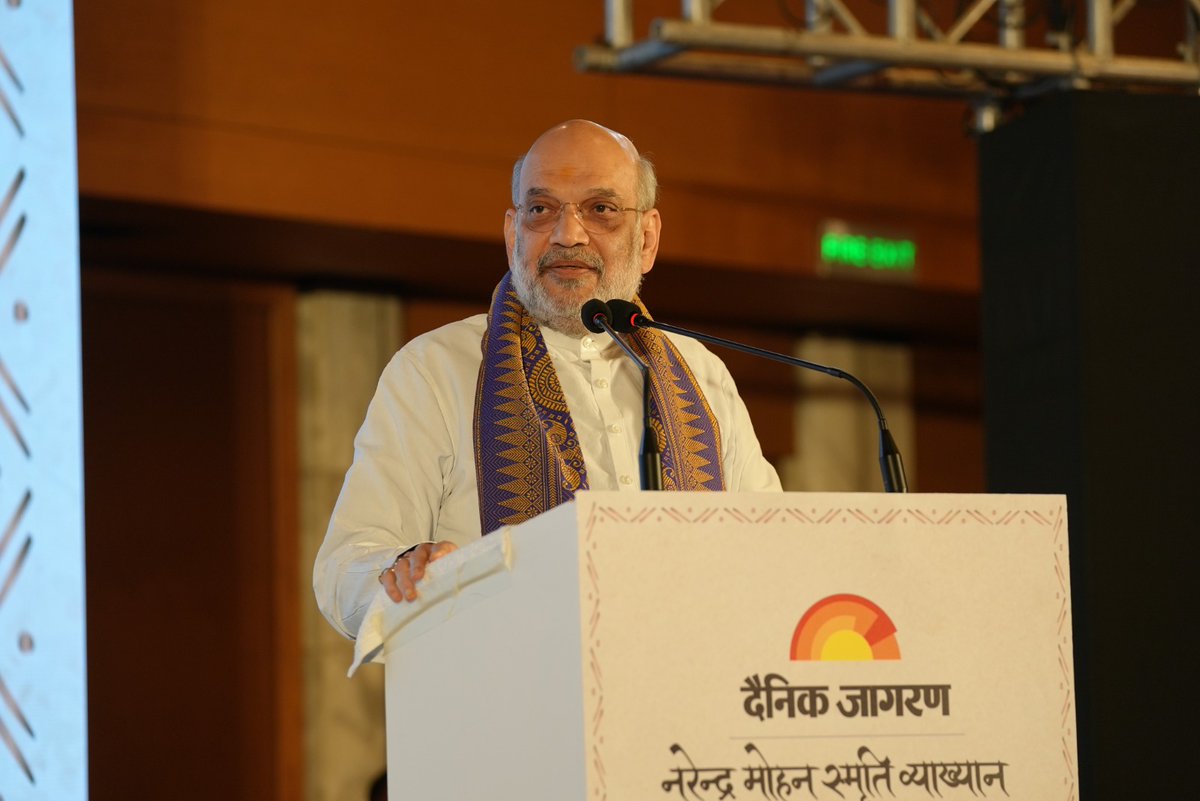
New Delhi, October 11: India’s Home Minister Amit Shah on Friday defended the Election Commission’s ongoing revision of electoral rolls in Bihar, saying the exercise was crucial to remove non-citizens from voter lists and safeguard the integrity of elections.
Speaking at a media event hosted by Dainik Jagran, Shah said the Special Intensive Revision (SIR) of voter rolls aimed to identify and eliminate infiltrators, who, he claimed, make up as much as 30% of the population in some areas. He accused the opposition Congress party of opposing the move for vote-bank politics, and noted that the Supreme Court was monitoring the process.
“It is the duty of the Election Commission to verify whether every name on the voter list belongs to an Indian citizen,” Shah said, calling the exercise a step toward “cleansing democracy of illegal influences.”
Shah also revealed details of a new high-powered demographic mission announced by Prime Minister Narendra Modi in August. The mission, he said, will examine illegal migration, its effects on religious and social composition, and changes in settlement patterns along India’s eastern borders. “This will create ripples,” he said, “but we will not compromise on national security or culture.”
Citing Census data, Shah claimed illegal migration from Bangladesh had caused sharp demographic changes in states such as Assam and West Bengal. He said Muslim population growth had reached 29% in Assam and over 40% in West Bengal, and in some districts as high as 70% — “numbers not possible without infiltration.” He alleged that infiltration had also reduced tribal populations in Jharkhand.
Shah accused the Trinamool Congress government in West Bengal of aiding infiltrators in obtaining documents such as Aadhaar cards and ration cards, adding that difficult terrain made full border control challenging despite deployment of the Border Security Force (BSF).
The minister drew a distinction between refugees and infiltrators, saying the former entered India fleeing religious persecution, while the latter crossed the border for economic reasons. “This country is not a dharamshala,” he said. “Those who came during Partition have the same rights as I do.”
Defending the Citizenship (Amendment) Act (CAA), Shah said it was designed to grant citizenship to persecuted minorities from Pakistan, Bangladesh, and Afghanistan, and not to strip anyone of citizenship. He blamed previous Congress governments for failing to uphold India’s commitment under the Nehru-Liaquat Pact to protect minorities displaced during Partition.
“Partition was a big mistake,” Shah said. “It fulfilled the British conspiracy to divide India. But today, under Prime Minister Modi, we are correcting historical wrongs.”
