

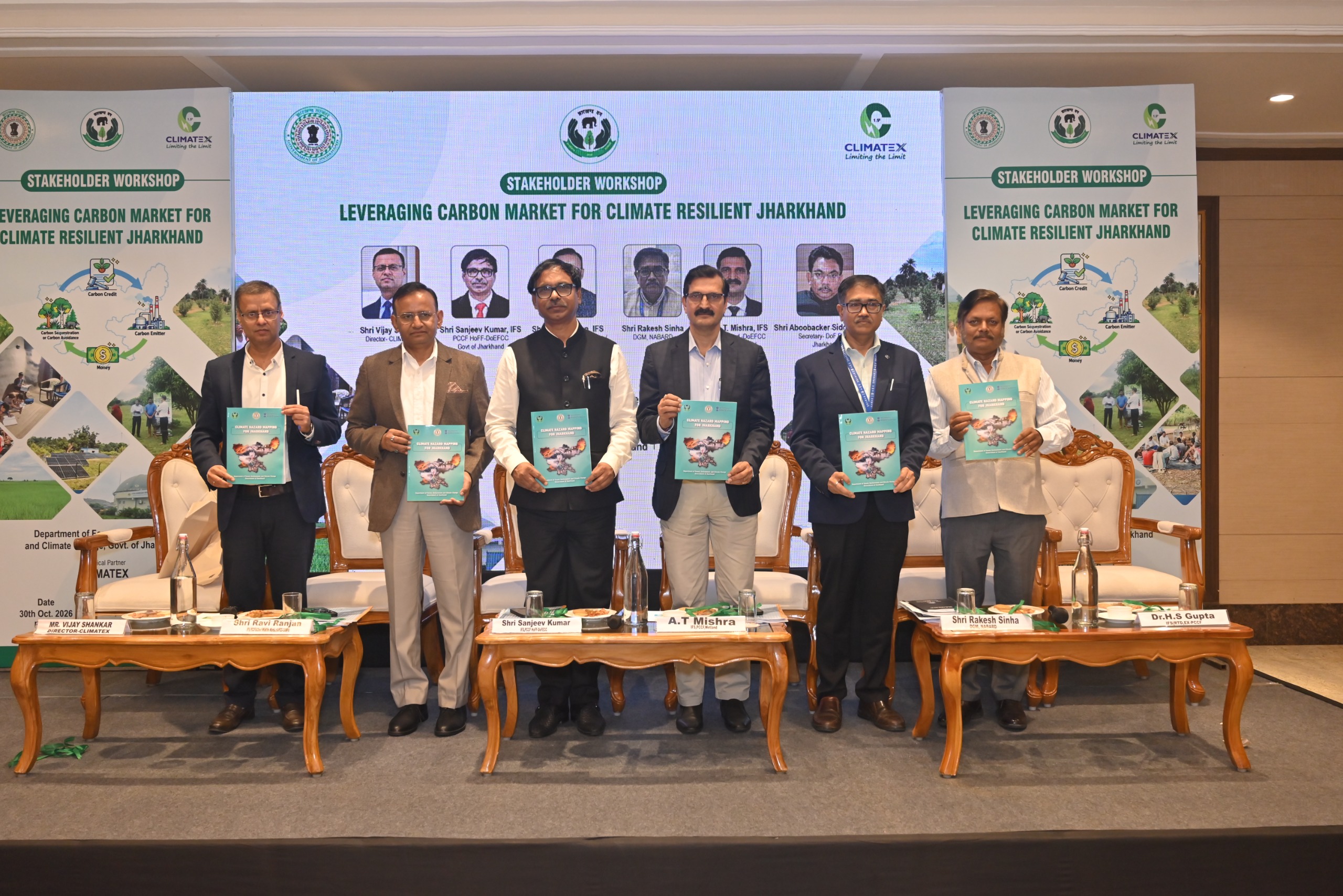
Ranchi, Oct 30: The Jharkhand Forest, Environment and Climate Change Department on Friday organised a stakeholder workshop on “Leveraging Carbon Market for a Climate-Resilient Jharkhand” at Hotel Chanakya BNR in Ranchi, bringing together government officials, financial institutions, climate experts, development organisations and private sector representatives to explore the potential of carbon finance in the state.
Addressing the workshop, Sanjeev Kumar, Principal Chief Conservator of Forests (PCCF) and Head of Forest Force, described carbon trading as an important tool for environmental conservation and improving local livelihoods. He stressed the need for coordination among departments, particularly those dealing with industry, mining and energy.
Citing ISRO data, Kumar said land degradation affects approximately 69 per cent of Jharkhand’s geographical area. He highlighted the need to promote water conservation, afforestation, land restoration and the use of biogas to address the challenge.
Ravi Ranjan, PCCF and Chief Wildlife Warden, emphasised that carbon projects should prioritise community livelihoods and be developed on the basis of scientific and evidence-based data.
Rakesh Sinha, Deputy General Manager at NABARD, discussed the potential of channelising carbon finance towards farmers and rural communities through the institution’s schemes and financial support. Former PCCF Dr H. S. Gupta highlighted the importance of carbon markets for environmental conservation and rural livelihoods, while A. T. Mishra, PCCF (Wetlands), stressed their role in wetland conservation and biodiversity promotion.
Vijay, Director of Climatex, said the workshop aimed to examine how carbon finance could support climate-resilient agriculture, agroforestry and rural livelihoods in Jharkhand. The welcome address was delivered by Anuradha Mishra, Divisional Forest Officer (DFO).
The workshop brought together representatives from NABARD, Birsa Agricultural University, GIZ, Climate Policy Initiative (CPI), Jharkhand State Livelihood Promotion Society (JSLPS), PRADAN, Social Alpha, Hindalco, Syngenta Foundation and the XCITE-XLRI-NABARD Incubation Center, among other organisations working in development and climate finance.
Discussions highlighted opportunities to mobilise carbon finance for farmers and tribal communities through agroforestry, land restoration and rural development schemes, while taking into account Jharkhand’s specific climate vulnerabilities.
The department also presented findings from a feasibility study conducted by CLIMATEX. A digital Measurement, Reporting and Verification (dMRV) tool was demonstrated at the workshop. The tool uses satellite imagery and scientific models to assess biomass and soil carbon stocks.
A report titled “Climate Hazard Mapping for Jharkhand” was also unveiled during the event.
Technical sessions examined ways to link government schemes with carbon markets, mobilise blended and philanthropic finance, and scale up climate-resilient projects through Corporate Social Responsibility (CSR) initiatives and impact investing.
The discussions underscored the potential of carbon finance to improve the incomes of rural and tribal communities, conserve natural resources and strengthen Jharkhand’s capacity to adapt to the impacts of climate change. Several officials from the Forest, Environment and Climate Change Department attended the workshop.
