

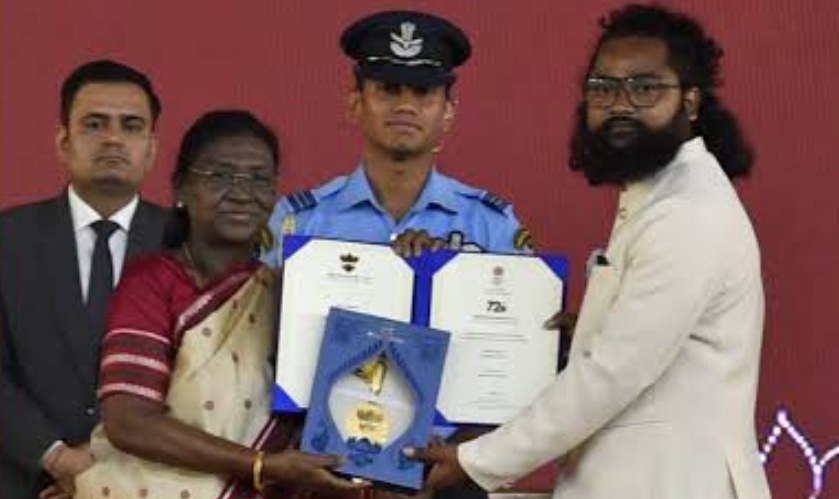
Ranchi, Sept 24: Filmmaker Ravi Raj Murmu, who hails from Kumirmudi village in Jharkhand’s East Singhbhum district, has received the National Film Award for Best Debut Film of a Director in the non-feature category for his Santali short film Angen.Murmu was presented the honour at the 72nd National Film Awards by President Droupadi Murmu.
The recognition has drawn attention to Santali-language filmmaking and the cultural narratives of Jharkhand’s tribal communities.Following the award ceremony, Murmu returned to Jharkhand and received a warm welcome at Birsa Munda Airport.
The 12-minute film Angen explores themes of migration, displacement and the loss of cultural identity. Its story follows a young cowherd who enters a divine world but later finds himself unable to return to his home.Murmu said the film attempts to highlight the experience of people who become disconnected from their roots and identity.
The filmmaker, 34, comes from a family with an agricultural background. He completed his graduation in mass communication and video production from Karim City College, Jamshedpur, in 2014.
Two years later, he joined the Film and Television Institute of India (FTII), Pune, for a master’s programme in film editing.Murmu wrote the screenplay for Angen during his time at FTII.
He has cited Bibhutibhushan Bandyopadhyay’s Pather Panchali and Satyajit Ray’s Apu Trilogy among his influences.The project initially faced difficulties in securing financial support, with some producers suggesting that the film be made in Hindi. The project remained pending for several years before Murmu revived it in 2023 while working as a guest lecturer at Karim City College.
The film was subsequently produced through a workshop involving students, while several of Murmu’s former FTII classmates contributed their support.
About Rs 2 lakh was spent on post-production, according to Murmu.Before receiving the National Film Award, Angen was screened at film festivals in Bengaluru, Mumbai and Kolkata.Murmu has dedicated the national honour to the Santhal community and expressed hope of expanding Angen into a feature-length film.
The award has also brought wider attention to Santali cinema and filmmakers working to preserve and present tribal stories through contemporary filmmaking.
