

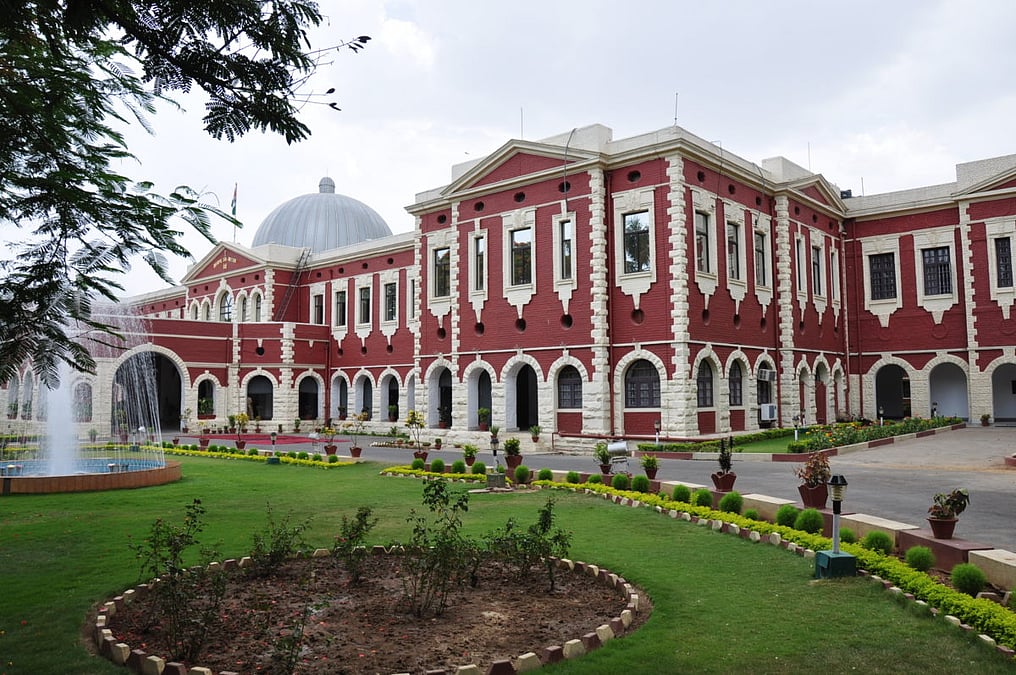
Ranchi, Sept 19: The Jharkhand High Court has reiterated that prolonged suspension of a government employee without serving a departmental charge-sheet cannot continue indefinitely, emphasising that suspension is intended as a preventive measure and not as a form of punishment.
A Division Bench comprising Justice Sujit Narayan Prasad and Justice Sanjay Prasad made the observation while hearing a petition filed by the Union of India challenging an order of the Central Administrative Tribunal (CAT) concerning the prolonged suspension of a postal employee.
The case relates to Shashi Bhushan Kumar, who was serving as Treasurer at the Giridih Head Post Office when he was suspended on September 27, 2019, in connection with alleged financial irregularities involving more than Rs 26 crore in the Jharkhand Postal Circle.
Although the suspension was reviewed periodically, the departmental charge-sheet was issued only on March 7, 2022, nearly two-and-a-half years after the employee was initially suspended.
The authorities had cited the ongoing Central Bureau of Investigation (CBI) probe into the alleged financial irregularities as one of the reasons for the delay in initiating departmental proceedings.
Kumar subsequently challenged the prolonged suspension before the Central Administrative Tribunal. The CAT interfered with the suspension and directed the authorities to consider his entitlement to salary after the initial three-month period, subject to adjustment of the subsistence allowance already paid.
The Union government then approached the Jharkhand High Court, arguing that the seriousness of the allegations and the pending investigation justified continuation of the suspension.
The High Court examined the matter in light of the Supreme Court’s judgment in Ajay Kumar Choudhary v. Union of India, which laid down principles concerning the duration and review of suspension orders.
The Supreme Court has held that suspension should ordinarily not continue beyond three months where a charge-sheet has not been served, while continuation after service of charges requires appropriate review and justification.
The Jharkhand High Court observed that the pendency of a criminal investigation, by itself, cannot provide an unlimited basis for keeping an employee under suspension.The Bench also emphasised the need for authorities to proceed with departmental action within a reasonable period rather than allowing suspension to continue for years without formal charges.
After considering the circumstances, the High Court found no sufficient ground to interfere with the CAT’s order and dismissed the Union government’s petition.
The ruling underscores the requirement for timely disciplinary proceedings and periodic review of suspension orders. It also reinforces the distinction between suspension as a temporary administrative measure and punishment imposed after completion of disciplinary proceedings.
