

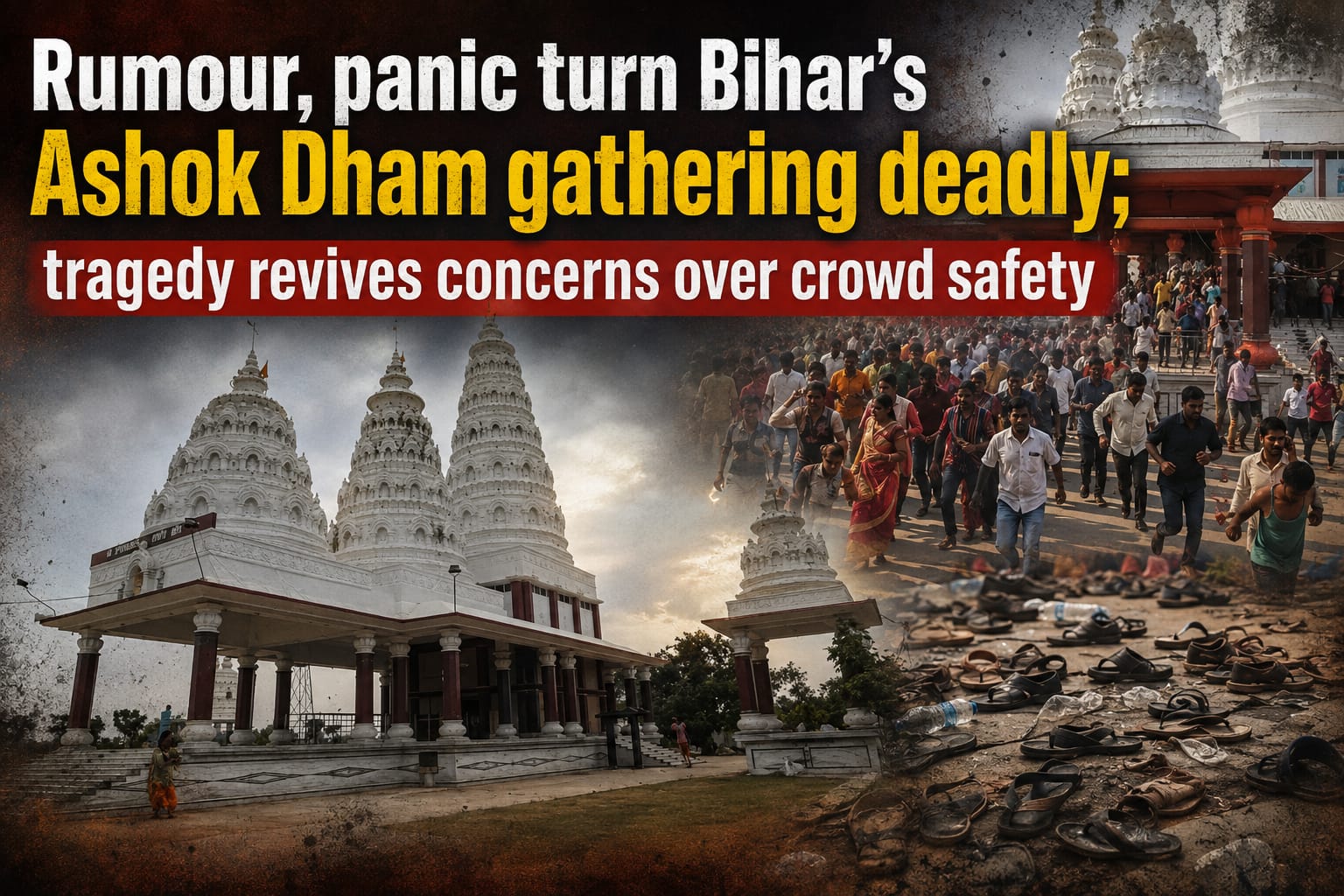
Patna, Aug 18: A rumour about an electrical wire falling on devotees reportedly triggered panic at Bihar’s Ashok Dham Temple in Lakhisarai, leaving at least seven people dead and more than a dozen injured during a massive gathering on the third Monday of Shravan.
Around 50,000 devotees had gathered at the Shri Indradamneshwar Mahadev Mandir for prayers and Jal Abhishek on August 17 when the situation suddenly turned chaotic. Preliminary accounts suggest devotees panicked after hearing that a live electric wire had fallen on people following the collapse of a pole. The wire was reportedly a cable and not a live electrical line.
The victims were reportedly women, with some of the injured said to be in critical condition.
Prime Minister Narendra Modi announced an ex-gratia of ₹2 lakh from the PMNRF for the next of kin of each deceased person and ₹50,000 for every injured person.
The incident has once again highlighted the danger posed by rumours and misinformation at densely packed religious gatherings, where sudden fear can trigger uncontrollable movement within seconds.
The concern was reinforced by an incident reported hours later near the Mahakaleshwar Temple in Ujjain, where panic reportedly spread during Nag Panchami following rumours of an electrical-current leak near a transformer. Barricades were broken as devotees rushed amid the confusion, while some people were injured after falling or fainting. The situation was brought under control after senior district officials reached the spot.
The scale of the gathering in Ujjain was enormous. Temple administrator Pratham Kaushik said more than 6 lakh devotees had visited Nag Chandreshwar and over 2 lakh had visited Mahakaleshwar by noon.
“Till 12 noon today, more than 6 lakh devotees had darshan of Bhagwan Nag Chandreshwar, and more than 2 lakh devotees had darshan of Lord Shri Mahakaleshwar,” Kaushik said.
“All devotees have been provided with every possible facility by the temple administration. Darshan continues at the temple,” he added.
The recurring pattern of rumours triggering panic has been witnessed at several major gatherings across the country.
At Haridwar’s Mansa Devi Temple last year, a rumour about a snapped power line reportedly triggered a stampede that killed six people and injured 35. District Magistrate Mayur Dixit had said authorities found evidence that someone had spread the rumour about an electric wire breaking.
“We found through photos and videos that someone spread the rumour of an electric wire breaking,” Dixit had said.
An inspection by Uttarakhand Power Corporation Limited, however, found no electrical leakage at the temple. Its then managing director Anil Kumar said, “The leakage of electric current was found to be zero,” and reported no evidence of anyone being electrocuted.
Bihar itself has witnessed a similar tragedy. In 2014, a stampede at Patna’s Gandhi Maidan during Dussehra celebrations killed at least 32 people, including 27 women, after rumours that an electrical wire had fallen on people.
At Madhya Pradesh’s Ratangarh Mata Temple in 2013, a rumour that a bridge was about to collapse triggered panic among a huge gathering, killing 115 people and injuring around 100.
Other deadly stampedes have also followed rumours or sudden fears. A 2008 stampede at Rajasthan’s Chamunda Devi Temple killed at least 168 people, while another at Himachal Pradesh’s Naina Devi Temple that year claimed 162 lives, mostly women and children, after reports of a landslide triggered panic.
In 2005, at least 40 people were killed at a relief centre in Chennai when thousands rushed for shelter or food coupons amid conflicting accounts about what triggered the stampede. In 2004, a rumour that free saris had run out resulted in the deaths of 21 women.
The incidents underscore that overcrowding, inadequate crowd management, insufficient preparedness and misinformation can combine to turn religious or public gatherings into disasters.
The Ashok Dham tragedy, therefore, is not merely a crowd-management warning but also a reminder of the need for rapid communication systems capable of immediately verifying and countering rumours.
In densely packed gatherings, authorities need to treat misinformation as a critical crowd-safety threat, alongside physical infrastructure, emergency access, surveillance and crowd-control measures.
