

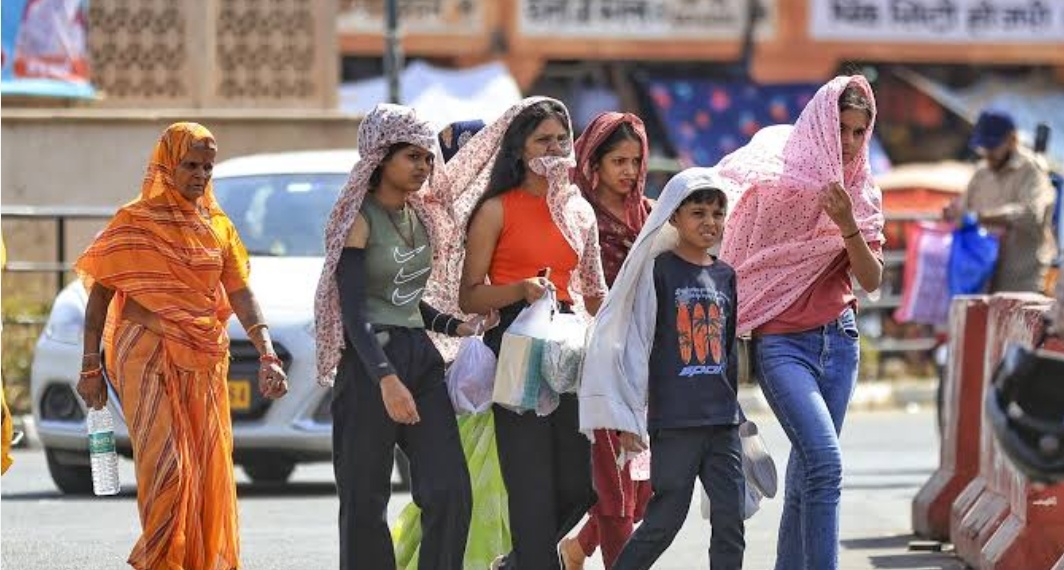
New Delhi, Aug 17: As Delhi faces increasingly intense and prolonged summer heat, a community-led project in one of the capital’s densely populated settlements is documenting how extreme temperatures affect the daily lives of vulnerable residents.Around 40 households in Sunder Nagri in northeast Delhi are maintaining heat diaries, locally described as “garmi khata”, to record their experiences during hot weather.
The initiative focuses on aspects often missed by conventional weather data, including housing conditions, work, health, sleep, family responsibilities and emotional well-being.Residents say coping with extreme heat can be particularly difficult in small homes with limited ventilation and inadequate cooling facilities. Some families use water to cool floors and bodies, while others rely on ceiling fans or evaporative coolers, depending on what they can afford.One resident, Gulshan, 39, lives with her four children in a one-room house.
Her family purchased a desert cooler, but limits its use to control electricity expenses. She has also resorted to wetting clothes before bedtime to make sleeping conditions more bearable. The family has subsequently experienced skin-related problems associated with prolonged dampness.The project aims to document such everyday experiences and provide a more detailed picture of heat exposure in low-income communities.
Researchers involved in the initiative say temperature readings alone cannot fully explain the impact of extreme heat because people’s exposure varies according to factors such as income, occupation, housing and location.For young residents such as 19-year-old Arshi, the heat affects both education and livelihood.
She studies through distance learning while making decorative tassels with her mother and sister. She sometimes spends time in an air-conditioned library to escape the heat but has to return home to assist her family.Measurements inside her small home illustrate the role of humidity. Although the indoor temperature was recorded at 29.3 degrees Celsius, relative humidity reached 84.6 per cent, resulting in a reported feels-like temperature of about 36.3 degrees Celsius.Street vendors face another set of challenges. Raja, 21, who sells vegetables from a pushcart, works in temperatures that can rise to around 45 degrees Celsius during peak summer. Heat causes vegetables to spoil faster and keeps potential customers indoors, affecting his earnings.
His home offers little relief, with limited ventilation and only a ceiling fan for cooling. With nights remaining warmer, he has started sleeping on the rooftop in an effort to find better airflow.Delhi and other Indian cities have been developing heat action plans to prepare for and respond to extreme temperatures. Such plans often rely heavily on meteorological information, but researchers argue that community-level experiences can provide valuable additional evidence.
The heat diary project seeks to bring these personal experiences into the broader discussion on heat preparedness, highlighting the need for responses that consider not only temperature levels but also housing, livelihoods, health and the ability of vulnerable communities to cope with extreme weather.
