

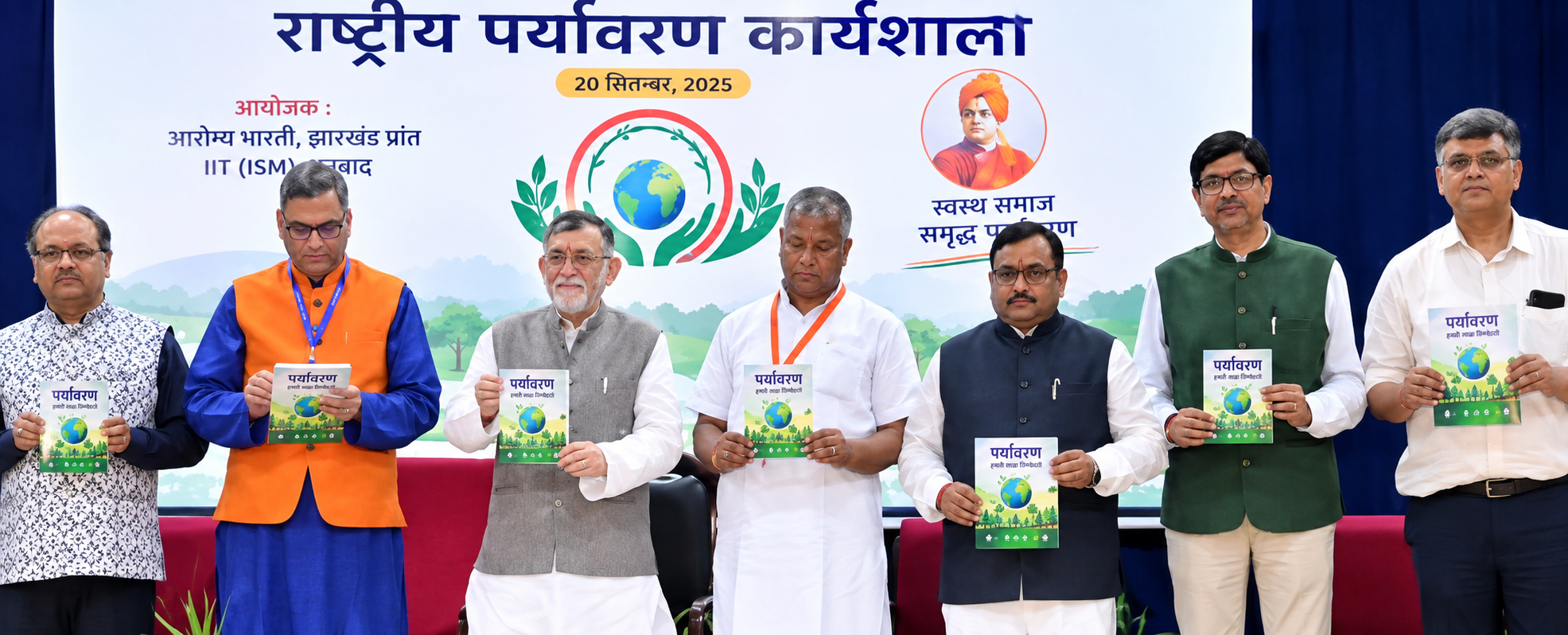
Dhanbad, Sept 20: Environmental protection cannot be achieved by the government or any single institution alone and requires active participation from society, educational institutions, scientists, industries and citizens, Jharkhand Governor Santosh Kumar Gangwar said on Sunday.
Addressing a national environmental workshop at the Golden Jubilee Hall of IIT (ISM) Dhanbad, Gangwar highlighted concerns related to trees, water conservation, plastic use and sanitation.
The workshop was organised jointly by Arogya Bharati and IIT (ISM).
The Governor said environmental pollution has a direct impact on human health, while climate change, air pollution and biodiversity loss have emerged as major challenges.
He stressed the need to maintain a balance with nature, noting that respect for the environment has traditionally been an important part of Indian life and culture.
Focus on sustainable development
Gangwar said Jharkhand’s forests and water resources are among the state’s important assets and called for their protection.
Referring to Mission LiFE, he urged people to conserve water and energy, reduce the use of plastic and adopt environmentally responsible practices.
He said development should not be pursued at the cost of future generations and called for a sustainable model that meets present needs while safeguarding resources for the future.
The Governor also linked environmental protection with public health, highlighting the importance of yoga, balanced nutrition, a healthy lifestyle and a clean environment.
Technology and environment must go together
IIT (ISM) Director Prof Sukumar Mishra said the challenge was not to choose between development and environmental protection, but to find ways to achieve both through a balanced approach.
He emphasised resource efficiency, the circular economy, clean technologies, renewable energy and responsible mining.
According to Mishra, scientific and technological solutions can help make economic development more sustainable.
Call for action at individual level
Arogya Bharati National Organisation Secretary Ashok Kumar Varshney underlined the close relationship between environmental conditions and human health.
He said environmental action should begin at the individual and household level.
Varshney stressed that merely planting trees was not enough and called for ensuring their survival, along with measures such as water recycling and groundwater recharge.
Experts and environmental activists from different parts of the country participated in the workshop and discussed practical measures for environmental protection. Participants also resolved to convert the recommendations emerging from the discussions into a concrete action plan.
Arogya Bharati national president Dr Rakesh Pandit, social worker Vikas Ranjan and several other members attended the programme.
Organisers and volunteers associated with the event included state secretary Jaiprakash Narayan Singh, women’s wing head Rama Sinha, state environment coordinator Arun Rai, district president Dr Vikash Raman, working president D S Choubey, secretary Vikas Ojha and other members.
