

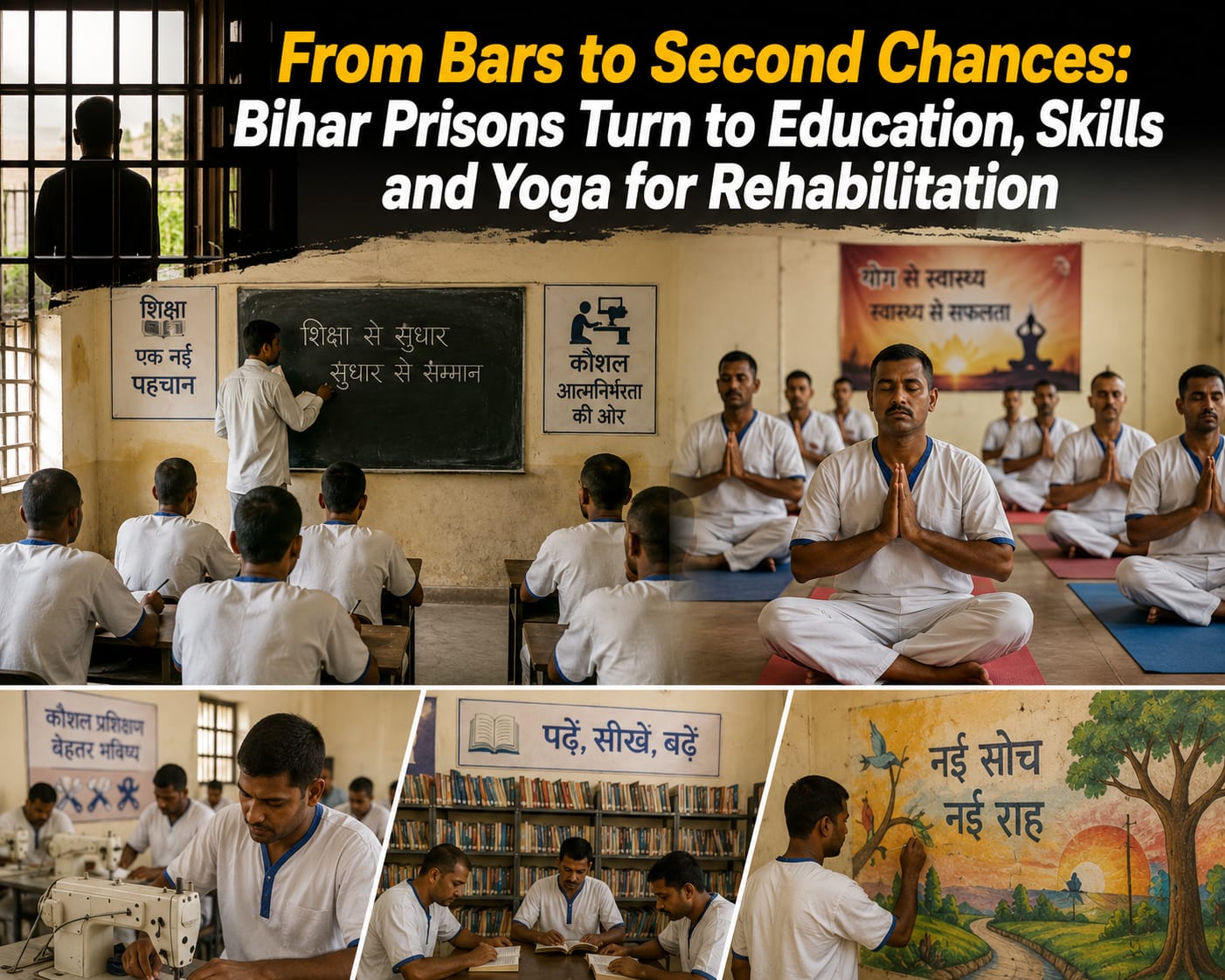
Patna, Aug 23: Classrooms, computer labs, vocational workshops, libraries and yoga sessions are increasingly becoming part of Bihar’s prison landscape as the administration shifts its focus from confinement towards rehabilitation and preparing inmates for life after release.
The prison administration is promoting education, skills training and creative activities with the stated aim of helping inmates become self-reliant citizens and reducing the chances of reoffending.
Education remains at the heart of the initiative, with prisoners encouraged to pursue school and higher studies through the National Institute of Open Schooling (NIOS) and Indira Gandhi National Open University (IGNOU).
According to the National Crime Records Bureau’s Prison Statistics India 2024 report, Bihar recorded the highest number of inmates benefiting from elementary education, at 24,050, followed by Tamil Nadu with 6,067 and Uttar Pradesh with 5,968.
The state also reported 6,844 inmates benefiting from adult education, 928 from higher education and 266 from computer education, taking the total beneficiaries across the four categories to 32,088.
Bihar also recorded 7,387 inmates receiving vocational training in 2024, the second-highest figure among states.
Data shared by the Home Department showed that 1,256 prisoners enrolled for Class X and 183 for Class XII through NIOS in 2025, while 1,565 inmates joined IGNOU programmes, including 1,354 who began higher education courses.
Several prisons now have dedicated study centres, smart classrooms, computer labs and libraries. At Bhabhua Divisional Jail, around 210 of its 556 inmates were preparing for matriculation examinations, while 35 were pursuing a Food and Nutrition certificate course through distance education.
The focus has also expanded beyond formal education to vocational and technical skills. In 2025-26, 3,902 inmates received vocational training, while 1,443 acquired technical skills through programmes linked to the National Institute of Electronics and Information Technology (NIELIT).
Computer labs have been established or expanded across 41 prison facilities, with around ₹2 crore spent on 250 computer sets, UPS units and tables.
The training programmes cover a wide range of activities, including computer operations, typing, internet use, agarbatti and candle making, goat rearing, poultry, vermicompost production, electrical and plumbing work, tailoring, beauty services and Mithila painting.
Jails in Kishanganj, Bhagalpur and Banka have also introduced programmes in computer literacy, self-employment and organic manure production.
The rehabilitation effort extends to the mental and physical well-being of inmates. A five-year agreement with the Art of Living organisation covers yoga and meditation sessions across all 59 jails in the state.
“All the prisons in Bihar are functioning exactly like reformative homes,” prison welfare officer Binod Kumar Prabhaskar said.
“A five-year agreement has been signed with Art of Living to support the mental and physical well-being of the prisoners,” he added.
Prabhaskar said master trainers inside the jails ensure that daily yoga sessions continue alongside morning physical training.
“Master trainers, within the jails ensure that daily yoga continues alongside physical training (PT) in the mornings,” he said.
Alongside yoga, meditation, NIOS and IGNOU literacy programmes and NIELIT computer training, the prison administration has also introduced Jail Radio, with prisoner RJs trained in-house to operate the service across jails.
Experts believe employment-oriented programmes could play an important role in reducing stress and violent behaviour among inmates.
“Employment-based activities could reduce stress and violent tendencies among prisoners,” said B N Prasad, professor and head of the Division of Sociology and Social Anthropology at AN Sinha Institute of Social Studies.
“Skills and responsibility could help inmates return to society as better citizens,” he said.
The administration is also exploring practical livelihood opportunities for inmates after release. A proposal to establish petrol pumps on vacant prison land could allow selected long-term prisoners with good conduct to handle sales, customer service and basic operations, beginning with Purnia Central Jail if approved by the Cabinet.
The reform agenda is being pursued alongside measures for hardened criminals, including plans for high-security jails in remote hill areas and an open jail at Shaheed Jubba Sahni Central Jail in Bhagalpur.
However, challenges such as overcrowding, the high proportion of undertrials and the need for stronger post-release support continue to remain.
The administration’s broader objective is to ensure that prisoners leave jail with education, employable skills, confidence and a greater ability to reintegrate into society.
